












Magnetism manipulated by ferroelectric polarization and epitaxial strain in a La0.75Sr0.25MnO3/BaTiO3 system
文献情報
出版日
2021-02-25
DOI
10.1039/D0CP05961G
インパクトファクター
3.676
著者
Dong Chen, Chun-Lei Wang
原文を見る
要旨
Exploring the manipulation of magnetism in perovskite oxides is scientifically interesting and of great technical importance in next-generation magnetic memory. Dual control of magnetism in superlattices through epitaxial strain and ferroelectric polarization may induce rich physical properties. In this work, we demonstrated a strong magnetoelectric coupling that appears in an La0.75Sr0.25MnO3/BaTiO3 superlattice. Reversible transitions in ferromagnetism, ferrimagnetism and anti-ferromagnetism, with strong magnetoelectric coupling, are achieved by precisely controlling the magnitude and spin-direction of the magnetic moments of Mn. Half-metallicity is demonstrated in the MnO2 layers, accompanied by the spin polarization of the superlattice varying from 100% to 0%. We realize the coexistence of ferroelectric polarization and metallicity, i.e., “ferroelectric metal”. The variation in strain and re-orientation of polarization lead to a change in interfacial Ti–O and Mn–O bond lengths, and hence a hybridization state, determining the magnetism of our system. The purpose-designed LSMO/BTO superlattice with intrinsic magnetoelectric coupling is a particularly interesting model system that can provide guidance for the development of spintronic devices.
関連文献
Water-in-water mesophases for templating inorganics
Andreas Taubert, Ernst Furrer, Wolfgang Meier
2004-09-02
Communication
DOI: 10.1039/B405610H
Racemic d,l-asparagine causes enantiomeric excess of other coexisting racemic d,l-amino acids during recrystallization: a hypothesis accounting for the origin of l-amino acids in the biosphere
Shosuke Kojo, Hiromi Uchino, Mayu Yoshimura, Kyoko Tanaka
2004-09-07
Communication
DOI: 10.1039/B409941A
Ionic hydrogenation of C-20, 22-ketene dithioacetal: stereoselective synthesis of steroidal C (20R) aldehydes
Bapurao B. Shingate, Braja G. Hazra, Vandana S. Pore, Rajesh G. Gonnade, Mohan M. Bhadbhade
2004-08-19
Communication
DOI: 10.1039/B407952C
Chiral amplification by polypeptides and its relevance to prebiotic catalysis
David R. Kelly, Alastair Meek, Stanley M. Roberts
2004-08-25
Communication
DOI: 10.1039/B404379K
Strongly red-fluorescent novel donor–π-bridge–acceptor–π-bridge–donor (D–π–A–π–D) type 2,1,3-benzothiadiazoles with enhanced two-photon absorption cross-sections
Shin-ichiro Kato, Taisuke Matsumoto, Tsutomu Ishi-i, Thies Thiemann, Motoyuki Shigeiwa, Hideki Gorohmaru, Shuichi Maeda, Yoshiro Yamashita, Shuntaro Mataka
2004-09-07
Communication
DOI: 10.1039/B410016F
Low-temperature synthetic method for size-controlled CdSe nanocrystals: utilization of boron selenide
Nora Iancu, Renu Sharma, Dong-Kyun Seo
2004-09-01
Communication
DOI: 10.1039/B408702J
The mechanism of the oxidative addition of aryl halides to Pd-catalysts: a DFT investigation
Lukas J. Gooßen, Debasis Koley, Holger Hermann, Walter Thiel
2004-08-20
Communication
DOI: 10.1039/B409144B
Photo-reversible Pb2+-complexation of thermosensitive poly(N-isopropyl acrylamide-co-spiropyran acrylate) in water
Takayuki Suzuki, Tatsuya Kato, Hiraku Shinozaki
2004-08-13
Communication
DOI: 10.1039/B407342H
Water reduction and oxidation on Pt–Ru/Y2Ta2O5N2catalyst under visible light irradiation
Meiying Liu, Wansheng You, Zhibin Lei, Guohua Zhou, Jianjun Yang, Guopeng Wu, Guijun Ma, Guoyou Luan, Tuyoshi Takata, Michikazu Hara, Can Li
2004-08-19
Communication
DOI: 10.1039/B407892F
A very large Rh–Rh bond shortening on excitation of the [Rh2(1,8-diisocyano-p-menthane)4]2+ ion by time-resolved synchrotron X-ray diffraction
Yu-Sheng Chen, Tim Graber
2004-08-19
Communication
DOI: 10.1039/B409463H
こちらもおすすめ
化合物よくある質問
3-イチチルビフェニルはどのように合成されますか?
3-イチチルビフェニルは、ビフェニルとイチプロピオニトリルを回収率約90%で反応させて合成されます。触媒は通常、亜リチウムホウ素を用います。
5668-93-93-Ethylbiphenyl
化合物よくある質問
8-溴-5-三氟甲基喹啉はどのように合成されますか?
8-溴-5-三氟甲基喹啉は、5-トリフルオロメチル-2-メチル-1,3-ベンゼンジオールをブロモエタノールと反応させて生成します。この反応は塩基性条件下で行われ...
917251-92-48-Bromo-5-(trifluoro...
化合物よくある質問
ジメチル4-(4,4,5,5-テトラメチル-1,3,2-ドioxaborolan-2-基)-2,6-ピリジンジカルボイル酸フェニルアミニドの代替品はありますか?
ジメチル4-(4,4,5,5-テトラメチル-1,3,2-ドioxaborolan-2-基)-2,6-ピリジンジカルボイル酸フェニルアミニドの代替品としては、4-...
741709-66-0Dimethyl 4-(4,4,5,5-...
化合物よくある質問
N-(3,5-ヘキサクロロ-4-ピリドインイル)-8-メチオキシ-5-キノリンカーボン酸の市場動向や研究トレンドはどのようなものでしょうか?
N-(3,5-ヘキサクロロ-4-ピリドインイル)-8-メチオキシ-5-キノリンカーボン酸の市場動向は、主に産業用途での需要により影響を受けます。研究トレンドとし...
199871-63-1N-(3,5-Dichloro-4-py...
化合物よくある質問
イソステアロイルグリセリルは安全ですか?
イソステアロイルグリセリルは一般的に安全性が高いとされていますが、過度な使用や個人差により皮�owsん炎などの反応が起こる可能性があります。使用前に医師に相談す...
222723-55-92-[(5Z,8Z,11Z,14Z)-5...
化合物よくある質問
1-(二苯甲基)-3,3-二氟-氮杂环丁烷の市場動向や研究トレンドはどうですか?
1-(二苯甲基)-3,3-二氟-氮杂环丁烷の市場動向は、医薬品や合成化学の研究分野で注目を集めています。新興研究は、該当化合物の合成改良と生体内での作用メカニズ...
288315-02-61-Benzhydryl-3,3-dif...
化合物よくある質問
3-チオフェンスチオールの物理化学的性質は何ですか?
3-チオフェンスチオールのCAS番号は7774-73-4です。結晶性の白色粉末で、分子量は122.17です。この化合物は水に微溶解し、エタノールやジクロロメタン...
7774-73-43-Thiophenethiol
化合物よくある質問
2-Methyl-2-propanyl (2S)-2-(aminomethyl)-1-piperidinecarboxylateは安全ですか?
2-Methyl-2-propanyl (2S)-2-(aminomethyl)-1-piperidinecarboxylateは一定の安全性基準を満たしていま...
475105-35-22-Methyl-2-propanyl ...
化合物よくある質問
CAS番号1316822-90-8の化合物は安全ですか?
CAS番号1316822-90-8の化合物は安全性に関しては評価が不足していますが、一般的には生物学的に活性な物質であり、取り扱いには適切な安全防護措置が必要で...
1316822-90-8Gal beta(1-3)[Neu5Ac...
化合物よくある質問
Tert-butyl 2-(2-羟基乙基)哌嗪-1-羧酸はどのように保存すればよいですか?
Tert-butyl 2-(2-羟基乙基)哌嗪-1-羧酸は、冷暗所で保存し、直射日光から遠ざけてください。容器は密閉し、高湿度や高温を避けて保管してください。
517866-79-4Tert-butyl 2-(2-hydr...
掲載誌
Physical Chemistry Chemical Physics

CiteScore:
5.5
自己引用率:
10.3%
年間論文数:
3036
Physical Chemistry Chemical Physics (PCCP) is an international journal co-owned by 19 physical chemistry and physics societies from around the world. This journal publishes original, cutting-edge research in physical chemistry, chemical physics and biophysical chemistry. To be suitable for publication in PCCP, articles must include significant innovation and/or insight into physical chemistry; this is the most important criterion that reviewers and Editors will judge against when evaluating submissions. The journal has a broad scope and welcomes contributions spanning experiment, theory, computation and data science. Topical coverage includes spectroscopy, dynamics, kinetics, statistical mechanics, thermodynamics, electrochemistry, catalysis, surface science, quantum mechanics, quantum computing and machine learning. Interdisciplinary research areas such as polymers and soft matter, materials, nanoscience, energy, surfaces/interfaces, and biophysical chemistry are welcomed if they demonstrate significant innovation and/or insight into physical chemistry. Joined experimental/theoretical studies are particularly appreciated when complementary and based on up-to-date approaches.
おすすめ化合物
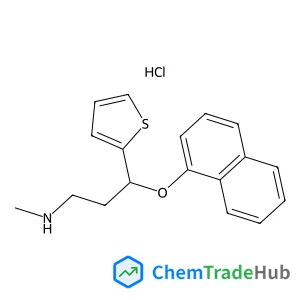
N-Methyl-3-(1-naphthyloxy)-3-(2-thienyl)-1-propanamine hydrochloride (1:1)
CAS番号:
1188266-11-6
分子式:
C18H20ClNOS
おすすめサプライヤー



免責事項
このページに表示される学術雑誌情報は、参考および研究目的のみを目的としています。当社は雑誌出版社とは提携しておらず、投稿の取り扱いも行っておりません。出版に関するお問い合わせは、各雑誌出版社に直接ご連絡ください。
表示されている情報に誤りがある場合は、support@chemtradehub.com までご連絡ください。迅速に確認し、対応いたします。