


Theoretical study of the adsorption of analgesic environmental pollutants on pristine and nitrogen-doped graphene nanosheets
文献情報
出版日
2020-12-23
DOI
10.1039/D0CP05543C
インパクトファクター
3.676
著者
原文を見る
要旨
Interactions of the analgesic medications dextropropoxyphene (DPP, opioid), paracetamol (PCL, nonnarcotic), tramadol (TDL, nonnarcotic), ibuprofen (IBN, nonsteroidal anti-inflammatory drug (NSAID)), and naproxen (NPX, NSAID) with pristine graphene (GN) and nitrogen-doped GN (NGN; containing only graphitic N atoms) nanosheets were explored using density functional theory (DFT) in the gas and aqueous phases. Calculations in the aqueous phase were performed using the integral equation formalism polarized continuum model (IEFPCM). Calculated geometry-optimized structures, partial atomic charges (determined using Natural Bond Orbital analysis), highest occupied molecular orbital (HOMO)-lowest unoccupied molecular orbital (LUMO) energy gaps, work functions (determined using time-dependent DFT), and molecular electrostatic potential plots showed that the adsorption process is physical in nature (viz. physisorption), primarily due to noncovalent π–π and van der Waals interactions. In addition, calculated adsorption energies (ΔEad) were exergonic, indicating that formation of the analgesic/GN and analgesic/NGN complexes is thermodynamically favorable in the gas (ΔEad values for analgesic/GN and analgesic/NGN were in the range of −66.56 kJ mol−1 to −106.78 kJ mol−1) and aqueous phases (ΔEad values for analgesic/GN and analgesic/NGN complexes were in the range of −58.75 kJ mol−1 to −100.46 kJ mol−1). Generally, for GN and NGN, adsorption was more endergonic in the aqueous phase by as much as +10.41 kJ mol−1. Calculated solvation energies (ΔEsolvation) were exergonic for all analgesic/GN complexes (ΔEsolvation values were in the range of −56.50 kJ mol−1 to −66.17 kJ mol−1) and analgesic/NGN complexes (ΔEsolvation values were in the range of −77.26 kJ mol−1 to −87.96 kJ mol−1), with analgesic/NGN complexes exhibiting greater stability in aqueous solutions (∼20 kJ mol−1 more stable). In summary, the results of this theoretical study demonstrate that the adsorption and solvation of analgesics on GN and NGN nanosheets is thermodynamically favorable. In addition, generally, analgesic/NGN complexes exhibit higher adsorption affinities and solvation energies in the gas and aqueous phases. Therefore, GN and NGN nanosheets are potential adsorbents for extracting analgesic contaminants from aqueous environments such as aquatic ecosystems.
おすすめジャーナル

Chemistry Education Research and Practice

Russian Journal of Coordination Chemistry

Organic Process Research & Development

Current Opinion in Solid State & Materials Science

Russian Journal of Organic Chemistry

Russian Journal of Applied Chemistry

Journal of Peptide Science

Journal of Saudi Chemical Society

Russian Journal of General Chemistry

Current Opinion in Colloid & Interface Science
関連文献
Sulfate aniontemplation of a neutral pseudorotaxane assembly using an indolocarbazole threading component
Michał J. Chmielewski, Liyun Zhao, Asha Brown, David Curiel, Mark R. Sambrook, Amber L. Thompson, Sergio M. Santos, Vitor Felix, Jason J. Davis, Paul D. Beer
2008-05-09
Communication
DOI: 10.1039/B804941F
Synthesis of an open-framework copper–germanium phosphate [Cu(H2O)2(OH)]2Ge(PO4)2
Yan Liu, Xiao-Li Yang, Jun Zhang, Yi-Zhi Li, You Song, Hong-Bin Du, Xiao-Zeng You
2008-05-19
Communication
DOI: 10.1039/B801542B
Tetrameric molecular bowl assembled from glycoluril building blocks
Neng-Fang She, Xiang-Gao Meng, Meng Gao, An-Xin Wu, Lyle Isaacs
2008-04-04
Communication
DOI: 10.1039/B800785C
Csp3–F bond activation by nucleophilic attack of the {Pt2S2} core assisted by non-covalent interactions
Ainara Nova, Gregori Ujaque, Pilar González-Duarte, Agustí Lledós
2008-04-29
Communication
DOI: 10.1039/B801889H
Ammonium salts as an inexpensive and convenient nitrogen source in the Cu-catalyzed amination of aryl halides at room temperature
Jinho Kim, Sukbok Chang
2008-05-23
Communication
DOI: 10.1039/B804637A
Synthesis of α-keto esters by the rhodium-catalysed reaction of cyanoformate with arylboronic acids
Hiroshi Shimizu, Masahiro Murakami
2007-04-26
Communication
DOI: 10.1039/B704105E
こちらもおすすめ
化合物よくある質問
6- bromo-1-cyclopropyl-1H-benzimidazoleの市場動向や研究トレンドはどうですか?
6- bromo-1-cyclopropyl-1H-benzimidazoleは、抗炎症、抗ウイルス作用を持つことが報告されており、新薬開発の研究対象として注目...
1416713-53-56-Bromo-1-cyclopropy...
化合物よくある質問
環氧プロpanol-d5を取り扱う際の実験室安全事項は何ですか?
取り扱う際には、防護眼鏡と手袋を使用し、ドラフトチャンバー内で操作することを推奨します。漏洩時には適切な手順で処理し、安全データシートを常に参照してください。
1246819-20-4Glycidol-d5
化合物よくある質問
2,2’-ジメチル-3,3’-ビピリジンはどのように合成されますか?
2,2’-ジメチル-3,3’-ビピリジンは、ピリジンと2-メチルアクリルアミドを有機合成反応で合成します。この反応では、ピリジンと2-メチルアクリルアミドを含有...
86156-55-02,2’-Dimethyl-3,3’-b...
化合物よくある質問
6-甲基ピリジン-2-ボリック酸の主な用途は何ですか?
6-甲基ピリジン-2-ボリック酸は、合成化学、医薬品合成、以及研究用途などに広く使用され、特に組換えDNA技術や分子生物学の研究において重要な役割を果たします。
372963-50-3(6-Methyl-2-pyridiny...
化合物よくある質問
(R)-3-(1-甲基-2-氧環己基)プロpano酸メチルは安全ですか?
(R)-3-(1-甲基-2-氧環己基)プロpano酸メチルは一定の安全性がありますが、直接的な皮膚接触や吸入は避けるべきです。使用する際は適切な個々の安全データ...
94089-47-1methyl 3-[(1R)-1-met...
化合物よくある質問
ketorolacはどのように保存すればよいですか?
ketorolacは、密封して遮光容器に保管し、直射日光や高温を避けて保存してください。温度は常温で保存し、湿度をなるべく低く保つことが推奨されます。
74103-06-3rac Ketorolac
化合物よくある質問
L-2,3-二氨基丙酸二盐酸盐を取り扱う際の実験室安全事項は何ですか?
L-2,3-二氨基丙酸二盐酸盐は腐食性が強く、皮膚や粘膜に刺激を与える可能性があります。取り扱う際は、防塵マスク、ゴーグル、手袋を使用し、適切な排気設備を使用し...
19777-68-5(S)-2,3-Diaminopropa...
化合物よくある質問
2-(4-溴ピリジン-2-基)乙腈の物理化学的性質は何ですか?
2-(4-溴ピリジン-2-基)乙腈のCAS番号は312325-73-8です。主に結晶形態で存在し、分子量は159.01 g/molです。この化合物は水に溶けやす...
312325-73-8(4-Bromo-2-pyridinyl...
化合物よくある質問
3-フローロ-[1,1-ベンジレン]-3,4-ジカルボン酸を取り扱う際の実験室安全事項は何ですか?
この化合物は毒性は低いですが、直接的な接触や吸入に注意が必要です。PPE(個人防護具)を着用し、ドラフトチャンバーを使用して操作することを推奨します。また、漏洩...
1261915-32-53'-Fluoro-[1,1'-biph...
化合物よくある質問
3-(1-氧代-1,3-二氢-2H-2-异吲哚)丙酸の主な用途は何ですか?
3-(1-氧代-1,3-二氢-2H-2-异吲哚)丙酸は、薬理学研究や医薬品製造において広く用いられる化合物です。また、工業的な用途でも一部の化学反応の触媒や助剤...
83747-30-23-(1-Oxo-1,3-dihydro...
掲載誌
Physical Chemistry Chemical Physics

CiteScore:
5.5
自己引用率:
10.3%
年間論文数:
3036
Physical Chemistry Chemical Physics (PCCP) is an international journal co-owned by 19 physical chemistry and physics societies from around the world. This journal publishes original, cutting-edge research in physical chemistry, chemical physics and biophysical chemistry. To be suitable for publication in PCCP, articles must include significant innovation and/or insight into physical chemistry; this is the most important criterion that reviewers and Editors will judge against when evaluating submissions. The journal has a broad scope and welcomes contributions spanning experiment, theory, computation and data science. Topical coverage includes spectroscopy, dynamics, kinetics, statistical mechanics, thermodynamics, electrochemistry, catalysis, surface science, quantum mechanics, quantum computing and machine learning. Interdisciplinary research areas such as polymers and soft matter, materials, nanoscience, energy, surfaces/interfaces, and biophysical chemistry are welcomed if they demonstrate significant innovation and/or insight into physical chemistry. Joined experimental/theoretical studies are particularly appreciated when complementary and based on up-to-date approaches.
おすすめ化合物
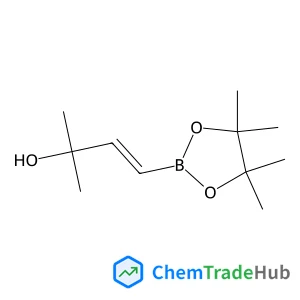
(E)-2-methyl-4-(4,4,5,5-tetramethyl-1,3,2-dioxaborolan-2-yl)but-3-en-2-ol
CAS番号:
581802-26-8
分子式:
C11H21BO3
おすすめサプライヤー




免責事項
このページに表示される学術雑誌情報は、参考および研究目的のみを目的としています。当社は雑誌出版社とは提携しておらず、投稿の取り扱いも行っておりません。出版に関するお問い合わせは、各雑誌出版社に直接ご連絡ください。
表示されている情報に誤りがある場合は、support@chemtradehub.com までご連絡ください。迅速に確認し、対応いたします。