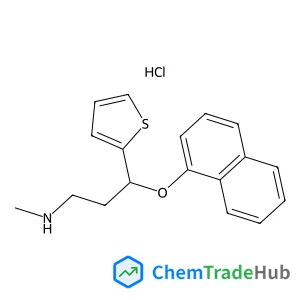
N-Methyl-3-(1-naphthyloxy)-3-(2-thienyl)-1-propanamine hydrochloride (1:1)
CAS番号:
1188266-11-6
分子式:
C18H20ClNOS
Sooyeon Kim, Udo Becker
The reduction of An(VI) (An = U, Np, and Pu) to An(IV) significantly decreases its solubility and mobility. This reaction can be hindered by complexation with inorganic (e.g., carbonate) or organic ligands. Ethylenediaminetetraacetic acid (EDTA) is one such organic ligand that forms stable complexes with actinides. Therefore, it may enhance the mobility of actinides. However, the redox kinetics and mechanisms of actinyl (An(V/VI)O2+/2+)–EDTA are not well characterized yet and are thus studied here using quantum-mechanical calculations. The principle is to approach the actinyl–EDTA and Fe2+ (reductant) in small incremental steps and calculate the system energy at each distance. The overall reaction is then delineated into sub-processes (encounter frequency in bulk solution, formation of outer-sphere complex, transition from outer- to inner-sphere complex, and electron transfer), and reaction rates are determined for each sub-process. The formation of outer-sphere complexes occurs rapidly in microseconds to seconds over a wide range of actinyl concentrations (pM to μM); in contrast, the transition to the inner-sphere complex is relatively slow (milliseconds to a few seconds). Immediate electron transfer to form the pentavalent actinide is observed along the reaction path for Np(VI) and Pu(VI), but not for U(VI). Surprisingly, in acidic conditions, one of the carboxylic groups gets protonated in EDTA of [UO2(edta)]2− rather than one of the amino groups. This process-based series of calculations can be applied to any redox reaction and allows the prediction of changes to the rate law and rate-limiting step in a more fundamental way for different environments.

Journal of Heterocyclic Chemistry

Helvetica Chimica Acta

Russian Chemical Reviews

Pharmacological Reviews

Planta Medica

Israel Journal of Chemistry

Proceedings of the National Academy of Sciences of the United States of America

Organic Preparations and Procedures International

Journal of Catalysis

European Journal of Wood and Wood Products
Shoshi Terada, Toshihiko Mandai, Risa Nozawa, Kazuki Yoshida, Kazuhide Ueno, Seiji Tsuzuki, Masayoshi Watanabe
DOI: 10.1039/C4CP00746H
Junying Zhang, Wenqiang Dang, Xingchen Yan, Hong Gao, Zhimin Ao
DOI: 10.1039/C4CP02656J
Yu. I. Prylutskyy, I. S. Pashkova, D. Wyrzykowski, A. Woziwodzka, G. Gołuński, J. Piosik, V. V. Cherepanov, U. Ritter
DOI: 10.1039/C4CP03367A
Dorit Shemesh, Sandra L. Blair, Sergey A. Nizkorodov
DOI: 10.1039/C4CP03130J
Kewei Wu, Ashok Bera, Chun Ma, Yuanmin Du, Yang Yang, Liang Li, Tom Wu
DOI: 10.1039/C4CP03573A
O. V. Magdysyuk, F. Adams, H.-P. Liermann, I. Spanopoulos, P. N. Trikalitis, M. Hirscher, R. E. Morris, M. J. Duncan, L. J. McCormick, R. E. Dinnebier
DOI: 10.1039/C4CP03298E
Nancy Faßheber, Johannes Dammeier, Gernot Friedrichs
DOI: 10.1039/C4CP01107D
Dao-Bo Li, Yuan-Yuan Cheng, Ling-Li Li, Wen-Wei Li, Yu-Xi Huang, Dan-Ni Pei, Zhong-Hua Tong, Yang Mu, Han-Qing Yu
DOI: 10.1039/C4CP04065A
Yongfeng Li, Meng Li, Liqing Jiang, Lin Lin, Lili Cui, Xingquan He
DOI: 10.1039/C4CP02528H
Marina Frank, Sebastian Funke, Hainer Wackerbarth, Guido H. Clever
DOI: 10.1039/C4CP02188F
3-イチチルビフェニルは、ビフェニルとイチプロピオニトリルを回収率約90%で反応させて合成されます。触媒は通常、亜リチウムホウ素を用います。
8-溴-5-三氟甲基喹啉は、5-トリフルオロメチル-2-メチル-1,3-ベンゼンジオールをブロモエタノールと反応させて生成します。この反応は塩基性条件下で行われ...
ジメチル4-(4,4,5,5-テトラメチル-1,3,2-ドioxaborolan-2-基)-2,6-ピリジンジカルボイル酸フェニルアミニドの代替品としては、4-...
N-(3,5-ヘキサクロロ-4-ピリドインイル)-8-メチオキシ-5-キノリンカーボン酸の市場動向は、主に産業用途での需要により影響を受けます。研究トレンドとし...
イソステアロイルグリセリルは一般的に安全性が高いとされていますが、過度な使用や個人差により皮�owsん炎などの反応が起こる可能性があります。使用前に医師に相談す...
1-(二苯甲基)-3,3-二氟-氮杂环丁烷の市場動向は、医薬品や合成化学の研究分野で注目を集めています。新興研究は、該当化合物の合成改良と生体内での作用メカニズ...
3-チオフェンスチオールのCAS番号は7774-73-4です。結晶性の白色粉末で、分子量は122.17です。この化合物は水に微溶解し、エタノールやジクロロメタン...
2-Methyl-2-propanyl (2S)-2-(aminomethyl)-1-piperidinecarboxylateは一定の安全性基準を満たしていま...
CAS番号1316822-90-8の化合物は安全性に関しては評価が不足していますが、一般的には生物学的に活性な物質であり、取り扱いには適切な安全防護措置が必要で...
Tert-butyl 2-(2-羟基乙基)哌嗪-1-羧酸は、冷暗所で保存し、直射日光から遠ざけてください。容器は密閉し、高湿度や高温を避けて保管してください。

Physical Chemistry Chemical Physics (PCCP) is an international journal co-owned by 19 physical chemistry and physics societies from around the world. This journal publishes original, cutting-edge research in physical chemistry, chemical physics and biophysical chemistry. To be suitable for publication in PCCP, articles must include significant innovation and/or insight into physical chemistry; this is the most important criterion that reviewers and Editors will judge against when evaluating submissions. The journal has a broad scope and welcomes contributions spanning experiment, theory, computation and data science. Topical coverage includes spectroscopy, dynamics, kinetics, statistical mechanics, thermodynamics, electrochemistry, catalysis, surface science, quantum mechanics, quantum computing and machine learning. Interdisciplinary research areas such as polymers and soft matter, materials, nanoscience, energy, surfaces/interfaces, and biophysical chemistry are welcomed if they demonstrate significant innovation and/or insight into physical chemistry. Joined experimental/theoretical studies are particularly appreciated when complementary and based on up-to-date approaches.
![1-(1-Benzyl-1,2,3,6-tetrahydropyridin-4-yl)-1H-benzo[d]imidazol-2(3H)-one structure](https://static.chemtradehub.com/structs/603/60373-71-9-7dfb.webp "1-(1-Benzyl-1,2,3,6-tetrahydropyridin-4-yl)-1H-benzo[d]imidazol-2(3H)-one structure")