












Glassy GaS: transparent and unusually rigid thin films for visible to mid-IR memory applications
文献情報
出版日
2020-10-19
DOI
10.1039/D0CP04697C
インパクトファクター
3.676
著者
Andrey Tverjanovich, Maxim Khomenko, Sergei Bereznev, Daniele Fontanari, Takeshi Usuki, Koji Ohara, David Le Coq, Pascal Masselin
原文を見る
要旨
Phase-change materials based on tellurides are widely used for optical storage (DVD and Blu-ray disks), non-volatile random access memories and for development of neuromorphic computing. Narrow-gap tellurides are intrinsically limited in the telecom spectral window, where materials having a wider gap are needed. Here we show that gallium sulfide GaS thin films prepared by pulsed laser deposition reveal good transparency from the visible to the mid-IR spectral range with optical gap Eg = 2.34 eV, high refractive index nR = 2.50 over the 0.8 ≤ λ ≤ 2.5 μm range and, unlike canonical chalcogenide glasses, the absence of photo-structural transformations with a laser-induced peak power density damage threshold above 1.4 TW cm−2 at 780 nm. The origin of the excellent damage threshold under a high-power laser and UV light irradiation resides in the rigid tetrahedral structure of vitreous GaS studied by high-energy X-ray diffraction and Raman spectroscopy and supported by first-principles simulations. The average local coordination number appears to be 〈m〉 = 3.44, well above the optimal connectivity, 2.4 ≤ 〈m〉 ≤ 2.7, and the total volume of microscopic voids and cavities is 34.4%, that is, lower than for the vast majority of binary sulfide glasses. The glass–crystal phase transition in gallium sulfide thin films may be accompanied by a drastic change in the nonlinear optical properties, opening up a new dimension for memory applications in the visible to mid-IR spectral ranges.
関連文献
Safe, facile radical-based reduction and hydrosilylation reactions in a microreactor using tris(trimethylsilyl)silane
Arjan Odedra, Karolin Geyer, Tomas Gustafsson, Ryan Gilmour, Peter H. Seeberger
2008-04-29
Communication
DOI: 10.1039/B803715A
Influence of a diene impurity on the molecular structure of phosphate-containing polymers with medical applications
Lisbeth Grøndahl, Edeline Wentrup-Byrne
2008-05-13
Communication
DOI: 10.1039/B803223H
Copper-free click chemistry for the in situ crosslinking of photodegradable star polymers
Jeremiah A. Johnson, Jeremy M. Baskin, Jeffrey T. Koberstein
2008-04-24
Communication
DOI: 10.1039/B803043J
A simple strategy for quantum dot assisted selective detection of cadmium ions
Subhash Banerjee, Soumitra Kar
2008-04-22
Communication
DOI: 10.1039/B803166E
Alkylation of active methylene compounds with alcohols catalyzed by an iridium complex
Masao Morita, Yasushi Obora, Yasutaka Ishii
2007-04-30
Communication
DOI: 10.1039/B702293J
One-step synthesis of ordered mesoporous carbonaceous spheres by an aerosol-assisted self-assembly
Yan Yan, Fuqiang Zhang, Yan Meng, Bo Tu, Dongyuan Zhao
2007-04-25
Communication
DOI: 10.1039/B702232H
Exploiting domino enyne metathesismechanisms for skeletal diversity generation‡
Richard J. Spandl, Hèléne Rudyk, David R. Spring
2008-06-03
Communication
DOI: 10.1039/B807278G
Gold nanoparticles become stable to cyanide etch when coated with hybrid lipid bilayers
Sarita Sitaula, Marilyn R. Mackiewicz, Scott M. Reed
2008-05-15
Communication
DOI: 10.1039/B801525B
A hierarchical self-similar structure of oriented calcite with association of an agar gel matrix: inheritance of crystal habit from nanoscale
Yuya Oaki, Shinichiro Hayashi, Hiroaki Imai
2007-04-30
Communication
DOI: 10.1039/B704129B
こちらもおすすめ
化合物よくある質問
6- bromo-1-cyclopropyl-1H-benzimidazoleの市場動向や研究トレンドはどうですか?
6- bromo-1-cyclopropyl-1H-benzimidazoleは、抗炎症、抗ウイルス作用を持つことが報告されており、新薬開発の研究対象として注目...
1416713-53-56-Bromo-1-cyclopropy...
化合物よくある質問
環氧プロpanol-d5を取り扱う際の実験室安全事項は何ですか?
取り扱う際には、防護眼鏡と手袋を使用し、ドラフトチャンバー内で操作することを推奨します。漏洩時には適切な手順で処理し、安全データシートを常に参照してください。
1246819-20-4Glycidol-d5
化合物よくある質問
2,2’-ジメチル-3,3’-ビピリジンはどのように合成されますか?
2,2’-ジメチル-3,3’-ビピリジンは、ピリジンと2-メチルアクリルアミドを有機合成反応で合成します。この反応では、ピリジンと2-メチルアクリルアミドを含有...
86156-55-02,2’-Dimethyl-3,3’-b...
化合物よくある質問
6-甲基ピリジン-2-ボリック酸の主な用途は何ですか?
6-甲基ピリジン-2-ボリック酸は、合成化学、医薬品合成、以及研究用途などに広く使用され、特に組換えDNA技術や分子生物学の研究において重要な役割を果たします。
372963-50-3(6-Methyl-2-pyridiny...
化合物よくある質問
(R)-3-(1-甲基-2-氧環己基)プロpano酸メチルは安全ですか?
(R)-3-(1-甲基-2-氧環己基)プロpano酸メチルは一定の安全性がありますが、直接的な皮膚接触や吸入は避けるべきです。使用する際は適切な個々の安全データ...
94089-47-1methyl 3-[(1R)-1-met...
化合物よくある質問
ketorolacはどのように保存すればよいですか?
ketorolacは、密封して遮光容器に保管し、直射日光や高温を避けて保存してください。温度は常温で保存し、湿度をなるべく低く保つことが推奨されます。
74103-06-3rac Ketorolac
化合物よくある質問
L-2,3-二氨基丙酸二盐酸盐を取り扱う際の実験室安全事項は何ですか?
L-2,3-二氨基丙酸二盐酸盐は腐食性が強く、皮膚や粘膜に刺激を与える可能性があります。取り扱う際は、防塵マスク、ゴーグル、手袋を使用し、適切な排気設備を使用し...
19777-68-5(S)-2,3-Diaminopropa...
化合物よくある質問
2-(4-溴ピリジン-2-基)乙腈の物理化学的性質は何ですか?
2-(4-溴ピリジン-2-基)乙腈のCAS番号は312325-73-8です。主に結晶形態で存在し、分子量は159.01 g/molです。この化合物は水に溶けやす...
312325-73-8(4-Bromo-2-pyridinyl...
化合物よくある質問
3-フローロ-[1,1-ベンジレン]-3,4-ジカルボン酸を取り扱う際の実験室安全事項は何ですか?
この化合物は毒性は低いですが、直接的な接触や吸入に注意が必要です。PPE(個人防護具)を着用し、ドラフトチャンバーを使用して操作することを推奨します。また、漏洩...
1261915-32-53'-Fluoro-[1,1'-biph...
化合物よくある質問
3-(1-氧代-1,3-二氢-2H-2-异吲哚)丙酸の主な用途は何ですか?
3-(1-氧代-1,3-二氢-2H-2-异吲哚)丙酸は、薬理学研究や医薬品製造において広く用いられる化合物です。また、工業的な用途でも一部の化学反応の触媒や助剤...
83747-30-23-(1-Oxo-1,3-dihydro...
掲載誌
Physical Chemistry Chemical Physics

CiteScore:
5.5
自己引用率:
10.3%
年間論文数:
3036
Physical Chemistry Chemical Physics (PCCP) is an international journal co-owned by 19 physical chemistry and physics societies from around the world. This journal publishes original, cutting-edge research in physical chemistry, chemical physics and biophysical chemistry. To be suitable for publication in PCCP, articles must include significant innovation and/or insight into physical chemistry; this is the most important criterion that reviewers and Editors will judge against when evaluating submissions. The journal has a broad scope and welcomes contributions spanning experiment, theory, computation and data science. Topical coverage includes spectroscopy, dynamics, kinetics, statistical mechanics, thermodynamics, electrochemistry, catalysis, surface science, quantum mechanics, quantum computing and machine learning. Interdisciplinary research areas such as polymers and soft matter, materials, nanoscience, energy, surfaces/interfaces, and biophysical chemistry are welcomed if they demonstrate significant innovation and/or insight into physical chemistry. Joined experimental/theoretical studies are particularly appreciated when complementary and based on up-to-date approaches.
おすすめ化合物
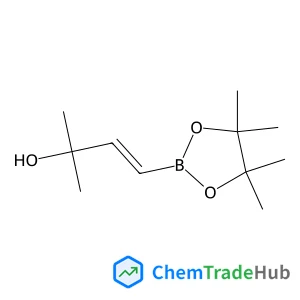
(E)-2-methyl-4-(4,4,5,5-tetramethyl-1,3,2-dioxaborolan-2-yl)but-3-en-2-ol
CAS番号:
581802-26-8
分子式:
C11H21BO3
おすすめサプライヤー



免責事項
このページに表示される学術雑誌情報は、参考および研究目的のみを目的としています。当社は雑誌出版社とは提携しておらず、投稿の取り扱いも行っておりません。出版に関するお問い合わせは、各雑誌出版社に直接ご連絡ください。
表示されている情報に誤りがある場合は、support@chemtradehub.com までご連絡ください。迅速に確認し、対応いたします。