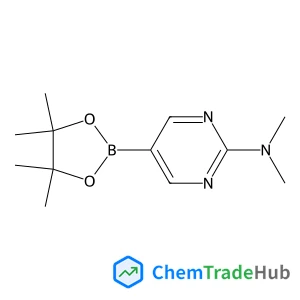
N,N-Dimethyl-5-(4,4,5,5-tetramethyl-1,3,2-dioxaborolan-2-yl)-2-pyrimidinamine
CAS番号:
1032759-30-0
分子式:
C12H20BN3O2
Yuki Higuchi, Daigo Setoyama, Kazuhisa Isegawa, Yusuke Tsuchikawa, Yoshihiro Matsumoto, Joseph Don Parker, Takenao Shinohara, Yasutaka Nagai
This study is the first report on liquid water and ice imaging conducted at a pulsed spallation neutron source facility. Neutron imaging can be utilised to visualise the water distribution inside polymer electrolyte fuel cells (PEFCs). Particularly, energy-resolved neutron imaging is a methodology capable of distinguishing between liquid water and ice, and is effective for investigating ice formation in PEFCs operating in a subfreezing environment. The distinction principle is based on the fact that the cross sections of liquid water and ice differ from each other at low neutron energies. In order to quantitatively observe transient freezing and thawing phenomena in a multiphase mixture (gas/liquid/solid) within real PEFCs with high spatial resolution, a pulsed neutron beam with both high intensity and wide energy range is most appropriate. In the validation study of the present work, we used water sealed in narrow capillary tubes to simulate the flow channels of a PEFC, and a pulsed neutron beam was applied to distinguish ice, liquid water and super-cooled water, and to clarify freezing and thawing phenomena of the water within the capillary tubes. Moreover, we have enabled the observation of liquid water/ice distributions in a large field of view (300 mm × 300 mm) by manufacturing a sub-zero environment chamber that can be cooled down to −30 °C, as a step towards in situ visualisation of full-size fuel cells.

Russian Journal of General Chemistry

Russian Journal of Coordination Chemistry

Drug Discovery Today

Chemical Communications

Chemistry Education Research and Practice

Crystallography Reports

Current Opinion in Colloid & Interface Science

Russian Journal of Organic Chemistry

Organic Process Research & Development

Nature Medicine
Yajun Tian, Huaixin Yang, Shuanglin Zhan, Yunfa Chen
DOI: 10.1039/B801966E
Cristina Femoni, Maria Carmela Iapalucci, Giuliano Longoni, Stefano Zacchini
DOI: 10.1039/B803992E
Yanhua Zhang, Jiaqi He, Jin-Pei Cheng
DOI: 10.1039/B703591H
Gaëlle Derrien, Clarence Charnay, Jerzy Zajac, Deborah J. Jones, Jacques Rozière
DOI: 10.1039/B804593C
Qiao Jin, Jian-Ping Xu, Jian Ji, Jia-Cong Shen
DOI: 10.1039/B801959B
Masao Morita, Yasushi Obora, Yasutaka Ishii
DOI: 10.1039/B702293J
Arjan Odedra, Karolin Geyer, Tomas Gustafsson, Ryan Gilmour, Peter H. Seeberger
DOI: 10.1039/B803715A
Lidia Armelao, Gregorio Bottaro, Silvio Quici, Marco Cavazzini, Maria Concetta Raffo, Francesco Barigelletti, Gianluca Accorsi
DOI: 10.1039/B702238G
Jinho Kim, Sukbok Chang
DOI: 10.1039/B804637A
6- bromo-1-cyclopropyl-1H-benzimidazoleは、抗炎症、抗ウイルス作用を持つことが報告されており、新薬開発の研究対象として注目...
取り扱う際には、防護眼鏡と手袋を使用し、ドラフトチャンバー内で操作することを推奨します。漏洩時には適切な手順で処理し、安全データシートを常に参照してください。
2,2’-ジメチル-3,3’-ビピリジンは、ピリジンと2-メチルアクリルアミドを有機合成反応で合成します。この反応では、ピリジンと2-メチルアクリルアミドを含有...
6-甲基ピリジン-2-ボリック酸は、合成化学、医薬品合成、以及研究用途などに広く使用され、特に組換えDNA技術や分子生物学の研究において重要な役割を果たします。
(R)-3-(1-甲基-2-氧環己基)プロpano酸メチルは一定の安全性がありますが、直接的な皮膚接触や吸入は避けるべきです。使用する際は適切な個々の安全データ...
ketorolacは、密封して遮光容器に保管し、直射日光や高温を避けて保存してください。温度は常温で保存し、湿度をなるべく低く保つことが推奨されます。
L-2,3-二氨基丙酸二盐酸盐は腐食性が強く、皮膚や粘膜に刺激を与える可能性があります。取り扱う際は、防塵マスク、ゴーグル、手袋を使用し、適切な排気設備を使用し...
2-(4-溴ピリジン-2-基)乙腈のCAS番号は312325-73-8です。主に結晶形態で存在し、分子量は159.01 g/molです。この化合物は水に溶けやす...
この化合物は毒性は低いですが、直接的な接触や吸入に注意が必要です。PPE(個人防護具)を着用し、ドラフトチャンバーを使用して操作することを推奨します。また、漏洩...
3-(1-氧代-1,3-二氢-2H-2-异吲哚)丙酸は、薬理学研究や医薬品製造において広く用いられる化合物です。また、工業的な用途でも一部の化学反応の触媒や助剤...

Physical Chemistry Chemical Physics (PCCP) is an international journal co-owned by 19 physical chemistry and physics societies from around the world. This journal publishes original, cutting-edge research in physical chemistry, chemical physics and biophysical chemistry. To be suitable for publication in PCCP, articles must include significant innovation and/or insight into physical chemistry; this is the most important criterion that reviewers and Editors will judge against when evaluating submissions. The journal has a broad scope and welcomes contributions spanning experiment, theory, computation and data science. Topical coverage includes spectroscopy, dynamics, kinetics, statistical mechanics, thermodynamics, electrochemistry, catalysis, surface science, quantum mechanics, quantum computing and machine learning. Interdisciplinary research areas such as polymers and soft matter, materials, nanoscience, energy, surfaces/interfaces, and biophysical chemistry are welcomed if they demonstrate significant innovation and/or insight into physical chemistry. Joined experimental/theoretical studies are particularly appreciated when complementary and based on up-to-date approaches.