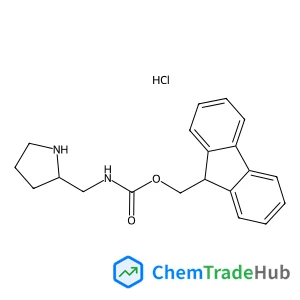
(S)-(9H-Fluoren-9-yl)methyl (pyrrolidin-2-ylmethyl)carbamate hydrochloride
CAS番号:
1217813-15-4
分子式:
C20H23ClN2O2
Mohammad Izadyar, Mojtaba Rezaeian, Alexey Victorov
In this article, 20 ns molecular dynamic (MD) simulations and density functional theory (DFT) were used to investigate the absorption of CO2 molecules by some functionalized 1,8-diazabicyclo[5,4,0]-udec-7-ene (DBU)-based ILs. According to the MD results, the highest coordination number for N⋯C is observed in the case of [DBUH+][Im−], which indicates that the functionalization of the imidazole anion by different alkyl groups decreases the interaction ability of the anion with CO2 molecules. The addition of water molecules to the ILs decreases the ability of the anion to interact with CO2 because of the hydrogen bond formation between the imidazole anions and water. Two different paths were proposed for CO2 absorption by the ILs, and the effect of alkyl groups on the kinetics and thermodynamics of the reaction was analyzed by using the M06-2X functional at the 6-311++G(d,p) level of theory in the gas phase and water. On the basis of the results, CO2 absorption is more favorable in [DBUH+][Im−], thermodynamically. Kinetic parameters show that the alkylation of the imidazole anion by ethyl, propyl, iso-propyl, and phenyl groups decreases the rate of CO2 absorption, because of the steric and electron-withdrawing effect of different alkyl groups. In the presence of water molecules, the lowest activation Gibbs energy is related to [DBUH+][Im−], which confirms the greater ability of this IL in CO2 absorption.
Noboru Ono, Hidemitsu Uno, Deok Yun Kim, Soo Bum Noh, Dongho Kim
DOI: 10.1039/B505340D
Florian Beuerle, Nikos Chronakis, Andreas Hirsch
DOI: 10.1039/B504748J
Osamu Hirata, Masayuki Takeuchi, Seiji Shinkai
DOI: 10.1039/B506883E
Balaji Sitharaman, Kyle R. Kissell, Keith B. Hartman, Lesa A. Tran, Andrei Baikalov, Irene Rusakova, Yanyi Sun, Htet A. Khant, Steven J. Ludtke, Wah Chiu, Sabrina Laus, Éva Tóth, Lothar Helm, André E. Merbach, Lon J. Wilson
DOI: 10.1039/B504435A
Dai Yamamoto
DOI: 10.1039/B505843K
Lan He, Yu An, Lihua Yuan, Kazuhiro Yamato, Wen Feng, Oksana Gerlitz, Chong Zheng, Bing Gong
DOI: 10.1039/B503921E
Naoyoshi Maezaki, Hiroaki Sawamoto, Hiroyuki Ishihara, Tetsuaki Tanaka
DOI: 10.1039/B506375B
2-メトキシ-4-(メチルスルフィニル)アミンは、主に医薬品および農薬の製造に使用されます。また、合成化学の一部として研究用材料としても利用されます。
代替品としては、4,6-二クロロピラミジンアミンや他のピラミジン系化合物が考えられます。ただし、目的と用途によって最適な代替品は異なります。
6-氯-4-甲基-1H-吲哚の廃棄物は、適切な容器に収集し、密閉して保管します。温度は常温、湿度は低く、直射日光を避けて保管することを推奨します。廃棄処理は専門...
2-フローユロ-4-(トリフルオロメチル)ベンゾイドのCAS番号は207974-08-1です。この化合物はGHS分類で毒性物質と有害な反応物質として分類されます...
4-ニトロフェニルN-[(ベンゼルオキシルカーボンイル]グリシングリシングリシン酸は、室温で暗所に保管し、乾燥した環境で保存することを推奨します。容器は密閉性の...
イソデスロラタドリンの代替品としては、デスロラタドリンや他の抗ヒスタミン薬が挙げられます。具体的には、デスロラタドリン、ラセカミド、フェルタドリンなどが、症状や...
5-甲氧基-1,2,3,4-四氢异喹啉盐酸盐の一般的な合成方法は、メタノール中で5-メトキシ-1,2,3,4-四ヒュドロイソキシンを塩酸で塩化します。この反応で...
CAS番号6471-78-9の4-アミノ-5-メトキシ-2-トルエンサルホニック酸は、GHS分類では corrosive(腐食性)と識別されます。EUのREAC...
甲基孕酮の取り扱いは、PPE(個人保護具)の使用が必要な重要な安全事項を伴います。防塵マスク、ゴーグル、手袋を着用することが推奨されます。ドラフトチャンバーを使...

Physical Chemistry Chemical Physics (PCCP) is an international journal co-owned by 19 physical chemistry and physics societies from around the world. This journal publishes original, cutting-edge research in physical chemistry, chemical physics and biophysical chemistry. To be suitable for publication in PCCP, articles must include significant innovation and/or insight into physical chemistry; this is the most important criterion that reviewers and Editors will judge against when evaluating submissions. The journal has a broad scope and welcomes contributions spanning experiment, theory, computation and data science. Topical coverage includes spectroscopy, dynamics, kinetics, statistical mechanics, thermodynamics, electrochemistry, catalysis, surface science, quantum mechanics, quantum computing and machine learning. Interdisciplinary research areas such as polymers and soft matter, materials, nanoscience, energy, surfaces/interfaces, and biophysical chemistry are welcomed if they demonstrate significant innovation and/or insight into physical chemistry. Joined experimental/theoretical studies are particularly appreciated when complementary and based on up-to-date approaches.