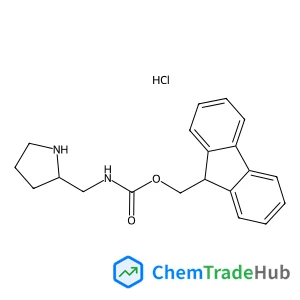
(S)-(9H-Fluoren-9-yl)methyl (pyrrolidin-2-ylmethyl)carbamate hydrochloride
CAS番号:
1217813-15-4
分子式:
C20H23ClN2O2
Chao He, Guocai Liu, Huiyan Zhao, Kun Zhao, Zuju Ma, Xingtao An
Inorganic ferroelectric perovskite oxides are more stable than hybrid perovskites. However, their solar energy harvesting efficiency is not so good. Here, by constructing a series of BiFeO3-based devices (solar cells), we investigated three factors that influence the photovoltaic performance, namely, spontaneous polarization, terminated ion species in the interface between BiFeO3 and the electrode, and polarized light irradiation. This work was carried out under the framework of the density functional theory combined with the non-equilibrium Green's function theory under a built-in electric field or finite bias. The results showed that (1) the photocurrent is larger only under a suitable electronic band gap rather than larger spontaneous polarization; (2) the photocurrent reaches the largest value in the Bi3+ ion-terminated interface than in the case of Fe3+ or O2− with the SrTiO3 electrode; (3) the photocurrent can be largely enhanced if the polarized direction of the monochromatic light is perpendicular to the spontaneous polarization direction. These results would deepen the understanding of some experimental results of BiFeO3-based solar cells.
Tim Phillips, Chatna Rajput, Lance Twyman, Ihtshamul Haq, Jim A. Thomas
DOI: 10.1039/B506946G
Dirk Jan V. C. van Steenis, Olivier R. P. David, Gino P. F. van Strijdonck, Jan H. van Maarseveen, Joost N. H. Reek
DOI: 10.1039/B507776A
Kazunori Nakashima, Tatsuo Maruyama, Noriho Kamiya, Masahiro Goto
DOI: 10.1039/B505479F
Gaku Fukuhara, Tadashi Mori
DOI: 10.1039/B504948B
Anne L. Boreen, Kristopher McNeill
DOI: 10.1039/B506971H
Peter B. Hitchcock, Gareth J. Rowlands, Rakesh Parmar
DOI: 10.1039/B507394D
Upendra. A. Joshi, Soo Hyun Chung, Jae Sung Lee
DOI: 10.1039/B508168H
Hui Hong, Tim Stinear, Paul Skelton, Jonathan B. Spencer, Peter F. Leadlay
DOI: 10.1039/B506835E
Chunling Fu, Jing Li
DOI: 10.1039/B508069J
Hanh. V. Ly, Taryn. D. Forster, Darren Maley, Masood Parvez, Roland Roesler
DOI: 10.1039/B508152A
2-メトキシ-4-(メチルスルフィニル)アミンは、主に医薬品および農薬の製造に使用されます。また、合成化学の一部として研究用材料としても利用されます。
代替品としては、4,6-二クロロピラミジンアミンや他のピラミジン系化合物が考えられます。ただし、目的と用途によって最適な代替品は異なります。
6-氯-4-甲基-1H-吲哚の廃棄物は、適切な容器に収集し、密閉して保管します。温度は常温、湿度は低く、直射日光を避けて保管することを推奨します。廃棄処理は専門...
2-フローユロ-4-(トリフルオロメチル)ベンゾイドのCAS番号は207974-08-1です。この化合物はGHS分類で毒性物質と有害な反応物質として分類されます...
4-ニトロフェニルN-[(ベンゼルオキシルカーボンイル]グリシングリシングリシン酸は、室温で暗所に保管し、乾燥した環境で保存することを推奨します。容器は密閉性の...
イソデスロラタドリンの代替品としては、デスロラタドリンや他の抗ヒスタミン薬が挙げられます。具体的には、デスロラタドリン、ラセカミド、フェルタドリンなどが、症状や...
5-甲氧基-1,2,3,4-四氢异喹啉盐酸盐の一般的な合成方法は、メタノール中で5-メトキシ-1,2,3,4-四ヒュドロイソキシンを塩酸で塩化します。この反応で...
CAS番号6471-78-9の4-アミノ-5-メトキシ-2-トルエンサルホニック酸は、GHS分類では corrosive(腐食性)と識別されます。EUのREAC...
甲基孕酮の取り扱いは、PPE(個人保護具)の使用が必要な重要な安全事項を伴います。防塵マスク、ゴーグル、手袋を着用することが推奨されます。ドラフトチャンバーを使...

Physical Chemistry Chemical Physics (PCCP) is an international journal co-owned by 19 physical chemistry and physics societies from around the world. This journal publishes original, cutting-edge research in physical chemistry, chemical physics and biophysical chemistry. To be suitable for publication in PCCP, articles must include significant innovation and/or insight into physical chemistry; this is the most important criterion that reviewers and Editors will judge against when evaluating submissions. The journal has a broad scope and welcomes contributions spanning experiment, theory, computation and data science. Topical coverage includes spectroscopy, dynamics, kinetics, statistical mechanics, thermodynamics, electrochemistry, catalysis, surface science, quantum mechanics, quantum computing and machine learning. Interdisciplinary research areas such as polymers and soft matter, materials, nanoscience, energy, surfaces/interfaces, and biophysical chemistry are welcomed if they demonstrate significant innovation and/or insight into physical chemistry. Joined experimental/theoretical studies are particularly appreciated when complementary and based on up-to-date approaches.