











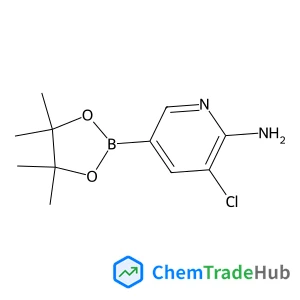
3-Chloro-5-(4,4,5,5-tetramethyl-1,3,2-dioxaborolan-2-yl)-2-pyridinamine
CAS番号:
1032758-99-8
分子式:
C11H16BClN2O2
Hongxing Hao, Qing Xie, Jingwen Ai, Yuan Wang, Hongtao Bian
Understanding the interfacial structure of aqueous electrolyte solutions is important and relevant to a wide range of systems, ranging from atmospheric aerosols to electrochemistry, and biological environments. Though significant efforts have been made to unravel the interfacial structure of water molecules, the structure and dynamics of ions at the interface have not yet been fully elucidated. Here, the interfacial structure of the aqueous solution was investigated directly by monitoring the thiocyanate (SCN−) anions using surface-specific sum frequency generation (SFG) vibrational spectroscopy. The molecular orientation of the SCN− anions and their adsorption behavior at the air/water interface were systematically determined by quantitative polarization analysis. The transition dipole of the CN stretching of the SCN− anion is oriented around 44° from the surface normal of the NaSCN aqueous solution surface and remained unchanged with the bulk concentration varying from 1 mol kg−1 to 13 mol kg−1. The free energy of adsorption of SCN− anions at the air/water interface was determined to be −1.53 ± 0.04 kcal mol−1. Furthermore, a new SFG peak positioned at 2080 cm−1 in the ppp polarization combination was observed at the air/15.0 mol kg−1 NaSCN aqueous solution interface for the first time. Concentration-dependent SFG analysis and density functional theory (DFT) calculation further revealed that the SCN− anions form an ion clustering structure at the air/water interface. The subtle and specific Na+ and K+ counter-cation effects on the interfacial structure of the SCN− anions at the aqueous solution interface were also observed, which showed that ion cooperativity plays an important role in affecting the interfacial structure of ions at the air/water interface. The results are expected to yield significant insights into the understanding of the structure of aqueous solution surfaces and the molecular level mechanism of the cationic Hofmeister effect.
I. Alcón
DOI: 10.1039/C7CP08076J
Tao Yang, Diego M. Andrada
DOI: 10.1039/C8CP00951A
Sepehr Ebadi
DOI: 10.1039/C7CP08481A
Lesheng Li, Yosuke Kanai
DOI: 10.1039/C7CP07247C
Sunghu Kim, Byung-Kuk Yoo, Yuri Choi, Oh-Hoon Kwon
DOI: 10.1039/C8CP01619D
Wenhao Yuan, Tianyu Li, Wei Li, Jiuzhong Yang
DOI: 10.1039/C7CP08518D
Fengjin Zhang, Di Zhang, Yong Du, Peipei Jin, Yanying Zhao, Xuming Zheng, Jiadan Xue
DOI: 10.1039/C8CP00484F
Zhixiao Liu, Wangyu Hu, Shiguo Zhang, Perla B. Balbuena, Partha P. Mukherjee
DOI: 10.1039/C8CP01462K
Gérôme Melaet, Vitalie Stavila, Lennie Klebanoff
DOI: 10.1039/C7CP07015B
Morten Lund Rasmussen, Hamid Hashemi, Hao Wu, Peter Glarborg, Matteo Pelucchi, Tiziano Faravelli, Paul Marshall
DOI: 10.1039/C7CP07552A
2-ヒドロキシ-5-ニトロベンジンブロモイドは特定の化学反応に適しているため、代替品は限られています。しかし、同様の構造を持つ2-ヒドロキシ-4-ニトロベンジン...
N-(2-ブロモフェニル)-1-チロール-3-オキソ-3-(ピペリジニル)プロペン-2-イル)ベンゼンアミドは有毒で、皮膚や粘膜に刺激を与える可能性があります。...
この化合物は、新規治療薬の開発に注目されています。市場では、その有効性と安全性が評価され、研究分野では、分子生物学と医薬化学の新たな発見が期待されています。
Succinimidyl-alanyl-phenylalanyl-prolyl-phenylalanine 4-nitroanilide は主に医薬品開発やポ...
メチル6-アミノ-5-クロロピリジン-2-カーボイル酸(CAS番号: 1256794-05-4)の使用には、GHS( Globally Harmonized S...
取り扱いには、耐薬品性の容器を使用し、通気性の良い場所で操作することを推奨します。漏れ時は、SDS(安全データシート)を参照して適切な措置を取ること。手洗いと洗...
(S)-3-ベンZYルピペリジン塩酸塩は、CAS番号1258940-00-9で表される化合物です。これは、(S)-3-苯基哌啶的盐酸盐であり、主に医薬品の原料と...
3,5-二甲基金剛胺は、主に医薬品の原料として使用され、また抗うつ薬や抗アルツハイマー薬の開発に利用されます。さらに、化粧品や食品添加物の製造でも重要な役割を果...
ビス(4-メチル-2-ペンチル)フェニルカルボン酸エステル (CAS番号: 1398066-13-1) の代替品には、ビス(2-エチルヘキシル)フェノールカルボ...

Physical Chemistry Chemical Physics (PCCP) is an international journal co-owned by 19 physical chemistry and physics societies from around the world. This journal publishes original, cutting-edge research in physical chemistry, chemical physics and biophysical chemistry. To be suitable for publication in PCCP, articles must include significant innovation and/or insight into physical chemistry; this is the most important criterion that reviewers and Editors will judge against when evaluating submissions. The journal has a broad scope and welcomes contributions spanning experiment, theory, computation and data science. Topical coverage includes spectroscopy, dynamics, kinetics, statistical mechanics, thermodynamics, electrochemistry, catalysis, surface science, quantum mechanics, quantum computing and machine learning. Interdisciplinary research areas such as polymers and soft matter, materials, nanoscience, energy, surfaces/interfaces, and biophysical chemistry are welcomed if they demonstrate significant innovation and/or insight into physical chemistry. Joined experimental/theoretical studies are particularly appreciated when complementary and based on up-to-date approaches.
![Pyrazolo[1,5-a]pyridine-3-carbothioamide structure](https://static.chemtradehub.com/structs/885/885275-44-5-aae0.webp "Pyrazolo[1,5-a]pyridine-3-carbothioamide structure")




