












The challenging playground of astrochemistry: an integrated rotational spectroscopy – quantum chemistry strategy
文献情報
出版日
2020-03-05
DOI
10.1039/D0CP00561D
インパクトファクター
3.676
著者
Cristina Puzzarini, Vincenzo Barone
原文を見る
要旨
While it is now well demonstrated that the interstellar medium (ISM) is characterized by a diverse and complex chemistry, a significant number of features in radioastronomical spectra are still unassigned and call for new laboratory efforts, which are increasingly based on integrated experimental and computational strategies. In parallel, the identification of an increasing number of molecules containing more than five atoms and at least one carbon atom (the so-called “interstellar” complex organic molecules), which can play a relevant role in the chemistry of life, raises the additional issue of how these species can be produced in the typical harsh conditions of the ISM. On these grounds, this perspective aims to present an integrated rotational spectroscopy – quantum chemistry approach for supporting radioastronomical observations and a computational strategy for contributing to the elucidation of chemical reactivity in the interstellar space.
関連文献
Vapour adsorption kinetics: statistical rate theory and zeta adsorption isotherm approach
Seyed Hadi Zandavi, C. A. Ward
2016-08-26
Paper
DOI: 10.1039/C6CP05088C
Enhanced low-temperature ionic conductivity via different Li+ solvated clusters in organic solvent/ionic liquid mixed electrolytes
Luis Aguilera, Johan Scheers, Aleksandar Matic
2016-08-16
Paper
DOI: 10.1039/C6CP04766A
A new perspective on the electron transfer: recovering the Butler–Volmer equation in non-equilibrium thermodynamics
Wolfgang Dreyer, Clemens Guhlke, Rüdiger Müller
2016-07-25
Paper
DOI: 10.1039/C6CP04142F
Molecular mechanisms responsible for hydrate anti-agglomerant performance
Anh Phan, Tai Bui, Erick Acosta, Pushkala Krishnamurthy, Alberto Striolo
2016-07-07
Paper
DOI: 10.1039/C6CP03296F
Dichlorophosphanyl isocyanate – spectroscopy, conformation and molecular structure in the gas phase and the solid state
Dingqing Li, Jan Schwabedissen, Hans-Georg Stammler, Norbert W. Mitzel, Helge Willner, Xiaoqing Zeng
2016-09-01
Paper
DOI: 10.1039/C6CP05377G
Evidence of spin-temperature in dynamic nuclear polarization: an exact computation of the EPR spectrum
Filippo Caracciolo, Marta Filibian, Pietro Carretta, Alberto Rosso, Andrea De Luca
2016-08-22
Paper
DOI: 10.1039/C6CP05047F
New solvatochromic probes: performance enhancement via regulation of excited state structures
Qianshu Li, Gary J. Blanchard
2016-08-19
Paper
DOI: 10.1039/C6CP04293G
The flow patterning capability of localized natural convection
Ling-Ting Huang, Ling Chao
2016-08-18
Paper
DOI: 10.1039/C6CP03501A
The impact of environment and resonance effects on the site of protonation of aminobenzoic acid derivatives
Jongcheol Seo, Stephan Warnke, Sandy Gewinner, Wieland Schöllkopf, Michael T. Bowers, Gert von Helden
2016-08-22
Paper
DOI: 10.1039/C6CP04941A
Observation of nanotwinning and room temperature ferromagnetism in sub-5 nm BiFeO3 nanoparticles: a combined experimental and theoretical study
Mandar M. Shirolkar, Xiaolei Dong, Jieni Li, Shiliu Yin, Ming Li, Haiqian Wang
2016-08-22
Paper
DOI: 10.1039/C6CP04369K
こちらもおすすめ
化合物よくある質問
2,3-スチオエポキシマドルを取り扱う際の実験室安全事項は何ですか?
取り扱いにはPPE(プロテクティブ・パーソナル・エイド)が必要で、防ぐ手袋と保護眼鏡を着用してください。ドラフトチャンバーの使用を推奨します。漏洩した場合は、適...
4267-80-52,3-Thioepoxy Madol
53981-25-22-Amino-6-fluorophen...
化合物よくある質問
BOC-S-3-アミニ-4-(4-メチオキシベンチル)-ブタン酸の代替品はありますか?
この化合物の代替品としては、BOC保護基を有さないアミノ酸やその他の保護基化合物が考えられます。また、メチオキシ基を有しない他の芳香族アミノ酸も代替品として挙げ...
126800-59-7(3S)-4-(4-Methoxyphe...
化合物よくある質問
Methyl 2-(chloromethyl)-3-nitrobenzoate(1218910-61-2)の代替品はありますか?
Methyl 2-(chloromethyl)-3-nitrobenzoate(1218910-61-2)の代替品としては、化学組成を変えることで効果を達成する...
1218910-61-2Methyl 2-(chlorometh...
化合物よくある質問
(2R)-2-アミノ-N-ベンジル-3-ヒドロキシプロパナミドを含む廃棄物はどのように処理すべきですか?
(2R)-2-アミノ-N-ベンジル-3-ヒドロキシプロパナミドを含む廃棄物は、適切な廃棄物管理ガイドラインに基づき処理する必要があります。まず、廃棄物を適切に収...
175481-39-7(2R)-2-amino-N-benzy...
化合物よくある質問
6,7-二氢-咪唑並[1,2-a]ピリドイン-8(5h)-酮はどのように合成されますか?
6,7-二氢-咪唑並[1,2-a]ピリドイン-8(5h)-酮は、2-ブロモフェニルアセトインとリン酸ハロゲン化物を反応させることで合成できます。この反応は高温で...
457949-09-66,7-Dihydroimidazo[1...
化合物よくある質問
エチル(3R)-3-ピロリジニル酢酸水和塩とは何ですか?
エチル(3R)-3-ピロリジニル酢酸水和塩は、CAS番号1332459-32-1の化合物で、(R)-乙基2-(ピロリジン-3-基)酢酸塩水和塩と呼ばれます。この...
1332459-32-1Ethyl (3R)-3-pyrroli...
化合物よくある質問
(2S)-{[(2-メチルエチルオキシ]カルボニル}アミノ)[2-(トリアフルオロメチルフェニル]エチカシック酸の物理化学的性質は何ですか?
(2S)-{[(2-メチルエチルオキシ]カルボニル}アミノ)[2-(トリアフルオロメチルフェニル]エチカシック酸のCAS番号は1203454-45-8です。この...
1203454-45-8(2S)-({[(2-Methyl-2-...
化合物よくある質問
2-ブロモ-1-(2-メチル-2-プロパニル)-4-ニトロベンゼンはどのように保存すればよいですか?
2-ブロモ-1-(2-メチル-2-プロパニル)-4-ニトロベンゼンは、直射日光を避けて暗所で、室温(約15℃〜25℃)、乾燥した場所に保存する必要があります。ま...
6310-17-42-Bromo-1-(2-methyl-...
化合物よくある質問
1-[(4-硝基フェニル)スルホニル]-1H-1,2,4-三唑の市場動向や研究トレンドはどうですか?
市場動向としては、1-[(4-硝基フェニル)スルホニル]-1H-1,2,4-三唑は主に農業用除草剤や合成化学製品の原料として利用されています。研究トレンドとして...
57777-84-11-[(4-Nitrophenyl)su...
掲載誌
Physical Chemistry Chemical Physics

CiteScore:
5.5
自己引用率:
10.3%
年間論文数:
3036
Physical Chemistry Chemical Physics (PCCP) is an international journal co-owned by 19 physical chemistry and physics societies from around the world. This journal publishes original, cutting-edge research in physical chemistry, chemical physics and biophysical chemistry. To be suitable for publication in PCCP, articles must include significant innovation and/or insight into physical chemistry; this is the most important criterion that reviewers and Editors will judge against when evaluating submissions. The journal has a broad scope and welcomes contributions spanning experiment, theory, computation and data science. Topical coverage includes spectroscopy, dynamics, kinetics, statistical mechanics, thermodynamics, electrochemistry, catalysis, surface science, quantum mechanics, quantum computing and machine learning. Interdisciplinary research areas such as polymers and soft matter, materials, nanoscience, energy, surfaces/interfaces, and biophysical chemistry are welcomed if they demonstrate significant innovation and/or insight into physical chemistry. Joined experimental/theoretical studies are particularly appreciated when complementary and based on up-to-date approaches.
おすすめ化合物
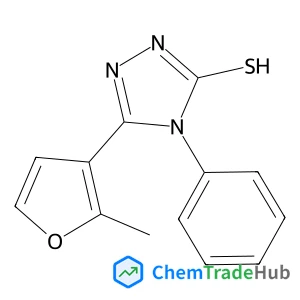
5-(2-Methyl-3-furyl)-4-phenyl-2,4-dihydro-3H-1,2,4-triazole-3-thione
CAS番号:
346464-59-3
分子式:
C13H11N3OS
おすすめサプライヤー




免責事項
このページに表示される学術雑誌情報は、参考および研究目的のみを目的としています。当社は雑誌出版社とは提携しておらず、投稿の取り扱いも行っておりません。出版に関するお問い合わせは、各雑誌出版社に直接ご連絡ください。
表示されている情報に誤りがある場合は、support@chemtradehub.com までご連絡ください。迅速に確認し、対応いたします。