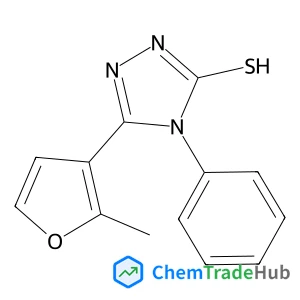
5-(2-Methyl-3-furyl)-4-phenyl-2,4-dihydro-3H-1,2,4-triazole-3-thione
CAS番号:
346464-59-3
分子式:
C13H11N3OS
Xiaoyue Liu, Jueming Yang, Xingwu Zhai, Hongxia Yan, Yanwen Zhang, Long Zhou
Through the density functional theory, we studied molecular devices composed of single tetrathiafulvalene (TTF) molecules connected with zigzag graphene nanoribbon electrodes by four different junctions. Interestingly, some devices have exhibited half-metallic behavior and can bring out a perfect spin filtering effect and remarkable negative differential resistance behavior. The current–voltage characteristics show that these four devices possess different spin current values. We found that all the TTF molecules were stretched due to interactions with the electrodes in the four devices. This leads to the Fermi levels of the three devices being down-shifted to the valence band; therefore, these devices exhibit half-metallic properties. The underlying mechanisms of the different spin current values are attributed to the different electron transmission pathways (via chemical bonds or through hopping between atoms). These results suggest that the device properties and conductance are controlled by different junctions. Our work predicts an effective way for designing high-performance spin-injected molecular devices.
Apisit Naramittanakul, Supacha Buttranon, Atitsa Petchsuk, Pimchai Chaiyen
DOI: 10.1039/D1RE00189B
Anirudh M. K. Nambiar, Christopher P. Breen, Timothy F. Jamison, Klavs F. Jensen
DOI: 10.1039/D1RE00350J
Chengjie Li, Minghui Guo, Ying Dai, Peikuan Xu, Bin Shi, Dewang Hou, Ruiguang Li
DOI: 10.1039/D1RE00336D
Lijuan Jiang, Benyu Sun, Shuangshuang Liu, Mengmeng Du, Qianqian Hu, Honghui Gong, Baozhong Liu
DOI: 10.1039/D1RE00352F
Gijs J. M. Habraken, Maloes Peeters, Carin H. J. T. Dietz, Cor E. Koning
DOI: 10.1039/B9PY00337A
DOI: 10.1039/D1RE00200G
Julien Dieu, François Jérôme, Catherine Batiot-Dupeyrat
DOI: 10.1039/D1RE00407G
Zhong'an Li, Wenbo Wu, Cheng Ye, Jingui Qin, Zhen Li
DOI: 10.1039/B9PY00225A
取り扱いにはPPE(プロテクティブ・パーソナル・エイド)が必要で、防ぐ手袋と保護眼鏡を着用してください。ドラフトチャンバーの使用を推奨します。漏洩した場合は、適...
この化合物の代替品としては、BOC保護基を有さないアミノ酸やその他の保護基化合物が考えられます。また、メチオキシ基を有しない他の芳香族アミノ酸も代替品として挙げ...
Methyl 2-(chloromethyl)-3-nitrobenzoate(1218910-61-2)の代替品としては、化学組成を変えることで効果を達成する...
(2R)-2-アミノ-N-ベンジル-3-ヒドロキシプロパナミドを含む廃棄物は、適切な廃棄物管理ガイドラインに基づき処理する必要があります。まず、廃棄物を適切に収...
6,7-二氢-咪唑並[1,2-a]ピリドイン-8(5h)-酮は、2-ブロモフェニルアセトインとリン酸ハロゲン化物を反応させることで合成できます。この反応は高温で...
エチル(3R)-3-ピロリジニル酢酸水和塩は、CAS番号1332459-32-1の化合物で、(R)-乙基2-(ピロリジン-3-基)酢酸塩水和塩と呼ばれます。この...
(2S)-{[(2-メチルエチルオキシ]カルボニル}アミノ)[2-(トリアフルオロメチルフェニル]エチカシック酸のCAS番号は1203454-45-8です。この...
2-ブロモ-1-(2-メチル-2-プロパニル)-4-ニトロベンゼンは、直射日光を避けて暗所で、室温(約15℃〜25℃)、乾燥した場所に保存する必要があります。ま...
市場動向としては、1-[(4-硝基フェニル)スルホニル]-1H-1,2,4-三唑は主に農業用除草剤や合成化学製品の原料として利用されています。研究トレンドとして...

Physical Chemistry Chemical Physics (PCCP) is an international journal co-owned by 19 physical chemistry and physics societies from around the world. This journal publishes original, cutting-edge research in physical chemistry, chemical physics and biophysical chemistry. To be suitable for publication in PCCP, articles must include significant innovation and/or insight into physical chemistry; this is the most important criterion that reviewers and Editors will judge against when evaluating submissions. The journal has a broad scope and welcomes contributions spanning experiment, theory, computation and data science. Topical coverage includes spectroscopy, dynamics, kinetics, statistical mechanics, thermodynamics, electrochemistry, catalysis, surface science, quantum mechanics, quantum computing and machine learning. Interdisciplinary research areas such as polymers and soft matter, materials, nanoscience, energy, surfaces/interfaces, and biophysical chemistry are welcomed if they demonstrate significant innovation and/or insight into physical chemistry. Joined experimental/theoretical studies are particularly appreciated when complementary and based on up-to-date approaches.