












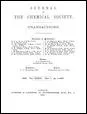
LXXXII.—Ethylstannic acid and derivatives
文献情報
出版日
DOI
10.1039/CT9211900758
インパクトファクター
0
著者
原文を見る
要旨
The first page of this article is displayed as the abstract.
関連文献
An experimental and theoretical investigation of the gas-phase benzene–OH radical adduct + O2 reaction
David Johnson, Severine Raoult, Marie-Thérèse Rayez, Jean-Claude Rayez, Robert Lesclaux
2002-08-28
Paper
DOI: 10.1039/B204415C
Kirkwood–Buff integrals for polymer–solvent mixtures. Preferential solvation and volumetric analysis in aqueous PEG solutions
2002-09-03
Paper
DOI: 10.1039/B204795K
FTIR study of low-temperature CO adsorption on high surface area tin(iv) oxide: Probing Lewis and Brønsted acidity
Patrick Gélin, Laurent Périer-Camby, Hélène Praliaud, Gérard Thomas
2002-08-28
Paper
DOI: 10.1039/B206336K
Density functional theory investigation of the reactions of CH2Br–I, CH2I–Br, CH2Cl–I, and CH2I–Cl isopolyhalomethanes with ethylene
Dongqi Wang, David Lee Phillips, Wei-Hai Fang
2002-09-16
Paper
DOI: 10.1039/B204898C
A random tunneling algorithm for the structural optimization problem
Haiyan Jiang, Wensheng Cai, Xueguang Shao
2002-08-28
Paper
DOI: 10.1039/B206251H
Correlated ab initio study of nucleic acid bases and their tautomers in the gas phase, in a microhydrated environment and in aqueous solution Part 1. Cytosine
Semen A. Trygubenko, Tetyana V. Bogdan, Manuel Rueda, Modesto Orozco, F. Javier Luque, Jiří Šponer, Petr Slavíček, Pavel Hobza
2002-07-25
Paper
DOI: 10.1039/B202156K
Density functional theoretical (DFT) and surface-enhanced Raman spectroscopic study of guanine and its alkylated derivatives Part 1. DFT calculations on neutral, protonated and deprotonated guanine
Bernd Giese, Don McNaughton
2002-09-11
Paper
DOI: 10.1039/B203829C
Molar volume of 6Li, 7Li and natural Li in the liquid state
Yuta Shimizu, Akitoshi Mizuno, Tadahiko Masaki
2002-08-13
Paper
DOI: 10.1039/B201956F
Reaction and dissociation mechanism control: the H2 + H2 system
Ernesto Garcia, Antonio Laganà
2002-08-30
Paper
DOI: 10.1039/B205377B
OH-initiated oxidation of benzene Part II.Influence of elevated NOx concentrations
Björn Klotz, Rainer Volkamer, Michael D. Hurley, Mads P. Sulbaek Andersen, Ole John Nielsen, Ian Barnes, Takashi Imamura, Klaus Wirtz, Karl-Heinz Becker, Ulrich Platt, Timothy J. Wallington, Nobuaki Washida
2002-08-13
Paper
DOI: 10.1039/B204398J
こちらもおすすめ
化合物よくある質問
噻奈普汀乙酯の物理化学的性質は何ですか?
CAS番号66981-77-9の噻奈普汀乙酯は、結晶性白色粉末であり、分子量は476.9 g/molです。この化合物は水に溶けにくく、一般的には有機溶媒で溶解し...
66981-77-9Ethyl 7-[(3-chloro-6...
化合物よくある質問
アミピシリン不純物Fとは何ですか?
アミピシリン不純物Fは、CAS番号124774-48-7の化合物です。これは、抗生物質アミピシリンの生産過程で生成される不純物の一つであり、(4S)-2-({[...
124774-48-7Ampicillin impurity ...
化合物よくある質問
イリジウム(I)ヘキサフルオロフォスファートの代替品はありますか?
イリジウム(I)ヘキサフルオロフォスファートの代替品として、他の有機金属化合物や非有機金属化合物が使用されることがあります。具体的には、ダイゾニウム塩や他の金属...
870077-94-43-Di-i-propylphosphi...
化合物よくある質問
含有3-(苯氧基甲基)苯硼酸频那醇酯の廃棄物はどのように処理すべきですか?
含有3-(苯氧基甲基)苯硼酸频那醇酯の廃棄物は、安全な方法で処理する必要があります。まず、廃棄物を適切な容器に収集し、避けて保管します。次に、専門の廃棄処理業者...
912569-68-74,4,5,5-Tetramethyl-...
化合物よくある質問
2-甲基辛-1-醇を取り扱う際の実験室安全事項は何ですか?
取り扱う際は、密閉のゴーグルと手袋を着用することが推奨されます。ドラフトチャンバーを使用し、漏洩時には速やかに取り扱いを中止し、適切な排気設備を使用してください...
818-81-52-Methyl-1-octanol
14066-05-8Scandium triperchlor...
化合物よくある質問
3α-アセトキノイドコレステロールエステルはどのように保存すればよいですか?
3α-アセトキノイドコレステロールエステルは、常温から低温(0-5℃)の暗所で保存し、密閉容器に入れることで安定性を保つことが推奨されます。また、湿気や酸素から...
30365-63-0Methyl (3alpha,5beta...
化合物よくある質問
2-ぶンジロキシ-4-(トリフルオロメチル)フェノルビノン酸の主な用途は何ですか?
2-ぶンジロキシ-4-(トリフルオロメチル)フェノルビノン酸は、化学合成の触媒としての使用や、医薬品の合成材料としての役割があります。また、特定の合成路線で使用...
1701435-39-3[2-(Benzyloxy)-4-(tr...
化合物よくある質問
(2S,3R)-2-氨基-3-甲基丁二酸はどのように合成されますか?
(2S,3R)-2-氨基-3-甲基丁二酸は、2-ヒドロキシ-3-メチル丁酸とアミノ化反応を行うことで合成されます。触媒としてジクロロメタンが使用され、選択性と収...
121570-10-3(2S,3R)-2-amino-3-me...
化合物よくある質問
1-Benzyl-2-phenyl-1H-imidazoleはどのように保存すればよいですか?
この化合物は常温で避けてください。直射日光を避け、密閉容器で保存し、湿気を防水の容器に入れて保管してください。
37734-89-71-Benzyl-2-phenyl-1H...
掲載誌
おすすめ化合物
おすすめサプライヤー





免責事項
このページに表示される学術雑誌情報は、参考および研究目的のみを目的としています。当社は雑誌出版社とは提携しておらず、投稿の取り扱いも行っておりません。出版に関するお問い合わせは、各雑誌出版社に直接ご連絡ください。
表示されている情報に誤りがある場合は、support@chemtradehub.com までご連絡ください。迅速に確認し、対応いたします。