












Spectroscopic evidence of a particular intermolecular interaction in iodomethane–ethanol mixtures: the cooperative effect of halogen bonding, hydrogen bonding, and the solvent effect
文献情報
出版日
2020-02-06
DOI
10.1039/C9CP05886A
インパクトファクター
3.676
著者
Fei Yao, Nan Gong, Wenhui Fang, Zhiwei Men
原文を見る
要旨
Halogen bonding, an attractive interaction that is analogous to hydrogen bonding, has been widely investigated by computational methods. However, halogen bonding in solution is hard to study by spectroscopic techniques since the intermolecular interaction often gives overlapping bands and may be difficult to interpret. The traditional interpretation of iodomethane–ethanol mixtures considered only hydrogen bonding effects and the experimental investigation was limited. Here, we employed near-infrared (NIR) spectroscopy, Raman, density functional theory calculation, and two-dimensional (2D) correlation analysis to find evidence of the halogen bonding in iodomethane–ethanol mixtures. Our results suggest that the blue-shifting C–I stretching band is probably due to the cooperative influence from halogen bonding, hydrogen bonding, and the solvent effect, while the O–H band is a cumulative band from three dimer complexes. The 2D correlation spectra further validate the hypothesis above and reveal the interaction evolution from the ethanol-rich region to the iodomethane region. These results indicate that the unique nature of the iodomethane–ethanol mixture and the larger σ-hole strengthen the halogen bond, leading to particular spectroscopic results which are different from those of the other halogenated alkanes.
関連文献
Characterization of single-phase flow hydrodynamics in a Berty reactor using computational fluid dynamics (CFD)
Khunnawat Ountaksinkul, Sirada Sripinun, Surapon Bubphacharoen, Amnart Jantharasuk, Piyasan Praserthdam
2021-11-16
Paper
DOI: 10.1039/D1RE00390A
Nitroxide-mediated copolymerization of methacrylic acid with sodium 4-styrene sulfonate: towards new water-soluble macroalkoxyamines for the synthesis of amphiphilic block copolymers and nanoparticles
Ségolène Brusseau, Joël Belleney, Stéphanie Magnet, Laurence Couvreur
2010-03-04
Paper
DOI: 10.1039/B9PY00371A
Application of reactor engineering concepts in continuous flow chemistry: a review
Nicole C. Neyt, Darren L. Riley
2021-05-04
Review Article
DOI: 10.1039/D1RE00004G
Linear release nanoparticle devices for advanced targeted cancer therapies with increased efficacy
Alice E. van der Ende, Vasanth Sathiyakumar, Roberto Diaz, Dennis E. Hallahan, Eva Harth
2010-01-04
Paper
DOI: 10.1039/B9PY00272C
Selective surface functionalization of polystyrene by inner-shell monochromatic irradiation and oxygen exposure
Daniel Eduardo Weibel, Felipe Kessler, Gunar Vingre da Silva Mota
2010-02-08
Paper
DOI: 10.1039/B9PY00342H
Catalyst-free valorization of poly-3-hydroxybutyrate to crotonic acid
Shimin Kang, Jinxia Fu, Jianhao Liang, Suxia Chen, Lijun Lu, Rongrong Miao
2021-08-02
Communication
DOI: 10.1039/D1RE00273B
Kinetic study of o-nitrotoluene nitration in a homogeneously continuous microflow
Jing Song, Yongjin Cui, Guangsheng Luo, Jian Deng, Yujun Wang
2021-09-28
Paper
DOI: 10.1039/D1RE00362C
Reaction kinetics and pathways of crotonic acid conversion in sub- and supercritical water for renewable fuel production
Diane Valenzuela Gubatanga
2021-11-15
Paper
DOI: 10.1039/D1RE00435B
Multi-scale reactive extrusion modelling approaches to design polymer synthesis, modification and mechanical recycling
Kyann De Smit, Yoshi W. Marien, Paul H. M. Van Steenberge, Mariya Edeleva
2022-01-11
Review Article
DOI: 10.1039/D1RE00556A
Micelles with surface conjugated RGDpeptide and crosslinked polyurea core viaRAFT polymerization
Hien T. T. Duong, T. L. Uyen Nguyen, Martina H. Stenzel
2009-11-25
Paper
DOI: 10.1039/B9PY00210C
こちらもおすすめ
化合物よくある質問
2,3-スチオエポキシマドルを取り扱う際の実験室安全事項は何ですか?
取り扱いにはPPE(プロテクティブ・パーソナル・エイド)が必要で、防ぐ手袋と保護眼鏡を着用してください。ドラフトチャンバーの使用を推奨します。漏洩した場合は、適...
4267-80-52,3-Thioepoxy Madol
53981-25-22-Amino-6-fluorophen...
化合物よくある質問
BOC-S-3-アミニ-4-(4-メチオキシベンチル)-ブタン酸の代替品はありますか?
この化合物の代替品としては、BOC保護基を有さないアミノ酸やその他の保護基化合物が考えられます。また、メチオキシ基を有しない他の芳香族アミノ酸も代替品として挙げ...
126800-59-7(3S)-4-(4-Methoxyphe...
化合物よくある質問
Methyl 2-(chloromethyl)-3-nitrobenzoate(1218910-61-2)の代替品はありますか?
Methyl 2-(chloromethyl)-3-nitrobenzoate(1218910-61-2)の代替品としては、化学組成を変えることで効果を達成する...
1218910-61-2Methyl 2-(chlorometh...
化合物よくある質問
(2R)-2-アミノ-N-ベンジル-3-ヒドロキシプロパナミドを含む廃棄物はどのように処理すべきですか?
(2R)-2-アミノ-N-ベンジル-3-ヒドロキシプロパナミドを含む廃棄物は、適切な廃棄物管理ガイドラインに基づき処理する必要があります。まず、廃棄物を適切に収...
175481-39-7(2R)-2-amino-N-benzy...
化合物よくある質問
6,7-二氢-咪唑並[1,2-a]ピリドイン-8(5h)-酮はどのように合成されますか?
6,7-二氢-咪唑並[1,2-a]ピリドイン-8(5h)-酮は、2-ブロモフェニルアセトインとリン酸ハロゲン化物を反応させることで合成できます。この反応は高温で...
457949-09-66,7-Dihydroimidazo[1...
化合物よくある質問
エチル(3R)-3-ピロリジニル酢酸水和塩とは何ですか?
エチル(3R)-3-ピロリジニル酢酸水和塩は、CAS番号1332459-32-1の化合物で、(R)-乙基2-(ピロリジン-3-基)酢酸塩水和塩と呼ばれます。この...
1332459-32-1Ethyl (3R)-3-pyrroli...
化合物よくある質問
(2S)-{[(2-メチルエチルオキシ]カルボニル}アミノ)[2-(トリアフルオロメチルフェニル]エチカシック酸の物理化学的性質は何ですか?
(2S)-{[(2-メチルエチルオキシ]カルボニル}アミノ)[2-(トリアフルオロメチルフェニル]エチカシック酸のCAS番号は1203454-45-8です。この...
1203454-45-8(2S)-({[(2-Methyl-2-...
化合物よくある質問
2-ブロモ-1-(2-メチル-2-プロパニル)-4-ニトロベンゼンはどのように保存すればよいですか?
2-ブロモ-1-(2-メチル-2-プロパニル)-4-ニトロベンゼンは、直射日光を避けて暗所で、室温(約15℃〜25℃)、乾燥した場所に保存する必要があります。ま...
6310-17-42-Bromo-1-(2-methyl-...
化合物よくある質問
1-[(4-硝基フェニル)スルホニル]-1H-1,2,4-三唑の市場動向や研究トレンドはどうですか?
市場動向としては、1-[(4-硝基フェニル)スルホニル]-1H-1,2,4-三唑は主に農業用除草剤や合成化学製品の原料として利用されています。研究トレンドとして...
57777-84-11-[(4-Nitrophenyl)su...
掲載誌
Physical Chemistry Chemical Physics

CiteScore:
5.5
自己引用率:
10.3%
年間論文数:
3036
Physical Chemistry Chemical Physics (PCCP) is an international journal co-owned by 19 physical chemistry and physics societies from around the world. This journal publishes original, cutting-edge research in physical chemistry, chemical physics and biophysical chemistry. To be suitable for publication in PCCP, articles must include significant innovation and/or insight into physical chemistry; this is the most important criterion that reviewers and Editors will judge against when evaluating submissions. The journal has a broad scope and welcomes contributions spanning experiment, theory, computation and data science. Topical coverage includes spectroscopy, dynamics, kinetics, statistical mechanics, thermodynamics, electrochemistry, catalysis, surface science, quantum mechanics, quantum computing and machine learning. Interdisciplinary research areas such as polymers and soft matter, materials, nanoscience, energy, surfaces/interfaces, and biophysical chemistry are welcomed if they demonstrate significant innovation and/or insight into physical chemistry. Joined experimental/theoretical studies are particularly appreciated when complementary and based on up-to-date approaches.
おすすめ化合物
![(1R,5R)-3-{[(2-Methyl-2-propanyl)oxy]carbonyl}-3-azabicyclo[3.1.0]hexane-1-carboxylic acid structure](https://static.chemtradehub.com/structs/116/1165450-63-4-bfe1.webp "(1R,5R)-3-{[(2-Methyl-2-propanyl)oxy]carbonyl}-3-azabicyclo[3.1.0]hexane-1-carboxylic acid structure")
![N-[2-(2-Pyridinyl)ethyl]-1-propanamine structure](https://static.chemtradehub.com/structs/554/55496-57-6-22b4.webp "N-[2-(2-Pyridinyl)ethyl]-1-propanamine structure")
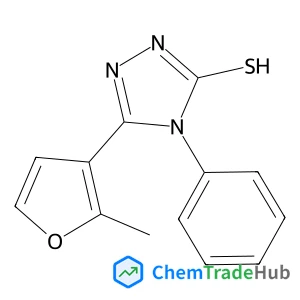
5-(2-Methyl-3-furyl)-4-phenyl-2,4-dihydro-3H-1,2,4-triazole-3-thione
CAS番号:
346464-59-3
分子式:
C13H11N3OS
おすすめサプライヤー





免責事項
このページに表示される学術雑誌情報は、参考および研究目的のみを目的としています。当社は雑誌出版社とは提携しておらず、投稿の取り扱いも行っておりません。出版に関するお問い合わせは、各雑誌出版社に直接ご連絡ください。
表示されている情報に誤りがある場合は、support@chemtradehub.com までご連絡ください。迅速に確認し、対応いたします。