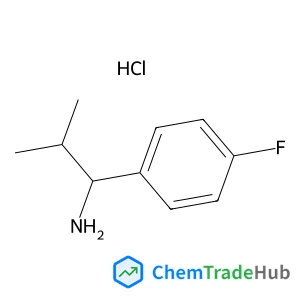
(1R)-1-(4-Fluorophenyl)-2-methyl-1-propanamine hydrochloride (1:1)
CAS番号:
1213329-40-8
分子式:
C10H15ClFN
Ricardo Flores-Cruz, Rafael López-Arteaga, Lizbeth Ramírez-Vidal, Fernando López-Casillas, Arturo Jiménez-Sánchez
Small-molecule fluorescent probes having optimized optical properties, such as high photostability and brightness, local microenvironment sensitivity and specific subcellular localizations, are increasingly available. Although the basis for designing efficient fluorophores for bioimaging applications is well established, implementing an improvement in a given photophysical characteristic always tends to compromise another optical property. This problem has enormous consequences for in vivo imaging, where ensuring a specific localization and precise control of the probe response is challenging. Herein we discuss a fluorescent probe, CC334, as a case study of the chromenylium-cyanine family that commonly exhibits highly complex photophysical schemes and highly interfered bioanalytical responses. By an exhaustive and concise analysis of the CC334 optical responses including detailed spectroscopic calibrations, steady-state microenvironment effects, ultrafast photophysics analysis and computational studies, we elucidate a new strategy to apply the probe in the singlet oxygen reactive oxygen species (1O2-ROS) monitoring using in vitro and in vivo models. The probe provides a new avenue for designing fluorescent probes to understand the dynamic behavior of subcellular environments.
S. A. F. Nastase, A. J. Logsdail
DOI: 10.1039/C8CP06736H
A-Reza Nekoei, Morteza Vatanparast
DOI: 10.1039/C8CP07003B
Itziar Zubieta, Pablo Llombart, Carlos Vega, Eva G. Noya
DOI: 10.1039/C8CP04964E
E. M. Neeman, T. R. Huet
DOI: 10.1039/C8CP04011G
Jessica Patel, Mihirsinh Chauhan, Nikita Vashistha, Mahesh Kumar, Brijesh Tripathi, Manoj Kumar Pandey
DOI: 10.1039/C8CP05518A
Po-Yu Yang, Hsing-Yin Chen, Chia-Lin Chang, Gao-Shee Leu, Che-Hsin Lin
DOI: 10.1039/C8CP02777C
Wilver A. Muriel, Rodrigo Morales-Cueto, William Rodríguez-Córdoba
DOI: 10.1039/C8CP06298F
U. P. Gawai, D. K. Gaikwad, M. R. Bodke, H. A. Khawal, K. K. Pandey, A. K. Yadav, S. N. Jha, D. Bhattacharyya, B. N. Dole
DOI: 10.1039/C8CP05267K
Sujeet Dutta, S. Krishna Prasad
DOI: 10.1039/C8CP03603A
Te-Chun Chu, Zachary J. Buras, Patrick Oßwald, Mengjie Liu, Mark Jacob Goldman, William H. Green
DOI: 10.1039/C8CP06097E
四氢-3-呋喃羧酰胺を含む廃棄物の処理は、まず安全に収集し、化学的処理または専門廃棄処理を行うことが推奨されます。高温焼却は一般的な選択肢ですが、環境保護の観点...
DIMETHYL 3-AMINO-2,5-THIOPHENEDICARBOXYLATE(CAS番号: 785803-74-9)は、GHS( Globally H...
5-フェニル-2,2'-ビピリジンは、ピリジン環とフェニル基を有する化合物から合成されます。一般的な合成方法は、4-ブロミノ苯と2,2'-ビピリジンの窒素上的ウ...
三溴甲基苯砜はCAS番号17025-47-7の化合物で、(Tribromomethyl)sulfonyl]benzeneと呼ばれています。この物質は、芳香族化合...
四氢吡喃-4,4-二甲酸二甲酯の廃棄物は、専門の廃棄処理業者に委託して安全に処理することが推奨されます。具体的には、反応性の点から常温で保存し、容器は密閉状態で...
N-叔丁氧羰基-N-甲乙二胺は、N-叔丁氧羰基アミンとプロピニルアミンのジアミン反応により合成されます。反応は無機触媒なしで行え、選択性と収率は良好です。
1,2-プロパンジオール-D6は、プロパン-1,2-ジオールをD6同位体と交換反応を行うことで合成されます。この反応は触媒を必要とし、選択性と収率が良好です。
4,4'-異プロピルジキレートは、CAS番号7418-16-8の化合物で、4,4'-(2,2-プロパネディイル)ジシクロヘキサンカーボン酸は、白色の粉末またはク...
この化合物は主に医薬品の開発に関与しており、特に抗炎症薬や神経保護剤の研究に利用されます。また、有機合成の中間体として工業製品の製造にも応用されることがあります...
ナトリウム5'-O-{ヘキシロキシ[(ヘキシロキシフォスフィニルオキシ)フィロホスフィル]アデノシン}を含む廃棄物は、適切な化学廃棄処理施設に引き渡す必要があり...

Physical Chemistry Chemical Physics (PCCP) is an international journal co-owned by 19 physical chemistry and physics societies from around the world. This journal publishes original, cutting-edge research in physical chemistry, chemical physics and biophysical chemistry. To be suitable for publication in PCCP, articles must include significant innovation and/or insight into physical chemistry; this is the most important criterion that reviewers and Editors will judge against when evaluating submissions. The journal has a broad scope and welcomes contributions spanning experiment, theory, computation and data science. Topical coverage includes spectroscopy, dynamics, kinetics, statistical mechanics, thermodynamics, electrochemistry, catalysis, surface science, quantum mechanics, quantum computing and machine learning. Interdisciplinary research areas such as polymers and soft matter, materials, nanoscience, energy, surfaces/interfaces, and biophysical chemistry are welcomed if they demonstrate significant innovation and/or insight into physical chemistry. Joined experimental/theoretical studies are particularly appreciated when complementary and based on up-to-date approaches.
![Potassium trifluoro[(2-methoxyethoxy)methyl]borate(1-) structure](https://static.chemtradehub.com/structs/910/910251-13-7-2d3a.webp "Potassium trifluoro[(2-methoxyethoxy)methyl]borate(1-) structure")