












Computational analysis of non-heme iron–oxo formation by direct NO release in nitrite reduction
文献情報
出版日
2019-02-26
DOI
10.1039/C9CP00370C
インパクトファクター
3.676
著者
Yuan-yuan Zhao, Po-Heng Lee
原文を見る
要旨
A direct NO-releasing reaction of nitrite catalyzed by [N(afaCy)3Fe(OTf)]+ (afa (azafulvene-amine); OTf (trifluoromethanesulfonate); Cy (cyclohexyl)) was investigated using density functional theory (DFT) with D3 dispersion correction. The complex featured a secondary coordination sphere that facilitated the formation of the iron–oxo product [N(afaCy)3FeO]+ with three (Fe)O⋯H–N hydrogen bonds. As a high-spin iron(II), the O-binding initial intermediate Fe(O)–nitrito was thermodynamically favorable in the S = 2 state. The cleavage of the (Fe)O–NO bond was performed by a β-electron shift to produce Fe(III)–O by electron rearrangement in the S = 5/2 state. The different electron configurations are responsible for the structural properties, the valence of iron in the complexes, and the pathways of the reactions. Moreover, the two different H-bonds, (Fe)O⋯H–N and (Fe)O–H⋯N (by O-protonation), in the product complexes played a role in determining the reaction channels by impacting the N–H bond rotation. Thus, an exothermic sequence of conversions Fe(II) → Fe(III)–O → Fe(III)–OH → Fe(III)–O was established for the targeted product formation. This process provided a clue to build two key intermediates, iron–oxo and iron–hydroxo, in a variety of biological and synthetic systems. The results of this study are in agreement with experimental observations and describe the roles of H-bonding in nitrite reduction catalyzed by the non-heme iron complex.
関連文献
Correction: Surface reaction kinetics of the methanol synthesis and the water gas shift reaction on Cu/ZnO/Al2O3
Bruno Lacerda de Oliveira Campos, Karla Herrera Delgado, Stefan Wild, Stephan Pitter, Jörg Sauer
2021-07-15
Correction
DOI: 10.1039/D1RE90031E
A review on photobioreactor design and modelling for microalgae production
Jack Legrand, Arnaud Artu, Jérémy Pruvost
2021-04-20
Review Article
DOI: 10.1039/D0RE00450B
UO2F2 particulate formation in an impinging jet gas reactor
Joshua A. Hubbard, Meng-Dawn Cheng, Lawrence Cheung, Jared R. Kirsch, Jason M. Richards, Glenn A. Fugate
2021-06-14
Paper
DOI: 10.1039/D1RE00105A
Rxn Rover: automation of chemical reactions with user-friendly, modular software
Long Qi
2021-11-29
Paper
DOI: 10.1039/D1RE00265A
Surface engineering of a Cu-based heterogeneous catalyst for efficient azide–alkyne click cycloaddition
Gianvito Vilé, Jiaxu Liu, Zhenmei Zhang
2021-07-06
Paper
DOI: 10.1039/D1RE00199J
Investigation of the effect of microflow reactor diameter on condensation reactions in l-proline-immobilized polymer monoliths
Seiya Nonaka, Hikaru Matsumoto, Masanori Nagao, Yu Hoshino, Yoshiko Miura
2021-11-23
Communication
DOI: 10.1039/D1RE00386K
Antimicrobial polysiloxane polymers and coatings containing pendant levofloxacin
Alex Kugel, Scott Ebert, Michael Jepperson, Laura Jarabek, Shane Stafslien
2010-01-28
Paper
DOI: 10.1039/B9PY00309F
Regeneration of pristine HZSM-5 extrudates during the production of deeply deoxygenated bio-oil from ex situ catalytic fast pyrolysis of biomass in a bench-scale fluidised-bed reactor
Nuttapan Promsampao, Nuwong Chollacoop, Adisak Pattiya
2021-11-24
Paper
DOI: 10.1039/D1RE00347J
こちらもおすすめ
化合物よくある質問
N,N-二乙基-4-ブロモナフサルレン-1-カルボニルアミドはどのように合成されますか?
N,N-二乙基-4-ブロモナフサルレン-1-カルボニルアミドは、4-ブロモナフサルビンとN,N-ジエチルアミド基を有する反応物を用いて合成されます。触媒の使用は...
1199773-48-24-bromo-N,N-diethyl-...
化合物よくある質問
大黄酚-8-O-葡萄糖苷の市場動向や研究トレンドはどうですか?
大黄酚-8-O-葡萄糖苷の市場は、医薬品、機能食品、研究化学物質としての需要が高まっています。特に、その抗炎症作用や抗ウイルス作用に関する研究が増えています。価...
13241-28-68-Hydroxy-6-methyl-9...
化合物よくある質問
アトラキュリウム不純物5塩酸塩の物理化学的性質は何ですか?
アトラキュリウム不純物5塩酸塩のCAS番号は2048273-58-9です。この化合物は結晶性であり、分子量は約435.4 g/molです。水に溶けやすく、反応性...
2048273-58-9Atracurium Impurity ...
化合物よくある質問
2-イソブチルシクロヘキサン酮とは何ですか?
2-イソブチルシクロヘキサン酮は、CAS番号39207-65-3の化合物で、化学式はC11H20Oです。この化合物は、有機合成化学において重要な原料として使用さ...
39207-65-32-Isobutyrylcyclohex...
化合物よくある質問
2-溴-6-甲基烟酸を取り扱う際の実験室安全事項は何ですか?
この化合物は毒性と刺激性があります。密閉されたドラフトチャンバー内で処理し、PPE(ゴーグル、手袋)を使用してください。漏洩時は即座に通気し、適切な漏洩処理材を...
1060810-09-42-bromo-6-methylpyri...
化合物よくある質問
6-アミノニコニタルデオキシド塩化水和物の物理化学的性質は何ですか?
6-アミノニコニタルデオキシド塩化水和物のCAS番号は1588441-31-9です。この化合物は結晶性粉末で、分子量は220.63 g/molです。水に溶けやす...
1588441-31-96-Aminonicotinaldehy...
化合物よくある質問
塩酸中毒藜碱はどのように合成されますか?
塩酸中毒藜碱は、ピペリジンとピリジンの反応により合成されます。具体的には、ピペリジンとピリジンを反応させ、塩基触媒を使用してピペリジン環内 enters 3-ピ...
15251-47-52-(3-PYRIDINYL)PIPER...
化合物よくある質問
Methyl 4-(6-formyl-2-pyridinyl)benzoateに適用される法規ガイドラインは何ですか?
この化合物はCAS番号834884-81-0で、GHS分類では高毒性の危険性を持つと見なされます。REACH規則では登録が求められ、FDA/EPAでは環境、健康...
834884-81-0Methyl 4-(6-formyl-2...
化合物よくある質問
1-エチynyル-3-(三氟甲氧基)ベンゼンについて「に適用される法規ガイドラインは何ですか」
CAS番号 866683-57-0の1-エチynyル-3-(三氟甲氧基)ベンゼンは、GHS分類では易燃性化学品が該当し、REACH規則では特定の危険性を評価する...
866683-57-01-Ethynyl-3-(trifluo...
化合物よくある質問
メチル2-ブロモイソニコネートの代替品はありますか?
メチル2-ブロモイソニコネートの代替品には、メチルイソニコネートや他のブロモ化合物が含まれます。これらの代替物は、特定の用途に応じて選択されます。
26156-48-9Methyl 2-bromoisonic...
掲載誌
Physical Chemistry Chemical Physics

CiteScore:
5.5
自己引用率:
10.3%
年間論文数:
3036
Physical Chemistry Chemical Physics (PCCP) is an international journal co-owned by 19 physical chemistry and physics societies from around the world. This journal publishes original, cutting-edge research in physical chemistry, chemical physics and biophysical chemistry. To be suitable for publication in PCCP, articles must include significant innovation and/or insight into physical chemistry; this is the most important criterion that reviewers and Editors will judge against when evaluating submissions. The journal has a broad scope and welcomes contributions spanning experiment, theory, computation and data science. Topical coverage includes spectroscopy, dynamics, kinetics, statistical mechanics, thermodynamics, electrochemistry, catalysis, surface science, quantum mechanics, quantum computing and machine learning. Interdisciplinary research areas such as polymers and soft matter, materials, nanoscience, energy, surfaces/interfaces, and biophysical chemistry are welcomed if they demonstrate significant innovation and/or insight into physical chemistry. Joined experimental/theoretical studies are particularly appreciated when complementary and based on up-to-date approaches.
おすすめ化合物
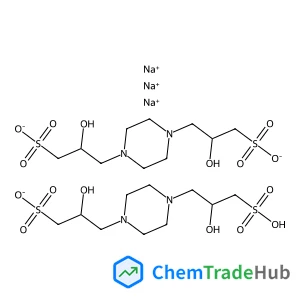
3,3'-(Piperazine-1,4-diyl)bis(2-hydroxypropane-1-sulfonic acid) Sodium Salt
CAS番号:
108321-08-0
分子式:
C20H41N4Na3O16S4
![5-(2-Phenylpyrazolo[1,5-a]pyridin-3-yl)-2H-pyrazolo[3,4-c]pyridazin-3-amine structure](https://static.chemtradehub.com/structs/865/865362-74-9-0091.webp "5-(2-Phenylpyrazolo[1,5-a]pyridin-3-yl)-2H-pyrazolo[3,4-c]pyridazin-3-amine structure")
おすすめサプライヤー






免責事項
このページに表示される学術雑誌情報は、参考および研究目的のみを目的としています。当社は雑誌出版社とは提携しておらず、投稿の取り扱いも行っておりません。出版に関するお問い合わせは、各雑誌出版社に直接ご連絡ください。
表示されている情報に誤りがある場合は、support@chemtradehub.com までご連絡ください。迅速に確認し、対応いたします。