












![Imidazo[1,2-c]pyrimidine structure](https://static.chemtradehub.com/structs/274/274-78-2-8b4c.webp "Imidazo[1,2-c]pyrimidine structure")
Full-color emissive carbon-dots targeting cell walls of onion for in situ imaging of heavy metal pollution
文献情報
出版日
2019-04-27
DOI
10.1039/C9AN00418A
インパクトファクター
4.616
著者
Zheng Yao, Zhiqiang Lai, Chengchi Chen, Suting Xiao, Peihui Yang
原文を見る
要旨
Plant cell walls (CWs) with complex macromolecular structures can surround and protect cells from a variety of harsh environmental conditions such as pathogens, herbivores, and trace metals. Here, a novel strategy for in situ imaging of plant cell walls was developed to evaluate heavy metal pollution via thiolated full-color emissive carbon-dots (F-CDs) targeting Pb(II)-adsorbed onion cell walls. The thiolated F-CDs with excellent optical properties from red light to blue light were synthesized through a facile electrochemical approach using new precursors of luminol and L-tryptophan and further modified with L-cysteine. Based on a strong covalent interaction of Pb(II) and thiolated F-CDs, we achieved in situ fluorescence imaging for the Pb(II) adsorbed on CWs, which showed enhanced red, blue and green multi-color fluorescence (FL) on CWs with increased Pb(II)-ion content. In contrast, multi-color fluorescence on cytoplasm diminished, attributed to F-CDs targeting and accumulating on the cytoskeleton which thus limited F-CD diffusion into protoplasm. Therefore, in situ fluorescent images for CWs can demonstrate heavy metal contamination degrees in plant cells. This facile and undamaging protocol will be beneficial for investigating heavy metal migration into the protoplast and fast evaluation of food quality and safety.
関連文献
One-pot access to 11-methyl-6H-indolo[2,3-b]quinolines via iodine-mediated annulation of indoles with 2-vinylanilines and evaluation of their biological activities
Jinglan Yan, Zeguo Fang, Jianglong Su, Qun He, Nawaf Al-Maharik, Qian Zhang, Yanhong Wei, Dong Li
2023-10-30
Research Article
DOI: 10.1039/D3QO01319G
Visualizing and characterizing excited states from time-dependent density functional theory
2023-12-12
Perspective
DOI: 10.1039/D3CP04226J
A halogen bonding molecular tweezer
Christoph J. Vonnemann, David Bulfield, Elric Engelage, Stefan M. Huber
2023-10-26
Research Article
DOI: 10.1039/D3QO01593A
Photoredox-catalyzed difunctionalization of alkenes with oxime esters and NH-sulfoximines
Hao-Cong Li, Guan-Nan Li, Hao-Sen Wang, Xiao-Lan Chen, Bing Yu
2023-11-21
Research Article
DOI: 10.1039/D3QO01575K
Unexpected reduction in thermal conductivity observed in graphene/h-BN heterostructures
Zhang Wu, Rumeng Liu, Ning Wei, Lifeng Wang
2023-12-23
Paper
DOI: 10.1039/D3CP05407A
NO-induced adaptive antiaromaticity in cyclobutadiene
Qianqian Deng, Sajid Imran, Jun Yan, Jun Zhu
2023-10-23
Research Article
DOI: 10.1039/D3QO01498C
Nitrogen adsorption on Nb2C6H4+ cations: the important role of benzyne (ortho-C6H4)
Feng-Xiang Zhang, Yi-Heng Zhang, Ming Wang, Jia-Bi Ma
2024-01-04
Paper
DOI: 10.1039/D3CP05524H
Control of excitation selectivity in pulse EPR on spin-correlated radical pairs with shaped pulses
Daniele Panariti, Sarah M. Conron, Jinyuan Zhang, Michael R. Wasielewski, Marilena Di Valentin, Claudia E. Tait
2023-12-26
Paper
DOI: 10.1039/D3CP06009H
Oxidation of a triple carbo[5]helicene with hypervalent iodine
Florian Rigoulet, Albert Artigas, Nawal Ferdi, Michel Giorgi, Yoann Coquerel
2023-10-12
Research Article
DOI: 10.1039/D3QO01439H
こちらもおすすめ
化合物よくある質問
3-イチチルビフェニルはどのように合成されますか?
3-イチチルビフェニルは、ビフェニルとイチプロピオニトリルを回収率約90%で反応させて合成されます。触媒は通常、亜リチウムホウ素を用います。
5668-93-93-Ethylbiphenyl
化合物よくある質問
8-溴-5-三氟甲基喹啉はどのように合成されますか?
8-溴-5-三氟甲基喹啉は、5-トリフルオロメチル-2-メチル-1,3-ベンゼンジオールをブロモエタノールと反応させて生成します。この反応は塩基性条件下で行われ...
917251-92-48-Bromo-5-(trifluoro...
化合物よくある質問
ジメチル4-(4,4,5,5-テトラメチル-1,3,2-ドioxaborolan-2-基)-2,6-ピリジンジカルボイル酸フェニルアミニドの代替品はありますか?
ジメチル4-(4,4,5,5-テトラメチル-1,3,2-ドioxaborolan-2-基)-2,6-ピリジンジカルボイル酸フェニルアミニドの代替品としては、4-...
741709-66-0Dimethyl 4-(4,4,5,5-...
化合物よくある質問
N-(3,5-ヘキサクロロ-4-ピリドインイル)-8-メチオキシ-5-キノリンカーボン酸の市場動向や研究トレンドはどのようなものでしょうか?
N-(3,5-ヘキサクロロ-4-ピリドインイル)-8-メチオキシ-5-キノリンカーボン酸の市場動向は、主に産業用途での需要により影響を受けます。研究トレンドとし...
199871-63-1N-(3,5-Dichloro-4-py...
化合物よくある質問
イソステアロイルグリセリルは安全ですか?
イソステアロイルグリセリルは一般的に安全性が高いとされていますが、過度な使用や個人差により皮�owsん炎などの反応が起こる可能性があります。使用前に医師に相談す...
222723-55-92-[(5Z,8Z,11Z,14Z)-5...
化合物よくある質問
1-(二苯甲基)-3,3-二氟-氮杂环丁烷の市場動向や研究トレンドはどうですか?
1-(二苯甲基)-3,3-二氟-氮杂环丁烷の市場動向は、医薬品や合成化学の研究分野で注目を集めています。新興研究は、該当化合物の合成改良と生体内での作用メカニズ...
288315-02-61-Benzhydryl-3,3-dif...
化合物よくある質問
3-チオフェンスチオールの物理化学的性質は何ですか?
3-チオフェンスチオールのCAS番号は7774-73-4です。結晶性の白色粉末で、分子量は122.17です。この化合物は水に微溶解し、エタノールやジクロロメタン...
7774-73-43-Thiophenethiol
化合物よくある質問
2-Methyl-2-propanyl (2S)-2-(aminomethyl)-1-piperidinecarboxylateは安全ですか?
2-Methyl-2-propanyl (2S)-2-(aminomethyl)-1-piperidinecarboxylateは一定の安全性基準を満たしていま...
475105-35-22-Methyl-2-propanyl ...
化合物よくある質問
CAS番号1316822-90-8の化合物は安全ですか?
CAS番号1316822-90-8の化合物は安全性に関しては評価が不足していますが、一般的には生物学的に活性な物質であり、取り扱いには適切な安全防護措置が必要で...
1316822-90-8Gal beta(1-3)[Neu5Ac...
化合物よくある質問
Tert-butyl 2-(2-羟基乙基)哌嗪-1-羧酸はどのように保存すればよいですか?
Tert-butyl 2-(2-羟基乙基)哌嗪-1-羧酸は、冷暗所で保存し、直射日光から遠ざけてください。容器は密閉し、高湿度や高温を避けて保管してください。
517866-79-4Tert-butyl 2-(2-hydr...
掲載誌
Analyst

CiteScore:
7.8
自己引用率:
5.6%
年間論文数:
653
Analyst publishes analytical and bioanalytical research that reports premier fundamental discoveries and inventions, and the applications of those discoveries, unconfined by traditional discipline barriers.
おすすめ化合物
![2-[(5Z,8Z,11Z,14Z)-5,8,11,14-Icosatetraen-1-yloxy]-1,3-propanediol structure](https://static.chemtradehub.com/structs/222/222723-55-9-0348.webp "2-[(5Z,8Z,11Z,14Z)-5,8,11,14-Icosatetraen-1-yloxy]-1,3-propanediol structure")
![2,4-Dichloro-6-isopropyl-5H-pyrrolo[3,4-d]pyrimidin-7(6H)-one structure](https://static.chemtradehub.com/structs/107/1079649-94-7-ad4a.webp "2,4-Dichloro-6-isopropyl-5H-pyrrolo[3,4-d]pyrimidin-7(6H)-one structure")
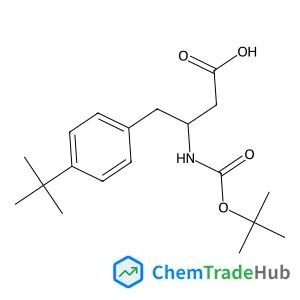
(S)-3-((tert-Butoxycarbonyl)amino)-4-(4-(tert-butyl)phenyl)butanoic acid
CAS番号:
403661-85-8
分子式:
C19H29NO4
おすすめサプライヤー



免責事項
このページに表示される学術雑誌情報は、参考および研究目的のみを目的としています。当社は雑誌出版社とは提携しておらず、投稿の取り扱いも行っておりません。出版に関するお問い合わせは、各雑誌出版社に直接ご連絡ください。
表示されている情報に誤りがある場合は、support@chemtradehub.com までご連絡ください。迅速に確認し、対応いたします。