











Multiplexing cytokine analysis: towards reducing sample volume needs in clinical diagnostics
文献情報
出版日
2019-04-18
DOI
10.1039/C9AN00297A
インパクトファクター
4.616
著者
Daniel Scott, Smita Joel
原文を見る
要旨
The trend for improved more precise diagnostics and management of disease heavily relies on the measurement of panels of biomarkers in physiological samples of patients. Ideally, the ultimate goal would be to detect as many clinically relevant biomarkers as possible in a single drop of blood, achieving quick, sensitive, reproducible, and affordable detection in small volume physiological samples. Bioluminescent (BL) proteins provide many of the desired characteristics required for such labels, including detection at extremely low concentrations, no interference from physiological fluids leading to excellent detection limits, and compatibility with many miniaturized systems. However, to date the use of BL proteins has been restricted by their limited multiplexing capabilities. BL proteins typically exhibit a single emission profile and decay kinetics making the simultaneous detection of multiple analytes difficult. Recent progresses in this area include the use of two different engineered luminescent proteins to achieve resolved signals via one-dimensional time resolution. This approach, however, to date only lead to a dual analyte detection. Herein, we have demonstrated that using a two-dimensional approach that combines both temporal and spatial resolution, we can expand the multiplexing capabilities of bioluminescent proteins. To that end, the photoprotein aequorin (AEQ) has been employed for the simultaneous detection of three separate analytes in a single well, differentiated through the use of three discrete time/wavelength windows. Through a combination of site-specific mutations and synthetic coelenterazines “semi-synthetic” AEQ variants have been developed with altered emission profiles and decay kinetics. In this study, two AEQ mutant proteins were genetically conjugated to three pro-inflammatory cytokines (tumor necrosis factor alpha, interleukins 6 and 8) resulting in AEQ-labeled cytokines. These fusion proteins were combined with synthetic coelenterazines resulting in proteins with differing emission maxima and half-lives to allow for the simultaneous detection of all three cytokines in a single sample. The validity of the assay was demonstrated in serum by employing human physiological samples and comparing our results with commercially available individual tests for each of the three cytokines.
関連文献
Classically forbidden nonadiabatic transitions in multidimensional chemical dynamics
I-Yun Hsiao, Yoshiaki Teranishi, Hiroki Nakamura
2024-01-10
Communication
DOI: 10.1039/D3CP04794F
Stereoselective synthesis of Δ(1)-pyrroline sulfonamides via a chiral aldehyde mediated cascade reaction
Wei Wen, Zhao-Pin Ai, Zhu-Lian Wu, Tian Cai, Qi-Xiang Guo
2023-11-15
Research Article
DOI: 10.1039/D3QO01675G
Photoinduced C–H heteroarylation of enamines via quadruple cleavage of CF2Br2
Lingling Zuo, Xiao Geng, Zhifang Li
2023-10-20
Research Article
DOI: 10.1039/D3QO01474F
BX3-mediated borylation for the synthesis of organoboron compounds
2023-10-19
Review Article
DOI: 10.1039/D3QO01487H
Enantioselective construction of quaternary stereocenters via organocatalytic arylation of isoxazolin-5-ones with o-quinone diimides
Ricardo Torán, Eduardo Portillo, Amparo Sanz-Marco, Carlos Vila, Gonzalo Blay
2023-10-24
Research Article
DOI: 10.1039/D3QO01600E
Rapid modular synthesis of indole ethers via dehydrogenative cross-coupling reaction of indoles and alcohols
Mao-Gui Huang, Xiao-Hong Chen, Hai-Bing Xu, Yue-Jin Liu
2023-11-14
Research Article
DOI: 10.1039/D3QO01501G
Correction: Blue-light induced iron-catalyzed chemoselective α-alkylation and α-olefination of arylacetonitriles with alcohols
Dingguo Song, Shiliang Wang, Weiwei Huang, Rong Chen, Fangyuan Hu, Lingxin Cheng, Xianghua Zhao, Fei Ling, Weihui Zhong
2023-11-22
Correction
DOI: 10.1039/D3QO90094K
こちらもおすすめ
化合物よくある質問
3-イチチルビフェニルはどのように合成されますか?
3-イチチルビフェニルは、ビフェニルとイチプロピオニトリルを回収率約90%で反応させて合成されます。触媒は通常、亜リチウムホウ素を用います。
5668-93-93-Ethylbiphenyl
化合物よくある質問
8-溴-5-三氟甲基喹啉はどのように合成されますか?
8-溴-5-三氟甲基喹啉は、5-トリフルオロメチル-2-メチル-1,3-ベンゼンジオールをブロモエタノールと反応させて生成します。この反応は塩基性条件下で行われ...
917251-92-48-Bromo-5-(trifluoro...
化合物よくある質問
ジメチル4-(4,4,5,5-テトラメチル-1,3,2-ドioxaborolan-2-基)-2,6-ピリジンジカルボイル酸フェニルアミニドの代替品はありますか?
ジメチル4-(4,4,5,5-テトラメチル-1,3,2-ドioxaborolan-2-基)-2,6-ピリジンジカルボイル酸フェニルアミニドの代替品としては、4-...
741709-66-0Dimethyl 4-(4,4,5,5-...
化合物よくある質問
N-(3,5-ヘキサクロロ-4-ピリドインイル)-8-メチオキシ-5-キノリンカーボン酸の市場動向や研究トレンドはどのようなものでしょうか?
N-(3,5-ヘキサクロロ-4-ピリドインイル)-8-メチオキシ-5-キノリンカーボン酸の市場動向は、主に産業用途での需要により影響を受けます。研究トレンドとし...
199871-63-1N-(3,5-Dichloro-4-py...
化合物よくある質問
イソステアロイルグリセリルは安全ですか?
イソステアロイルグリセリルは一般的に安全性が高いとされていますが、過度な使用や個人差により皮�owsん炎などの反応が起こる可能性があります。使用前に医師に相談す...
222723-55-92-[(5Z,8Z,11Z,14Z)-5...
化合物よくある質問
1-(二苯甲基)-3,3-二氟-氮杂环丁烷の市場動向や研究トレンドはどうですか?
1-(二苯甲基)-3,3-二氟-氮杂环丁烷の市場動向は、医薬品や合成化学の研究分野で注目を集めています。新興研究は、該当化合物の合成改良と生体内での作用メカニズ...
288315-02-61-Benzhydryl-3,3-dif...
化合物よくある質問
3-チオフェンスチオールの物理化学的性質は何ですか?
3-チオフェンスチオールのCAS番号は7774-73-4です。結晶性の白色粉末で、分子量は122.17です。この化合物は水に微溶解し、エタノールやジクロロメタン...
7774-73-43-Thiophenethiol
化合物よくある質問
2-Methyl-2-propanyl (2S)-2-(aminomethyl)-1-piperidinecarboxylateは安全ですか?
2-Methyl-2-propanyl (2S)-2-(aminomethyl)-1-piperidinecarboxylateは一定の安全性基準を満たしていま...
475105-35-22-Methyl-2-propanyl ...
化合物よくある質問
CAS番号1316822-90-8の化合物は安全ですか?
CAS番号1316822-90-8の化合物は安全性に関しては評価が不足していますが、一般的には生物学的に活性な物質であり、取り扱いには適切な安全防護措置が必要で...
1316822-90-8Gal beta(1-3)[Neu5Ac...
化合物よくある質問
Tert-butyl 2-(2-羟基乙基)哌嗪-1-羧酸はどのように保存すればよいですか?
Tert-butyl 2-(2-羟基乙基)哌嗪-1-羧酸は、冷暗所で保存し、直射日光から遠ざけてください。容器は密閉し、高湿度や高温を避けて保管してください。
517866-79-4Tert-butyl 2-(2-hydr...
掲載誌
Analyst

CiteScore:
7.8
自己引用率:
5.6%
年間論文数:
653
Analyst publishes analytical and bioanalytical research that reports premier fundamental discoveries and inventions, and the applications of those discoveries, unconfined by traditional discipline barriers.
おすすめ化合物
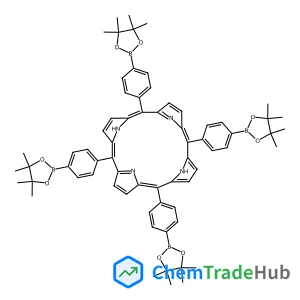
5,10,15,20-tetrakis(4-boronic acid pinacol ester phenyl) porphyrin
CAS番号:
1332748-00-1
分子式:
C68H74B4N4O8
おすすめサプライヤー




免責事項
このページに表示される学術雑誌情報は、参考および研究目的のみを目的としています。当社は雑誌出版社とは提携しておらず、投稿の取り扱いも行っておりません。出版に関するお問い合わせは、各雑誌出版社に直接ご連絡ください。
表示されている情報に誤りがある場合は、support@chemtradehub.com までご連絡ください。迅速に確認し、対応いたします。