












A tough and self-healing poly(l-glutamic acid)-based composite hydrogel for tissue engineering
文献情報
出版日
2018-09-27
DOI
10.1039/C8TB01981A
インパクトファクター
6.331
著者
Weijun Zhang, Kunxi Zhang, Shifeng Yan, Jie Wu, Jingbo Yin
原文を見る
要旨
A hydrogel with excellent mechanical properties and self-healing ability provides a promising tool for the repair of load-bearing tissues under a dynamic microenvironment. In this study, poly(L-glutamic acid) (PLGA)-based composite hydrogels with good toughness and self-healing ability were fabricated via filling soft self-healing hydrogels into a tough porous hydrogel skeleton. The PLGA-based tough porous hydrogel skeleton was treated by laser ablation to form a uniform porous structure with 85% porosity and 260 μm pore diameter, and the structure formation was reinforced by the hydrophobic assembly mechanism. The resulting hydrogel skeleton possessed good toughness (maximum compressive stress of 0.51 MPa with strain of 80%) and could fully recover after cyclic compression tests. Furthermore, PLGA-based self-healing hydrogels were fabricated based on a Schiff base reaction, followed by being composited with a tough porous hydrogel skeleton. More importantly, the composite hydrogel exhibited a homogenous interpenetrated structure that inherited mechanical strength and the self-healing ability of the two original compositions. These composite hydrogels exhibited a compressive failure stress of 0.21 MPa at a 63% strain, which was 1.3-fold higher than the value of the original porous hydrogel skeleton at 63% strain. The healing percentage gradually reached 81% within 6 h, indicating the good self-healing efficiency. Furthermore, live/dead staining images revealed that 89% of laden cells remained alive after culture for 7 days. Moreover, the composite hydrogel could self-heal even after cell encapsulation. The developed PLGA-based composite hydrogel will be a promising biomaterial for the repair of load-bearing tissues.
関連文献
Microporous polyimide networks constructed through a two-step polymerization approach, and their carbon dioxide adsorption performance
Hongyan Yao, Na Zhang, Ningning Song, Kunzhi Shen, Pengfei Huo, Shiyang Zhu, Yunhe Zhang, Shaowei Guan
2017-01-04
Paper
DOI: 10.1039/C6PY01814A
One pot synthesis of higher order quasi-block copolymer libraries via sequential RAFT polymerization in an automated synthesizer
Graeme Moad, San H. Thang
2014-05-16
Paper
DOI: 10.1039/C4PY00496E
Microwave-assisted solution polycondensation of l-lactic acid using a Dean–Stark apparatus for a non-thermal microwave polymerization effect induced by the electric field
Shinji Yamada, Akinori Takasu, Sadatsugu Takayama, Kazuhiko Kawamura
2014-05-16
Paper
DOI: 10.1039/C4PY00639A
The living anionic polymerization of activated aziridines: a systematic study of reaction conditions and kinetics
Elisabeth Rieger, Tassilo Gleede, Katja Weber, Angelika Manhart, Manfred Wagner, Frederik R. Wurm
2017-04-06
Paper
DOI: 10.1039/C7PY00436B
Janus nanoparticles inside polymeric materials: interfacial arrangement toward functional hybrid materials
Qiuyan Yang, Katja Loos
2016-11-17
Review Article
DOI: 10.1039/C6PY01795A
Synthesis of amphiphilic diblock copolymers derived from renewable dextran by nitroxide mediated polymerization: towards hierarchically structured honeycomb porous films
Senbin Chen, Marie-Hélène Alves, Maud Save, Laurent Billon
2014-05-12
Paper
DOI: 10.1039/C4PY00390J
Preparation of sulfonic acid functional proton conducting phosphazenes by covalent protection
Ferda Hacıvelioğlu
2017-04-17
Paper
DOI: 10.1039/C7PY00189D
Conformation pre-organization in fluorene-based conjugated polymer for simultaneous enhancement of luminescence and charge mobility
Juxin He, Luyang Du, Cong Wang, Mingjian Jiang, Linlin Liu, Yueqi Mo, Zengqi Xie, Bing Yang, Yuguang Ma
2017-01-11
Paper
DOI: 10.1039/C6PY01995A
“Arm-first” approach for the synthesis of star-shaped stereoregular polymers through living coordination polymerization
Zhenghai Shi, Fang Guo, Rui Tan, Hui Niu, Tingting Li, Yang Li
2017-01-31
Communication
DOI: 10.1039/C6PY02097F
In situ synthesis of thermo-responsive ABC triblock terpolymer nano-objects by seeded RAFT polymerization
Yaqing Qu, Fei Huo, Quanlong Li, Xin He, Shentong Li, Wangqing Zhang
2014-05-30
Paper
DOI: 10.1039/C4PY00510D
こちらもおすすめ
化合物よくある質問
6- bromo-1-cyclopropyl-1H-benzimidazoleの市場動向や研究トレンドはどうですか?
6- bromo-1-cyclopropyl-1H-benzimidazoleは、抗炎症、抗ウイルス作用を持つことが報告されており、新薬開発の研究対象として注目...
1416713-53-56-Bromo-1-cyclopropy...
化合物よくある質問
環氧プロpanol-d5を取り扱う際の実験室安全事項は何ですか?
取り扱う際には、防護眼鏡と手袋を使用し、ドラフトチャンバー内で操作することを推奨します。漏洩時には適切な手順で処理し、安全データシートを常に参照してください。
1246819-20-4Glycidol-d5
化合物よくある質問
2,2’-ジメチル-3,3’-ビピリジンはどのように合成されますか?
2,2’-ジメチル-3,3’-ビピリジンは、ピリジンと2-メチルアクリルアミドを有機合成反応で合成します。この反応では、ピリジンと2-メチルアクリルアミドを含有...
86156-55-02,2’-Dimethyl-3,3’-b...
化合物よくある質問
6-甲基ピリジン-2-ボリック酸の主な用途は何ですか?
6-甲基ピリジン-2-ボリック酸は、合成化学、医薬品合成、以及研究用途などに広く使用され、特に組換えDNA技術や分子生物学の研究において重要な役割を果たします。
372963-50-3(6-Methyl-2-pyridiny...
化合物よくある質問
(R)-3-(1-甲基-2-氧環己基)プロpano酸メチルは安全ですか?
(R)-3-(1-甲基-2-氧環己基)プロpano酸メチルは一定の安全性がありますが、直接的な皮膚接触や吸入は避けるべきです。使用する際は適切な個々の安全データ...
94089-47-1methyl 3-[(1R)-1-met...
化合物よくある質問
ketorolacはどのように保存すればよいですか?
ketorolacは、密封して遮光容器に保管し、直射日光や高温を避けて保存してください。温度は常温で保存し、湿度をなるべく低く保つことが推奨されます。
74103-06-3rac Ketorolac
化合物よくある質問
L-2,3-二氨基丙酸二盐酸盐を取り扱う際の実験室安全事項は何ですか?
L-2,3-二氨基丙酸二盐酸盐は腐食性が強く、皮膚や粘膜に刺激を与える可能性があります。取り扱う際は、防塵マスク、ゴーグル、手袋を使用し、適切な排気設備を使用し...
19777-68-5(S)-2,3-Diaminopropa...
化合物よくある質問
2-(4-溴ピリジン-2-基)乙腈の物理化学的性質は何ですか?
2-(4-溴ピリジン-2-基)乙腈のCAS番号は312325-73-8です。主に結晶形態で存在し、分子量は159.01 g/molです。この化合物は水に溶けやす...
312325-73-8(4-Bromo-2-pyridinyl...
化合物よくある質問
3-フローロ-[1,1-ベンジレン]-3,4-ジカルボン酸を取り扱う際の実験室安全事項は何ですか?
この化合物は毒性は低いですが、直接的な接触や吸入に注意が必要です。PPE(個人防護具)を着用し、ドラフトチャンバーを使用して操作することを推奨します。また、漏洩...
1261915-32-53'-Fluoro-[1,1'-biph...
化合物よくある質問
3-(1-氧代-1,3-二氢-2H-2-异吲哚)丙酸の主な用途は何ですか?
3-(1-氧代-1,3-二氢-2H-2-异吲哚)丙酸は、薬理学研究や医薬品製造において広く用いられる化合物です。また、工業的な用途でも一部の化学反応の触媒や助剤...
83747-30-23-(1-Oxo-1,3-dihydro...
掲載誌
Journal of Materials Chemistry B
CiteScore:
12
自己引用率:
4.9%
年間論文数:
831
Journal of Materials Chemistry A, B & C cover high quality studies across all fields of materials chemistry. The journals focus on those theoretical or experimental studies that report new understanding, applications, properties and synthesis of materials. The journals have a strong history of publishing quality reports of interest to interdisciplinary communities and providing an efficient and rigorous service through peer review and publication. The journals are led by an international team of Editors-in-Chief and Associate Editors who are all active researchers in their fields. Journal of Materials Chemistry A, B & C are separated by the intended application of the material studied. Broadly, applications in energy and sustainability are of interest to Journal of Materials Chemistry A, applications in biology and medicine are of interest to Journal of Materials Chemistry B, and applications in optical, magnetic and electronic devices are of interest to Journal of Materials Chemistry C. More than one Journal of Materials Chemistry journal may be suitable for certain fields and researchers are encouraged to submit their paper to the journal that they feel best fits for their particular article. Example topic areas within the scope of Journal of Materials Chemistry B are listed below. This list is neither exhaustive nor exclusive. Antifouling coatings Biocompatible materials Bioelectronics Bioimaging Biomimetics Biomineralisation Bionics Biosensors Diagnostics Drug delivery Gene delivery Immunobiology Nanomedicine Regenerative medicine & Tissue engineering Scaffolds Soft robotics Stem cells Therapeutic devices image block All articles published in Journal of Materials Chemistry B from 2019 onwards will be indexed in MEDLINE®. Articles that primarily focus on providing insight into the underlying science and performance of biomaterials within a biological environment are more suited to our companion journal, Biomaterials Science.
おすすめ化合物
![2-{[(1R,2S)-2-Aminocyclohexyl]amino}-4-{[3-(2H-1,2,3-triazol-2-yl)phenyl]amino}-5-pyrimidinecarboxamide structure](https://static.chemtradehub.com/structs/137/1370261-96-3-40df.webp "2-{[(1R,2S)-2-Aminocyclohexyl]amino}-4-{[3-(2H-1,2,3-triazol-2-yl)phenyl]amino}-5-pyrimidinecarboxamide structure")
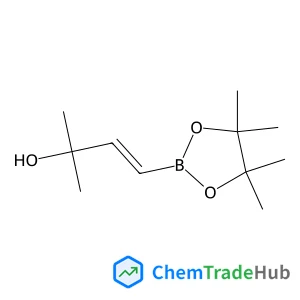
(E)-2-methyl-4-(4,4,5,5-tetramethyl-1,3,2-dioxaborolan-2-yl)but-3-en-2-ol
CAS番号:
581802-26-8
分子式:
C11H21BO3
おすすめサプライヤー





免責事項
このページに表示される学術雑誌情報は、参考および研究目的のみを目的としています。当社は雑誌出版社とは提携しておらず、投稿の取り扱いも行っておりません。出版に関するお問い合わせは、各雑誌出版社に直接ご連絡ください。
表示されている情報に誤りがある場合は、support@chemtradehub.com までご連絡ください。迅速に確認し、対応いたします。