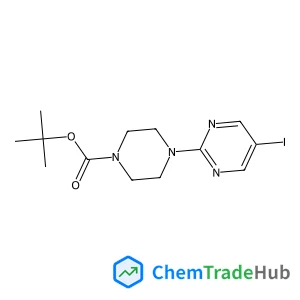
2-Methyl-2-propanyl 4-(5-iodo-2-pyrimidinyl)-1-piperazinecarboxylate
CAS番号:
1027616-32-5
分子式:
C13H19IN4O2
Lester Martínez, Mónica Benito, Lluís Soler, Elies Molins, Jordi Llorca
High surface area titania lyogels have been prepared, thermally transformed into TiO2 polymorphs at 400–850 °C, and decorated by ball milling with preformed Au nanoparticles of ca. 2 nm to ensure the same contact points at the metal–support interphase. The best performance in the photogeneration of hydrogen from gaseous water–ethanol under dynamic conditions in a fixed bed reactor has been obtained with the lyogel calcined at 550 °C, with a hydrogen photoproduction rate of 19.8 mmol H2 g−1 h−1 under an irradiance of 80 mW cm−2 and GHSV = 26 000 h−1. This photocatalyst contains 84% anatase and 16% rutile polymorphs, very similar to the standard P25. A series of photocatalysts prepared by lyophilization of a mixture of the titania gel and the preformed Au nanoparticles and calcination under the same conditions has resulted in samples with Au nanoparticles up to 18 nm strongly interacting with TiO2. The presence of Au nanoparticles in the composite lyogel has strongly retarded the transformation of anatase into rutile. The results have shown that the TiO2 polymorph has a greater influence than the Au nanoparticle size on the photoproduction of hydrogen.
Jamie D. Young, Michael Staniforth, Martin J. Paterson, Gareth M. Roberts, Vasilios G. Stavros
DOI: 10.1039/C3CP53726A
Guang Shao, Huijuan Yu, Na Zhang, Yanjian He, Kejun Feng, Xin Yang, Rihui Cao, Menglian Gong
DOI: 10.1039/C3CP53871K
Jingtao Wang, Minghui Zhang, Jin Zhai, Lei Jiang
DOI: 10.1039/C3CP51712H
Daniel Stone, Laura Daubney
DOI: 10.1039/C3CP52466C
Lai-Hung Lai, Maria A. Loi
DOI: 10.1039/C3CP54145B
Xi Zhang, Chang Q. Sun, Hajime Hirao
DOI: 10.1039/C3CP52149D
Gal Wittenberg, William Sheffler, Dana Darchi, David Baker
DOI: 10.1039/C3CP53264J
DOI: 10.1039/C3CP53590H
Wenguang Fan, Simon Jewell, Yiyi She, Michael K. H. Leung
DOI: 10.1039/C3CP54098G
Mitsuhiko Miyazaki, Akihiro Takeda, Matthias Schmies, Makoto Sakai, Kentaro Misawa, Shun-ichi Ishiuchi, François Michels, Klaus Müller-Dethlefs, Otto Dopfer, Masaaki Fujii
DOI: 10.1039/C3CP53533A
カルボニル基が付いた5-氰基-1-{[(2-メチル-2-プロpanyl)オキシ]カーボンイル}1H-吲哚-2-イリド-2-ボリン酸は、直射日光を避けて室温(15...
この化合物は合成化学分野において、特にピリジン化合物の合成や改良に用いられます。最近の研究では、ピリジン化合物の新規合成法や特性の改良が注目されています。市場動...
聚二季戊四醇六丙烯酸酯は、医薬品、ポリマー、センサー、半導体などの業界で広く使用されています。特にポリマー業界では硬化剤として、医薬分野では医療機器の製造に使用...
1-氯-5-硝基异喹啉は、薬理学や合成化学の研究分野で注目されています。市場動向としては、その生物学的な活性や合成可能性を評価する研究が増えています。また、代替...
2-チロール-5-メチルスルフェニル-3-trifルオルメチルベンゼンは、トリフルオロメチル化反応と硫化反応を経て合成されます。通常、トリフルオロメチル化剤と硫...
p-トールイルマグネシウムブロミドのCAS番号は4294-57-9です。この化合物は白色の結晶性粉末で、分子量は204.32です。溶剤中で良好に溶解しますが、水...
1-(5-甲基-2-硫化素基)プロパン-1-酮の市場動向は、化学産業全体の需要に影響を受けますが、最近では pharmaceutical 分野での応用が注目され...
十一碳烯酰甘氨酸は吸入や皮膚から吸収されることがあり、取り扱う際には防塵マスクと手袋を使用してください。ドラフトチャンバーを用いて漏洩を処理し、適切なSDS(S...
この化合物は吸入や皮膚吸収による毒性があるため、防塵マスク、ゴーグル、防護手袋を使用する必要があります。ドラフトチャンバーでの操作が必要です。漏洩時には即座に換...
安全性は化合物の使用方法によります。直接的な毒性は報告されていませんが、吸入や皮膚接触には注意が必要です。適切な防護服を着用し、換気を図ることを推奨します。