












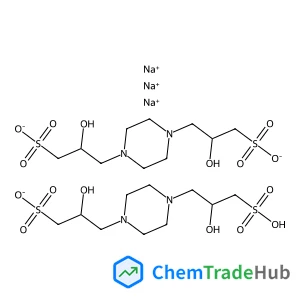
3,3'-(Piperazine-1,4-diyl)bis(2-hydroxypropane-1-sulfonic acid) Sodium Salt
CAS番号:
108321-08-0
分子式:
C20H41N4Na3O16S4
Katarzyna Szymańska, Zofia Hrydziuszko, Jolanta Bryjak
Kinetic resolution of a non-equimolar mixture of optical isomers may be a problem, and no study on the very fast, high-yield continuous-flow resolution process has been reported. In this paper, we demonstrate the exceptional performance of the microstructured monolithic reactor in the continuous kinetic resolution of the non-equimolar mixture (S : R = 85 : 15) of the secondary allylic alcohol (+)-1-[(1S,5R)-6,6-dimethylbicyclo[3.1.0]hex-2-en-2-yl]ethanol using Pseudomonas cepacia lipase (PCL) as the biocatalyst. The siliceous rods (6 × 40 mm), which were synthesized by the sol–gel method combined with phase separation and were applied as microreactors, featured a very open 3D tortuous pore structure with flow-through channels 20–30 μm dia. and mesopores of 20 nm (4 cm3 g−1 total pore volume, surface area 285 m2 g−1). After hydrophobization with hexadecyl groups, a 7.25 mg enzyme was attached by adsorption to a single monolith (0.25 g). The continuous-flow experiments showed that high substrate conversions can be obtained even for residence times (τ) that are less than 2 min, to give remarkable space-time yield values of approximately 100 g h−1 L−1. For the flow rate of 0.45 mL min−1 (τ = 2.14 min), the targeted substrate was fully transformed (de > 99%) to the corresponding ester. Stability of the system was confirmed during the 10 day continuous operation. A comparative study with a batch slurry system, using the same lipase immobilized on the silica gel powder, proved the vast superiority of the developed system.
Matthijs R. Panman, Arthur C. Newton, Jannie Vos, Bart van den Bosch, Vladica Bocokić, Joost N. H. Reek, Sander Woutersen
DOI: 10.1039/C2CP43565A
Hee-Kook Kang, Seong-Rae Lee, Won Il Cho, Byung Won Cho
DOI: 10.1039/C2CP42824E
Sofie Van Damme, Patrick Bultinck, Venkatesan Subramanian
DOI: 10.1039/C2CP42038D
Tian-You Cheng, Hui-Hsien Wang, Sheng Hsiung Chang, Jen-You Chu, Juen-Haw Lee
DOI: 10.1039/C3CP43270J
Gareth P. Stevenson, Ruth E. Baker, Gareth F. Kennedy, Alan M. Bond, David J. Gavaghan, Kathryn Gillow
DOI: 10.1039/C2CP43193A
Sergio Díaz-Tendero, Manuel Alcamí
DOI: 10.1039/C2CP42542D
Bjørn Kvamme, Tatiana Kuznetsova, Pilvi-Helina Kivelæ, Jordan Bauman
DOI: 10.1039/C2CP43061D
Kawon Oum, Peter W. Lohse, Johannes R. Klein, Oliver Flender, Mirko Scholz, Anders Hagfeldt, Gerrit Boschloo, Thomas Lenzer
DOI: 10.1039/C3CP44095H
Yan-Feng Zhu, Juan Zhang, Lu Xu, Ya Guo, Xiao-Ping Wang, Rong-Gui Du, Chang-Jian Lin
DOI: 10.1039/C3CP43572E
Sergey Yakovlev, Kenneth H. Downing
DOI: 10.1039/C2CP42969A
間 brom 苯甲酰腈は、合成化学や薬物化学において重要な Intermediate として使用されています。市場動向としては、その合成性と機能性により、研究開...
CAS番号117324-58-0の塩酸メチル2アミノ-5-トリフルオロメチルベンゼートは、GHS分類により腐食性物質と判定されます。REACH規則では、製造、販...
毒性があるため、適切な安全対策が必須です。皮膚や粘膜への刺激性が強く、吸入や誤飲により健康被害を引き起こす可能性があります。取扱時にはガスマスクや手袋、眼鏡を使...
三氟甲基ピリジン-2-甲アミン塩酸塩は安全性に注意が必要です。毒性は低レベルですが、直接的接触や吸入は避けるべきです。適切な手袋や防塵マスクを着用し、密閉された...
1-エチル-4-(4-硝基フェニル)ピペリジンは有毒であり、取扱には注意が必要です。保管や作業中に手袋を着用し、目や皮膚に接触しないように注意する必要があります...
1,1-ジメトキシプロパン-2-オンは一般的に低毒性ですが、皮膚や目への刺激性があるため、取扱いには注意が必要です。蒸気や液体の吸入には有害な可能性があり、適切...
この化合物はCAS番号259259-80-8に対応しています。GHS分類では、毒性、燃焼性、反応性、炎症性を考慮に入れ、適切な危険性分類が行われます。REACH...
この化合物は、冷却庫で-20℃の温度、乾燥した容器に保管し、直日光から保護する必要があります。湿度の高い環境や高温は避けてください。

Reaction Chemistry & Engineering is an interdisciplinary journal reporting cutting-edge research focused on enhancing the understanding and efficiency of reactions. Reaction engineering leverages the interface where fundamental molecular chemistry meets chemical engineering and technology. Challenges in chemistry can be overcome by the application of new technologies, while engineers may find improved solutions for process development from the latest developments in reaction chemistry. Reaction Chemistry & Engineering is a unique forum for researchers whose interests span the broad areas of chemical engineering and chemical sciences to come together in solving problems of importance to wider society. All papers should be written to be approachable by readers across the engineering and chemical sciences. Papers that consider multiple scales, from the laboratory up to and including plant scale, are particularly encouraged.
![O-Benzyl-N-[(9H-fluoren-9-ylmethoxy)carbonyl]-N-methyl-L-threonine structure](https://static.chemtradehub.com/structs/198/198561-81-8-a56e.webp "O-Benzyl-N-[(9H-fluoren-9-ylmethoxy)carbonyl]-N-methyl-L-threonine structure")





