












Sterically very bulky aliphatic/aromatic phosphine-sulfonate palladium catalysts for ethylene polymerization and copolymerization with polar monomers
文献情報
出版日
2018-12-06
DOI
10.1039/C8PY01568F
インパクトファクター
5.582
著者
Yixin Zhang, Lei Cui, Zhongbao Jian
原文を見る
要旨
A class of sterically very bulky aliphatic/aromatic phosphine-sulfonate ligands L1–L4 and the corresponding neutral palladium complexes 1–4 {[κ2(P,O)-(menthyl)ArP(C6H4SO2O)]PdMe(pyr)} (1: Ar = 2-(2′,6′-(MeO)2C6H3)C6H4; 2: Ar = 2-(C6H5)C6H4; 3: Ar = 2-(2′,6′-F2C6H3)C6H4; 4: Ar = (MeO)3C6H2) were synthesized and comprehensively identified by NMR spectroscopy, single-crystal X-ray diffraction, and elemental analysis. All of these palladium catalysts were employed in ethylene polymerization, generating highly linear polyethylenes (methyl branches < 1/1000 C) with a high molecular weight (up to 19.4 × 10⁴ g mol−1) in a high activity of up to 3.3 × 10⁶ g mol−1 h−1. More remarkably, in the copolymerization of ethylene and a variety of challenging polar vinyl monomers such as acrylate, acrylic acid, acrylamide, vinyl ether, vinyl acetate, and acrylonitrile, the preferred catalysts 3 and 4 again showed significantly high activity, affording highly linear functionalized polyethylenes with a clearly enhanced molecular weight. Especially for the copolymerization of acrylates with ethylene, both the catalytic activity and the copolymer molecular weight are close to the same order of magnitude for ethylene homopolymerization, which are up to 106 g mol−1 h−1 and 105 g mol−1, respectively.
関連文献
Review of one-dimensional and two-dimensional nanostructured materials for hydrogen generation
Veluru Jagadeesh Babu, Sesha Vempati, Seeram Ramakrishna
2014-11-28
Perspective
DOI: 10.1039/C4CP04245J
Role of oxygen vacancies in the surface evolution of H at CeO2(111): a charge modification effect
Guanzhong Lu
2014-12-17
Paper
DOI: 10.1039/C4CP04766D
Changes in microstructure and physical properties of skutterudites after severe plastic deformation
Jiri Bursik, Jelena Horky, Ramakrishnan Anbalagan, Ramesh Chandra Mallik, Michael Zehetbauer
2014-12-18
Paper
DOI: 10.1039/C4CP05230G
Atomic force microscopy in biomaterials surface science
2014-12-10
Perspective
DOI: 10.1039/C4CP04427D
Carbon nanoscroll from C4H/C4F-type graphene superlattice: MD and MM simulation insights
Yehan Tao, Xiaofang Li, Tiantian Wu, Yakang Jin, Zhongyang Zhang
2014-12-04
Paper
DOI: 10.1039/C4CP04102J
Fundamental frequency from classical molecular dynamics
Tomonori Yamada, Misako Aida
2014-12-03
Paper
DOI: 10.1039/C4CP04068F
Molecular dynamics simulation of planar elongational flow in a nematic liquid crystal based on the Gay–Berne potential
Sten Sarman, Aatto Laaksonen
2014-12-09
Paper
DOI: 10.1039/C4CP04891A
Structural heterogeneity and dynamics of dyes on TiO2: implications for charge transfer across organic–inorganic interfaces
Jeffrey R. Christianson, J. R. Schmidt
2014-12-18
Paper
DOI: 10.1039/C4CP04814H
Co(iii) protoporphyrin IX chloride in solution: spin-state and metal coordination revealed from resonant inelastic X-ray scattering and electronic structure calculations
Jie Xiao, Bernd Winter
2014-12-12
Paper
DOI: 10.1039/C4CP04703F
Magnetic and microwave absorption properties of self-assemblies composed of core–shell cobalt–cobalt oxide nanocrystals
Zhongzhu Wang, Hong Bi, Peihong Wang, Min Wang, Zhiwei Liu, Lei shen, Xiansong Liu
2014-12-11
Paper
DOI: 10.1039/C4CP04985C
こちらもおすすめ
化合物よくある質問
2-ブロモ-9,9-ジフェニル-9H-フルオレンの主な用途は何ですか?
2-溴-9,9-二苯基芴は、医薬品、工業材料、有機合成の研究分野で応用されます。特に、レーザー材料や機能性ポリマーの合成に使用されることがあります。また、蛍光色...
474918-32-62-Bromo-9,9-diphenyl...
化合物よくある質問
四氯化铱の市場動向や研究トレンドはどうですか?
四氯化铱の市場は研究開発分野で注目されており、特にナノ技術や金属有機框架(MOFs)の分野での需要が増加傾向にあります。価格は安定しており、中国や韓国での生産が...
207399-11-9Tetrachloroiridium h...
882-06-44-Nitrocinnamic acid
化合物よくある質問
1-(4-溴-3-氟苯基)-2-氯乙酮を含む廃棄物はどのように処理すべきですか?
1-(4-溴-3-氟苯基)-2-氯乙酮 (CAS番号: 1260857-14-4) の廃棄物は専門的な廃棄処理が必要です。まず、廃棄物は密閉された容器に収集し、...
1260857-14-41-(4-Bromo-3-fluorop...
化合物よくある質問
苦参酚Kとは何ですか?
苦参酚Kは、CAS番号101236-49-1を持つ化合物で、主に天然由来の生薬から抽出されます。この化合物は、抗炎症作用や抗癌作用を持つことが報告されています。
101236-49-1Kushenol K
化合物よくある質問
POTASSIUM (1-(TERTBUTOXYCARBONYL)AZETIDIN-3-YL)TRIFLUOROBORATE を含む廃棄物はどのように処理すべきですか?
POTASSIUM (1-(TERTBUTOXYCARBONYL)AZETIDIN-3-YL)TRIFLUOROBORATE を含む廃棄物は、まず安全なエント...
1430219-73-0Potassium (1-(tert-b...
化合物よくある質問
4-庚基-4’-联苯羧酸の市場動向や研究トレンドはどうですか?
4-庚基-4’-聯苯羧酸は、特殊化学品や合成化学の分野で用いられる化学物質ですが、市場動向としては、研究開発の進展とともに需要が増加しています。また、環境配慮型...
58573-94-74'-Heptyl-4-biphenyl...
化合物よくある質問
6-ブロモ-3-メトキシ-1-フェニル-1H-インドゾールを含む廃棄物はどのように処理すべきですか?
6-ブロモ-3-メトキシ-1-フェニル-1H-インドゾールを含む廃棄物は、適切な化学廃棄処理が必要です。通常、廃棄物は密閉容器に収集され、専門の廃棄処理業者に引...
1332527-03-36-Bromo-3-methoxy-1-...
化合物よくある質問
4,4-二甲基-2-吡咯烷酮はどの業界で使用されていますか?
4,4-二甲基-2-吡咯烷酮は医薬、ポリマー、センサー、半導体などの業界で広く使用されています。特に溶媒としての性能が高く評価されています。
66899-02-34,4-dimethylpyrrolid...
51312-42-6Sodium Phosphotungst...
掲載誌
Polymer Chemistry

CiteScore:
8.6
自己引用率:
7.3%
年間論文数:
457
Polymer Chemistry welcomes submissions in all areas of polymer science that have a strong focus on macromolecular chemistry. Manuscripts may cover a broad range of fields, yet no direct application focus is required.
おすすめ化合物
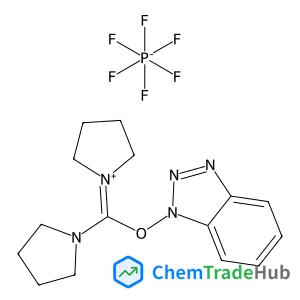
(1H-Benzotriazol-1-yloxy)(di-1-pyrrolidinyl)methylium hexafluorophosphate
CAS番号:
105379-24-6
分子式:
C15H21F6N5OP
おすすめサプライヤー





免責事項
このページに表示される学術雑誌情報は、参考および研究目的のみを目的としています。当社は雑誌出版社とは提携しておらず、投稿の取り扱いも行っておりません。出版に関するお問い合わせは、各雑誌出版社に直接ご連絡ください。
表示されている情報に誤りがある場合は、support@chemtradehub.com までご連絡ください。迅速に確認し、対応いたします。