













Chlorophyll derivatives as catalysts and comonomers for atom transfer radical polymerizations
文献情報
出版日
2018-11-13
DOI
10.1039/C8PY01492B
インパクトファクター
5.582
著者
Bernadetta Gajewska, Samuel Raccio, Kyle J. Rodriguez
原文を見る
要旨
Copper trisodium chlorophyllin is obtained from natural chlorophyll, and is widely used as a major green food colorant in cosmetics and in medical devices. Copper chlorophyllin also proves to be an efficient catalyst and comonomer for atom transfer radical polymerizations (ATRP). Aqueous ATRP of poly(ethylene glycol) acrylate (PEGA) results in PEGA-chlorophyllin copolymers with narrow molecular weight distributions and a controlled content of chlorophyllin. The reactions proceed with first order kinetics, and the polymer's molecular weight increases with conversion. The resulting copolymers could find application in drug delivery and in biomedical materials, or as solar energy harvesting materials. In order to suppress the incorporation of the catalyst into the growing polymer chains, the vinyl bond of chlorin e6, one of the major porphyrin components of chlorophyllin, is deactivated by hydrobromination and hydration. Complexation of copper by the porphyrin leads to a bio-derived catalyst which mediates the polymerization of PEGA, yielding homopolymers with molecular weights ranging from 4000–5000 g mol−1 and dispersities ≤ 1.11. UV-Vis spectroscopy indicates that chlorophyllin is stable during the polymerization. Copper chlorophyllin is a plant-derived compound from a renewable feedstock that can be used for a more environmentally friendly route to ATRP.
関連文献
Temperature-dependent ESR and computational studies on antiferromagnetic electron transfer in the yeast NADH dehydrogenase Ndi1
Kaiqi Wu, Wenfei Li, Lu Yu, Wei Tong, Yue Feng, Shenglong Ling, Longhua Zhang, Xiao Zheng, Maojun Yang
2017-01-09
Paper
DOI: 10.1039/C6CP08107J
Cyclopentadithiophene organic core in small molecule organic solar cells: morphological control of carrier recombination
Rocío Domínguez, Núria F. Montcada, Pilar de la Cruz, Fernando Langa
2016-12-23
Paper
DOI: 10.1039/C6CP08166E
Anions coordinating anions: analysis of the interaction between anionic Keplerate nanocapsules and their anionic ligands
Josep Bonet Avalos
2017-01-25
Paper
DOI: 10.1039/C6CP08511C
The deactivation mechanism of Pb on the Ce/TiO2 catalyst for the selective catalytic reduction of NOx with NH3: TPD and DRIFT studies
2017-01-18
Paper
DOI: 10.1039/C6CP07271B
Combining the spin-separated exact two-component relativistic Hamiltonian with the equation-of-motion coupled-cluster method for the treatment of spin–orbit splittings of light and heavy elements
Zhanli Cao, Zhendong Li, Fan Wang, Wenjian Liu
2017-01-10
Paper
DOI: 10.1039/C6CP07588F
A tailored multi-frequency EPR approach to accurately determine the magnetic resonance parameters of dynamic nuclear polarization agents: application to AMUPol
P. Gast, D. Mance, E. Zurlo, M. Baldus, M. Huber
2017-01-18
Paper
DOI: 10.1039/C6CP05864G
Modeling the abnormally slow infiltration rate in mesoporous films
Claudio L. A. Berli, Magalí Mercuri, Martín G. Bellino
2016-12-12
Communication
DOI: 10.1039/C6CP06602J
こちらもおすすめ
化合物よくある質問
2-ブロモ-9,9-ジフェニル-9H-フルオレンの主な用途は何ですか?
2-溴-9,9-二苯基芴は、医薬品、工業材料、有機合成の研究分野で応用されます。特に、レーザー材料や機能性ポリマーの合成に使用されることがあります。また、蛍光色...
474918-32-62-Bromo-9,9-diphenyl...
化合物よくある質問
四氯化铱の市場動向や研究トレンドはどうですか?
四氯化铱の市場は研究開発分野で注目されており、特にナノ技術や金属有機框架(MOFs)の分野での需要が増加傾向にあります。価格は安定しており、中国や韓国での生産が...
207399-11-9Tetrachloroiridium h...
882-06-44-Nitrocinnamic acid
化合物よくある質問
1-(4-溴-3-氟苯基)-2-氯乙酮を含む廃棄物はどのように処理すべきですか?
1-(4-溴-3-氟苯基)-2-氯乙酮 (CAS番号: 1260857-14-4) の廃棄物は専門的な廃棄処理が必要です。まず、廃棄物は密閉された容器に収集し、...
1260857-14-41-(4-Bromo-3-fluorop...
化合物よくある質問
苦参酚Kとは何ですか?
苦参酚Kは、CAS番号101236-49-1を持つ化合物で、主に天然由来の生薬から抽出されます。この化合物は、抗炎症作用や抗癌作用を持つことが報告されています。
101236-49-1Kushenol K
化合物よくある質問
POTASSIUM (1-(TERTBUTOXYCARBONYL)AZETIDIN-3-YL)TRIFLUOROBORATE を含む廃棄物はどのように処理すべきですか?
POTASSIUM (1-(TERTBUTOXYCARBONYL)AZETIDIN-3-YL)TRIFLUOROBORATE を含む廃棄物は、まず安全なエント...
1430219-73-0Potassium (1-(tert-b...
化合物よくある質問
4-庚基-4’-联苯羧酸の市場動向や研究トレンドはどうですか?
4-庚基-4’-聯苯羧酸は、特殊化学品や合成化学の分野で用いられる化学物質ですが、市場動向としては、研究開発の進展とともに需要が増加しています。また、環境配慮型...
58573-94-74'-Heptyl-4-biphenyl...
化合物よくある質問
6-ブロモ-3-メトキシ-1-フェニル-1H-インドゾールを含む廃棄物はどのように処理すべきですか?
6-ブロモ-3-メトキシ-1-フェニル-1H-インドゾールを含む廃棄物は、適切な化学廃棄処理が必要です。通常、廃棄物は密閉容器に収集され、専門の廃棄処理業者に引...
1332527-03-36-Bromo-3-methoxy-1-...
化合物よくある質問
4,4-二甲基-2-吡咯烷酮はどの業界で使用されていますか?
4,4-二甲基-2-吡咯烷酮は医薬、ポリマー、センサー、半導体などの業界で広く使用されています。特に溶媒としての性能が高く評価されています。
66899-02-34,4-dimethylpyrrolid...
51312-42-6Sodium Phosphotungst...
掲載誌
Polymer Chemistry

CiteScore:
8.6
自己引用率:
7.3%
年間論文数:
457
Polymer Chemistry welcomes submissions in all areas of polymer science that have a strong focus on macromolecular chemistry. Manuscripts may cover a broad range of fields, yet no direct application focus is required.
おすすめ化合物
![5-Acetyl-2,3-dihydrobenzo[b]furan structure](https://static.chemtradehub.com/structs/908/90843-31-5-eea4.webp "5-Acetyl-2,3-dihydrobenzo[b]furan structure")


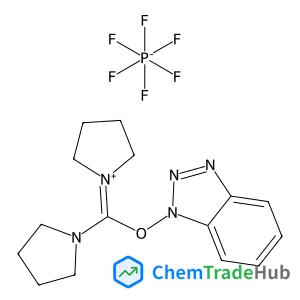
(1H-Benzotriazol-1-yloxy)(di-1-pyrrolidinyl)methylium hexafluorophosphate
CAS番号:
105379-24-6
分子式:
C15H21F6N5OP
おすすめサプライヤー




免責事項
このページに表示される学術雑誌情報は、参考および研究目的のみを目的としています。当社は雑誌出版社とは提携しておらず、投稿の取り扱いも行っておりません。出版に関するお問い合わせは、各雑誌出版社に直接ご連絡ください。
表示されている情報に誤りがある場合は、support@chemtradehub.com までご連絡ください。迅速に確認し、対応いたします。