












Establishment of a molecular design to obtain visible-light-activated azoxy polymer actuators
文献情報
出版日
2018-03-15
DOI
10.1039/C8PY00199E
インパクトファクター
5.582
著者
Yang Chen, Laibing Wang, Xiangqiang Pan, Jin'an Wu, Wei Zhang, Zhengbiao Zhang, Xiulin Zhu
原文を見る
要旨
The development of visible-light-activated photoswitches has significantly progressed in the past few decades. Herein, two kinds of photoresponsive azoxy polymers were prepared directly from bis-/trinitro-functionalized monomers via an efficient small molecular synthetic method with ultraviolet/visible light irradiation under metal-free and mild conditions. This strategy avoids the use of metal complexes and toxic compounds, while proceeding with high yields (up to 97%) and excellent selectivity without generating azo, amine, or inorganic compounds. Moreover, polymerization showed an efficient process with very high monomer conversion and perfect selectivity. The obtained main-chain linear and hyperbranched azoxy polymers were characterized by 1H NMR, GPC, UV-vis and FT-IR spectra. The π–π* absorptions of the obtained polymers in the UV-vis spectra showed a significant red-shift to the visible light region. Therefore, the photoisomerization of the prepared polymers can be driven by visible light, representing the first visible-light-driven aromatic azoxy polymer actuators.
関連文献
Preparation, structure, and some coordination properties of 2-chloro-3,3-diphenyl-3-thioxo-1-(2,4,6-tri-t-butylphenyl)-1,3-diphosphapropene
Shigekazu Ito, Hongze Liang, Masaaki Yoshifuji
2003-01-13
Communication
DOI: 10.1039/B211230B
Novel alignment technique for LCD-biosensors
Johan Hoogboom, Joost Clerx, Matthijs B. J. Otten, Alan E. Rowan, Theo Rasing, Roeland J. M. Nolte
2003-10-31
Communication
DOI: 10.1039/B310860K
A reagentless electrochemical biosensor based on a protein scaffold
Sulay D. Jhaveri, J. Matthew Mauro, Harold M. Goldston, Caroline L. Schauer, Leonard M. Tender, Scott A. Trammell
2003-01-02
Communication
DOI: 10.1039/B209452E
Enantioselective total synthesis of (−)-heliannuol A
Hidetoshi Kishuku, Mitsuru Shindo, Kozo Shishido
2003-01-09
Communication
DOI: 10.1039/B211227B
A bilayer to monolayer phase transition in liquid crystal glycolipids
Valérie Molinier, Paul H. J. Kouwer, Yves Queneau, Juliette Fitremann, Grahame Mackenzie, John W. Goodby
2003-10-23
Communication
DOI: 10.1039/B308880D
Facile deposition of [60]fullerene on the electrode by electrochemical oxidative polymerization of thiophene
Tsukasa Hatano, Masayuki Takeuchi, Seiji Shinkai
2003-01-08
Communication
DOI: 10.1039/B210433D
Extending solid-phase methods in inorganic synthesis: the first dinuclear platinum complex synthesised via the solid phase
Steven van Zutphen, Marc S. Robillard, Gijs A. van der Marel, Herman S. Overkleeft, Hans den Dulk, Jaap Brouwer, Jan Reedijk
2003-02-07
Communication
DOI: 10.1039/B212388F
The reaction of ‘GaI’ with a 1,3-diyne: synthesis, characterisation and reactivity of a novel C–C coupled ene–diyne–bis(gem-organodigallium(iii)) complex
Robert J. Baker, Cameron Jones
2003-01-14
Communication
DOI: 10.1039/B210868M
C–H Activation of imidazolium salts by Pt(0) at ambient temperature: synthesis of hydrido platinum bis(carbene) compounds
Marcel A. Duin, Nicolas D. Clement, Kingsley J. Cavell, Cornelis J. Elsevier
2003-01-14
Communication
DOI: 10.1039/B211235C
A novel aggregate of [Mn2(μ-O)2] units: [Mn8O10(O2CMe)6(H2O)2(bpy)6]4+ with a serpentine core
Anastasios J. Tasiopoulos, Khalil A. Abboud, George Christou
2003-01-29
Communication
DOI: 10.1039/B211345G
こちらもおすすめ
化合物よくある質問
2,3-スチオエポキシマドルを取り扱う際の実験室安全事項は何ですか?
取り扱いにはPPE(プロテクティブ・パーソナル・エイド)が必要で、防ぐ手袋と保護眼鏡を着用してください。ドラフトチャンバーの使用を推奨します。漏洩した場合は、適...
4267-80-52,3-Thioepoxy Madol
53981-25-22-Amino-6-fluorophen...
化合物よくある質問
BOC-S-3-アミニ-4-(4-メチオキシベンチル)-ブタン酸の代替品はありますか?
この化合物の代替品としては、BOC保護基を有さないアミノ酸やその他の保護基化合物が考えられます。また、メチオキシ基を有しない他の芳香族アミノ酸も代替品として挙げ...
126800-59-7(3S)-4-(4-Methoxyphe...
化合物よくある質問
Methyl 2-(chloromethyl)-3-nitrobenzoate(1218910-61-2)の代替品はありますか?
Methyl 2-(chloromethyl)-3-nitrobenzoate(1218910-61-2)の代替品としては、化学組成を変えることで効果を達成する...
1218910-61-2Methyl 2-(chlorometh...
化合物よくある質問
(2R)-2-アミノ-N-ベンジル-3-ヒドロキシプロパナミドを含む廃棄物はどのように処理すべきですか?
(2R)-2-アミノ-N-ベンジル-3-ヒドロキシプロパナミドを含む廃棄物は、適切な廃棄物管理ガイドラインに基づき処理する必要があります。まず、廃棄物を適切に収...
175481-39-7(2R)-2-amino-N-benzy...
化合物よくある質問
6,7-二氢-咪唑並[1,2-a]ピリドイン-8(5h)-酮はどのように合成されますか?
6,7-二氢-咪唑並[1,2-a]ピリドイン-8(5h)-酮は、2-ブロモフェニルアセトインとリン酸ハロゲン化物を反応させることで合成できます。この反応は高温で...
457949-09-66,7-Dihydroimidazo[1...
化合物よくある質問
エチル(3R)-3-ピロリジニル酢酸水和塩とは何ですか?
エチル(3R)-3-ピロリジニル酢酸水和塩は、CAS番号1332459-32-1の化合物で、(R)-乙基2-(ピロリジン-3-基)酢酸塩水和塩と呼ばれます。この...
1332459-32-1Ethyl (3R)-3-pyrroli...
化合物よくある質問
(2S)-{[(2-メチルエチルオキシ]カルボニル}アミノ)[2-(トリアフルオロメチルフェニル]エチカシック酸の物理化学的性質は何ですか?
(2S)-{[(2-メチルエチルオキシ]カルボニル}アミノ)[2-(トリアフルオロメチルフェニル]エチカシック酸のCAS番号は1203454-45-8です。この...
1203454-45-8(2S)-({[(2-Methyl-2-...
化合物よくある質問
2-ブロモ-1-(2-メチル-2-プロパニル)-4-ニトロベンゼンはどのように保存すればよいですか?
2-ブロモ-1-(2-メチル-2-プロパニル)-4-ニトロベンゼンは、直射日光を避けて暗所で、室温(約15℃〜25℃)、乾燥した場所に保存する必要があります。ま...
6310-17-42-Bromo-1-(2-methyl-...
化合物よくある質問
1-[(4-硝基フェニル)スルホニル]-1H-1,2,4-三唑の市場動向や研究トレンドはどうですか?
市場動向としては、1-[(4-硝基フェニル)スルホニル]-1H-1,2,4-三唑は主に農業用除草剤や合成化学製品の原料として利用されています。研究トレンドとして...
57777-84-11-[(4-Nitrophenyl)su...
掲載誌
Polymer Chemistry

CiteScore:
8.6
自己引用率:
7.3%
年間論文数:
457
Polymer Chemistry welcomes submissions in all areas of polymer science that have a strong focus on macromolecular chemistry. Manuscripts may cover a broad range of fields, yet no direct application focus is required.
おすすめ化合物
![(1R,5R)-3-{[(2-Methyl-2-propanyl)oxy]carbonyl}-3-azabicyclo[3.1.0]hexane-1-carboxylic acid structure](https://static.chemtradehub.com/structs/116/1165450-63-4-bfe1.webp "(1R,5R)-3-{[(2-Methyl-2-propanyl)oxy]carbonyl}-3-azabicyclo[3.1.0]hexane-1-carboxylic acid structure")
![6-(Benzyloxy)-8-(2-bromoacetyl)-2H-benzo[b][1,4]oxazin-3(4H)-one structure](https://static.chemtradehub.com/structs/926/926319-53-1-2287.webp "6-(Benzyloxy)-8-(2-bromoacetyl)-2H-benzo[b][1,4]oxazin-3(4H)-one structure")
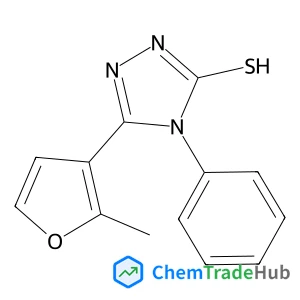
5-(2-Methyl-3-furyl)-4-phenyl-2,4-dihydro-3H-1,2,4-triazole-3-thione
CAS番号:
346464-59-3
分子式:
C13H11N3OS
おすすめサプライヤー




免責事項
このページに表示される学術雑誌情報は、参考および研究目的のみを目的としています。当社は雑誌出版社とは提携しておらず、投稿の取り扱いも行っておりません。出版に関するお問い合わせは、各雑誌出版社に直接ご連絡ください。
表示されている情報に誤りがある場合は、support@chemtradehub.com までご連絡ください。迅速に確認し、対応いたします。