












New flavonoids from the Saudi Arabian plant Retama raetam which stimulates secretion of insulin and inhibits α-glucosidase
文献情報
出版日
2019-01-21
DOI
10.1039/C8OB02755B
インパクトファクター
3.876
著者
Mohammad Nur-e-Alam, Muhammad Yousaf, Ifat Parveen, Rahman M. Hafizur, Usman Ghani, Sarfaraz Ahmed, Abdul Hameed, Adnan J. Al-Rehaily
原文を見る
要旨
Retama raetam is a bush which is a member of the family Fabaceae. It is used traditionally in North Africa and Saudi Arabia for the treatment of diabetes. Several flavonoids and alkaloids are already known from this plant. Chromatographic fractionation and purification led to the isolation of three new derivatives of prenylated flavones, retamasin C–E, and four new derivatives of prenylated isoflavones, retamasin F–I, in addition to two isoflavones which have not been previously reported in this plant. Particularly interesting structures included isoflavones containing 3,5-dihydro-2H-2,5-methanobenzo[e][1,4]dioxepine and 3a,8b-dihydro-7-hydroxyfuro[3,2-b]benzo[2,1-d]furan units, both of which are new amongst natural product flavonoids. Five new examples (two flavones and three isoflavones) strongly enhanced the glucose-triggered release of insulin by murine pancreatic islets and one isoflavone was a potent inhibitor of α-glucosidase. This study may rationalise the traditional medicinal use of R. raetam and provide new leads for drug design in the treatment of diabetes.
関連文献
Ba7Mn5Cr2O20: charge and chemical order
Sarah J. Dunstone, Joanna H. Clark, Michael A. Hayward
2007-04-20
Communication
DOI: 10.1039/B703877A
Aqueous-biphasic hydroformylation of higher alkenes promoted by alkylimidazolium salts
Simon L. Desset, David J. Cole-Hamilton, Douglas F. Foster
2007-04-10
Communication
DOI: 10.1039/B618785D
Enantioselective catalytic syntheses of α-branched chiral amines
Stefan Bräse, Thomas Baumann, Stefan Dahmen, Henning Vogt
2007-01-30
Feature Article
DOI: 10.1039/B611619A
Multilayer films of single-component and charged tetraaminocalix[4]arenes based on hydrogen bonding
Shuiying Gao, Daqiang Yuan, Rong Cao
2007-02-16
Communication
DOI: 10.1039/B617105B
Twisted oxygen-containing oligosilanes—unprecedented examples of σ–n mixed conjugated systems
Clemens Krempner, Ralf Ludwig, Anke Flemming, Ralf Miethchen, Martin Köckerling
2007-02-15
Communication
DOI: 10.1039/B618438C
Pore-expansion of monodisperse mesoporous silica spheres by a novel surfactant exchange method
Mamoru Mizutani, Yuri Yamada, Kazuhisa Yano
2006-12-19
Communication
DOI: 10.1039/B613163H
Use of porous anodic alumina membranes as a nanometre-diameter column for high performance liquid chromatography
Tomohisa Yamashita, Shuji Kodama, Mikiya Ohto, Eriko Nakayama, Nobutaka Takayanagi, Tomoko Kemmei, Norio Teramae, Yukio Saito
2007-02-12
Communication
DOI: 10.1039/B615369K
A dizinc complex for selective fluorescence sensing of uridine and uridine-containing dinucleotides
Carla Bazzicalupi, Andrea Bencini, Laura Bussotti, Emanuela Berni, Silvia Biagini, Enrico Faggi, Claudia Giorgi, Andrea Lapini, Agnese Marcelli, Barbara Valtancoli
2007-02-12
Communication
DOI: 10.1039/B617453A
Vancomycin architecture dependence on the capture efficiency of antibody-modified microbeads by magnetic nanoparticles
Arnold J. Kell, Benoit Simard
2007-02-05
Communication
DOI: 10.1039/B617427B
こちらもおすすめ
化合物よくある質問
2-氟-4-イオドベンzo酸エチルエステルを取り扱う際の実験室安全事項は何ですか?
2-氟-4-イオドベンzo酸エチルエステルは有機溶媒を用いた反応であり、ドラフトチャンバーでの操作が必要です。漏洩時にはSDS参照の安全措置を講じ、PPE(防護...
205750-82-9Benzoic acid, 2-fluo...
化合物よくある質問
血根碱の主な用途は何ですか?
血根碱は主に医薬分野で利用され、抗炎症や抗がん剤としての潜在的な効果が研究されています。また、化学研究や薬物開発において、新しい薬剤設計の参考となる化合物として...
2447-54-313-Methyl[1,3]benzod...
化合物よくある質問
Methyl 3-methoxythiophene-2-carboxylateの主な用途は何ですか?
Methyl 3-メトキシスチフェン-2-カルボン酸メチルエステルは、薬品合成、染料製造、以及合成中間体としての用途が広がっています。
62353-75-7Methyl 3-methoxythio...
化合物よくある質問
丹磺酰-L-亮氨酸はどのように保存すればよいですか?
丹磺酰-L-亮氨酸は乾燥した場所で、直射日光から保護し、低温(室温以下)で保存してください。密閉容器に入れて保管することをおすすめします。
1100-22-7N-{[5-(Dimethylamino...
化合物よくある質問
5-(苄氧基)ピラミジン-4-アミンの代替品はありますか?
5-(苄氧基)ピラミジン-4-アミンの代替品として、6-メトキシピラミジンや5-フェニルピラミジンなどが挙げられます。これらの化合物は、5-(苄氧基)ピラミジン...
92289-50-45-benzyloxypyrimidin...
化合物よくある質問
8-ヒドロキシノルデコペントアセートの物理化学的性質は何ですか?
8-ヒドロキシノルデコペントアセートはCAS番号84807-87-4の化合物で、分子量は750.02 uです。これは油溶性で、水に溶けにくい特徴があります。反応...
84807-87-4(5Z,8Z,11Z,13E,15S)-...
化合物よくある質問
tert-ブチル(エス)-1-ヒドロキシペンタ-4-エン-2-イルカルバamateの主な用途は何ですか?
tert-ブチル(エス)-1-ヒドロキシペンタ-4-エン-2-イルカルバamateは主に医薬品の合成材料や分析化学の試薬として使用されます。
116613-81-12-Methyl-2-propanyl ...
化合物よくある質問
ブコール-L-2-フローヨルブリンについて適切な法規ガイドラインは何ですか?
ブコール-L-2-フローヨルブリン(CAS番号: 1196107-73-9)は、GHS(グローバルハザードアサessmentシステム)に基づく危害分類と表示が求...
1196107-73-92-Bromo-13,13-dimeth...
化合物よくある質問
6-ブロモ-N-環丙基-2-ピリジニニメタンの市場動向や研究トレンドはどうですか
6-ブロモ-N-環丙基-2-ピリジニニメタンは、薬理学研究や合成化学に使用される化合物であり、特に抗ウイルス薬や抗がん薬の開発に注目されています。市場では、薬物...
959237-20-86-Bromo-N-cyclopropy...
化合物よくある質問
RS-AMPÀはどのように保存すればよいですか?
RS-AMPÀは、遮光容器に保存し、室温(15〜25℃)で保管することが推奨されます。高湿や熱は物質を劣化させるため、湿度は50%以下に保つことが重要です。また...
74341-63-2(RS)-AMPA
掲載誌
Organic & Biomolecular Chemistry

CiteScore:
3.4
自己引用率:
10.3%
年間論文数:
1041
Organic & Biomolecular Chemistry (OBC) publishes original and high impact research and reviews in organic chemistry. We welcome research that shows new or significantly improved protocols or methodologies in total synthesis, synthetic methodology or physical and theoretical organic chemistry as well as research that shows a significant advance in the organic chemistry or molecular design aspects of chemical biology, catalysis, supramolecular and macromolecular chemistry, theoretical chemistry, mechanism-oriented physical organic chemistry, medicinal chemistry or natural products. Articles published in the journal should report new work which makes a highly-significant impact in the field. Routine and incremental work is generally not suitable for publication in the journal. More details about key areas of our scope are below. In all cases authors should include in their article clear rationale for why their research has been carried out.
おすすめ化合物
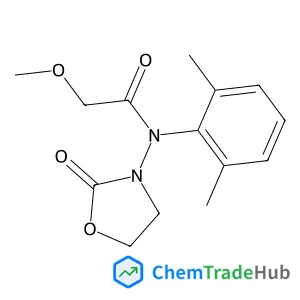
N-(2,6-Dimethylphenyl)-2-methoxy-N-(2-oxo-1,3-oxazolidin-3-yl)acetamide
CAS番号:
77732-09-3
分子式:
C14H18N2O4
おすすめサプライヤー




免責事項
このページに表示される学術雑誌情報は、参考および研究目的のみを目的としています。当社は雑誌出版社とは提携しておらず、投稿の取り扱いも行っておりません。出版に関するお問い合わせは、各雑誌出版社に直接ご連絡ください。
表示されている情報に誤りがある場合は、support@chemtradehub.com までご連絡ください。迅速に確認し、対応いたします。