












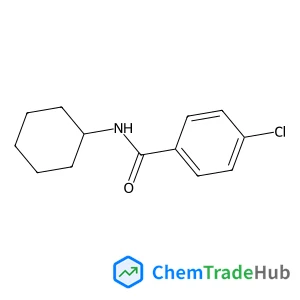
Synthesis of benzimidazoles by CuI-catalyzed three-component reaction of 2-haloaniline, ammonia and aldehyde in water
文献情報
出版日
2018-10-10
DOI
10.1039/C8OB02172D
インパクトファクター
3.876
著者
Fang Ke, Peng Zhang, Chen Lin, Xiaoyan Lin, Jianhua Xu, Xiangge Zhou
原文を見る
要旨
An efficient copper-catalyzed three-component reaction of 2-haloaniline, ammonia and aldehyde for the synthesis of benzimidazoles with 1,10-phenanthroline as the ligand has been developed. A variety of substituted benzimidazole derivatives can be obtained in yields up to 95%.
関連文献
Entropy-driven rearrangement of the water network at the hydrated amide group of the trans-formanilide–water cluster in the gas phase
Kenji Sakota, Yuiga Shimazaki, Hiroshi Sekiya
2011-03-03
Communication
DOI: 10.1039/C0CP02836C
Unexpected optical response of single ZnO nanowires probed using controllable electrical contacts
Y. J. Zeng, M. Menghini, D. Y. Li, S. S. Lin, Z. Z. Ye, J. Hadermann, T. Moorkens, J. W. Seo, J.-P. Locquet, C. Van Haesendonck
2011-03-14
Paper
DOI: 10.1039/C1CP00012H
A master-equation approach to the description of proton-driven spin diffusion from crystal geometry using simulated zero-quantum lineshapes
Jean-Nicolas Dumez, Lyndon Emsley
2011-03-22
Paper
DOI: 10.1039/C1CP00004G
Isomerization of spirobenzopyrans bearing electron-donating and electron-withdrawing groups in acidic aqueous solutions
Taku Satoh, Kimio Sumaru, Toshiyuki Takagi, Katsuki Takai, Toshiyuki Kanamori
2011-03-11
Paper
DOI: 10.1039/C0CP01989E
Catalysis by metal–organic frameworks: fundamentals and opportunities
Marco Ranocchiari
2011-01-14
Perspective
DOI: 10.1039/C0CP02394A
The leapfrog principle for boron fullerenes: a theoretical study of structure and stability of B112
Jules Tshishimbi Muya, G. Gopakumar, Minh Tho Nguyen, Arnout Ceulemans
2011-03-18
Paper
DOI: 10.1039/C0CP02130J
Ab initio and DFT studies of the spin–orbit and spin–spin contributions to the zero-field splitting tensors of triplet nitrenes with aryl scaffolds
Kenji Sugisaki, Kazuo Toyota, Kazunobu Sato, Daisuke Shiomi, Masahiro Kitagawa, Takeji Takui
2011-03-10
Paper
DOI: 10.1039/C0CP02809F
Polyoxometalate-stabilized Pt nanoparticles and their electrocatalytic activities
Thomas Hsu-Yao, Kevin P. Browne, Nicole Honesty, YuYe J. Tong
2011-03-14
Paper
DOI: 10.1039/C0CP02805C
Study of host–guest interactions in benzodiazacoronands by means of solid state NMRspectroscopy, X-ray diffraction and quantum mechanical computations
Katarzyna Nowicka, Anna Bujacz, Piotr Paluch, Adam Sobczuk, Agata Jeziorna, Włodzimierz Ciesielski, Grzegorz D. Bujacz, Janusz Jurczak, Marek J. Potrzebowski
2011-03-08
Paper
DOI: 10.1039/C0CP02401E
こちらもおすすめ
化合物よくある質問
6-苄基-6,7-二氢-5H-吡咯并3,4-b吡啶とは何ですか?
6-苄基-6,7-二氢-5H-吡咯并3,4-b吡啶は、CAS番号109966-30-5の化合物です。これは、6-ベンジル基を持つ6,7-二氢-5H-吡咯並みの化...
109966-30-56-Benzyl-6,7-dihydro...
化合物よくある質問
半硫酸奎宁单水水合物はどのように保存すればよいですか?
半硫酸奎宁单水水合物は、乾燥した涼しい場所に保管し、直射日光や湿気を避ける必要があります。保存温度は常温(15〜25℃)が適切で、湿度は40%以下を維持すること...
6119-70-6Quinine sulfate hydr...
化合物よくある質問
D-核糖-5-リン酸二ナトリウムとは何ですか?
D-核糖-5-リン酸二ナトリウムは、CAS番号18265-46-8を有する化合物で、D-核糖の5位付加部位にリン酸基が結合した化合物です。この化合物は、水溶性で...
18265-46-8Disodium (2R,3R,4R)-...
2257-52-5Isopropylhydrazine
化合物よくある質問
3-乙酰基-4-羟基喹啉-2(1H)-酮はどのように合成されますか?
3-乙酰基-4-羟基喹啉-2(1H)-酮は、ハイドロキノンと酢酸アセトイルアミドのアミド化反応により合成されます。この反応は塩基触媒を用いて行われ、選択性は良好...
26138-64-73-Acetyl-4-hydroxyqu...
2280037-51-44-Amino-1-(3-bipheny...
化合物よくある質問
5-溴-4-甲基-1H-吲唑とは何ですか?
5-溴-4-甲基-1H-吲唑は、CAS番号1082041-34-6の化学物質で、化学式はC10H9BrNです。この化合物は淡黄色の結晶性粉末で、吸湿性があります...
1082041-34-65-Bromo-4-methyl-1H-...
化合物よくある質問
3-(4メトキシフェニル)オキテナン-3カーボイル酸の代替品はありますか?
3-(4メトキシフェニル)オキテナン-3カーボイル酸の代替品は、その用途により異なりますが、例えば4-(メトキシフェニル)オキテナン-3カーボイル酸や、他のオキ...
1416323-25-53-(4-Methoxyphenyl)-...
化合物よくある質問
3-イリドオキシピロロ[2,3-b]ピリジン-5-カルボキシlic酸は安全ですか?
3-イリドオキシピロロ[2,3-b]ピリジン-5-カルボキシlic酸は危険な化合物ではありませんが、適切な手袋や保護眼鏡の使用を推奨します。誤って摂取または接触...
1060816-80-93-Iodo-1H-pyrrolo[2,...
化合物よくある質問
3-氟-4- iodobenolを取り扱う際の実験室安全事項は何ですか?
3-氟-4- iodobenolは可燃性を有し、強力な反応性を持つため、取り扱いには注意が必要です。PPE(個人保護具)の着用、ドラフトチャンバーの使用、漏洩時...
122927-84-83-Fluoro-4-iodopheno...
掲載誌
Organic & Biomolecular Chemistry

CiteScore:
3.4
自己引用率:
10.3%
年間論文数:
1041
Organic & Biomolecular Chemistry (OBC) publishes original and high impact research and reviews in organic chemistry. We welcome research that shows new or significantly improved protocols or methodologies in total synthesis, synthetic methodology or physical and theoretical organic chemistry as well as research that shows a significant advance in the organic chemistry or molecular design aspects of chemical biology, catalysis, supramolecular and macromolecular chemistry, theoretical chemistry, mechanism-oriented physical organic chemistry, medicinal chemistry or natural products. Articles published in the journal should report new work which makes a highly-significant impact in the field. Routine and incremental work is generally not suitable for publication in the journal. More details about key areas of our scope are below. In all cases authors should include in their article clear rationale for why their research has been carried out.
おすすめ化合物
おすすめサプライヤー





免責事項
このページに表示される学術雑誌情報は、参考および研究目的のみを目的としています。当社は雑誌出版社とは提携しておらず、投稿の取り扱いも行っておりません。出版に関するお問い合わせは、各雑誌出版社に直接ご連絡ください。
表示されている情報に誤りがある場合は、support@chemtradehub.com までご連絡ください。迅速に確認し、対応いたします。