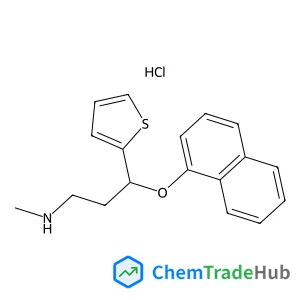
N-Methyl-3-(1-naphthyloxy)-3-(2-thienyl)-1-propanamine hydrochloride (1:1)
CAS番号:
1188266-11-6
分子式:
C18H20ClNOS
Olapeju Bolarinwa, Meng Zhang, Erin Mulry, Min Lu, Jianfeng Cai
The utilization of bioactive peptides in the development of highly selective and potent pharmacological agents for the disruption of protein–protein interactions is appealing for drug discovery. It is known that HIV-1 entry into a host cell is through a fusion process that is mediated by the trimeric viral glycoprotein gp120/41, which is derived from gp160 through proteolytic processing. Peptides derived from the HIV gp41 C-terminus have proven to be potent in inhibiting the fusion process. These peptides bind tightly to the hydrophobic pocket on the gp-41 N-terminus, which was previously identified as a potential inhibitor binding site. In this study, we introduce modified 23-residue C-peptides, 3 and 4, bearing a sulfono-γ-AA residue substitution and hydrocarbon stapling, respectively, which were developed for HIV-1 gp-41 N-terminus binding. Intriguingly, both 3 and 4 were capable of inhibiting envelope-mediated membrane fusion in cell–cell fusion assays at nanomolar potency. Our study reveals that sulfono-γ-AA modified peptides could be used for the development of more potent anti-HIV agents.
Georg Hohlneicher, Lars Packschies, Johannes Weber
DOI: 10.1039/B700914N
DOI: 10.1039/B612615D
Elizabeth Rincón, Manuel Yáñez, Alejandro Toro-Labbé, Otilia Mó
DOI: 10.1039/B618050G
DOI: 10.1039/B701402C
A. K. Soper
DOI: 10.1039/B701855J
S. Yu. Grebenshchikov, Z.-W. Qu, H. Zhu, R. Schinke
DOI: 10.1039/B701020F
Stefan Laubach, Peter C. Schmidt, Andreas Thißen, Francisco Javier Fernandez-Madrigal, Qi-Hui Wu, Wolfram Jaegermann, Matthias Klemm, Siegfried Horn
DOI: 10.1039/B612489E
DOI: 10.1039/B614121H
T. Schalow, B. Brandt, D. E. Starr, M. Laurin, S. K. Shaikhutdinov, S. Schauermann, J. Libuda, H.-J. Freund
DOI: 10.1039/B614546A
Bradley F. Parsons, Sean M. Sheehan, Terry A. Yen, Daniel M. Neumark, Nadine Wehres, Rainer Weinkauf
DOI: 10.1039/B703045B
3-イチチルビフェニルは、ビフェニルとイチプロピオニトリルを回収率約90%で反応させて合成されます。触媒は通常、亜リチウムホウ素を用います。
8-溴-5-三氟甲基喹啉は、5-トリフルオロメチル-2-メチル-1,3-ベンゼンジオールをブロモエタノールと反応させて生成します。この反応は塩基性条件下で行われ...
ジメチル4-(4,4,5,5-テトラメチル-1,3,2-ドioxaborolan-2-基)-2,6-ピリジンジカルボイル酸フェニルアミニドの代替品としては、4-...
N-(3,5-ヘキサクロロ-4-ピリドインイル)-8-メチオキシ-5-キノリンカーボン酸の市場動向は、主に産業用途での需要により影響を受けます。研究トレンドとし...
イソステアロイルグリセリルは一般的に安全性が高いとされていますが、過度な使用や個人差により皮�owsん炎などの反応が起こる可能性があります。使用前に医師に相談す...
1-(二苯甲基)-3,3-二氟-氮杂环丁烷の市場動向は、医薬品や合成化学の研究分野で注目を集めています。新興研究は、該当化合物の合成改良と生体内での作用メカニズ...
3-チオフェンスチオールのCAS番号は7774-73-4です。結晶性の白色粉末で、分子量は122.17です。この化合物は水に微溶解し、エタノールやジクロロメタン...
2-Methyl-2-propanyl (2S)-2-(aminomethyl)-1-piperidinecarboxylateは一定の安全性基準を満たしていま...
CAS番号1316822-90-8の化合物は安全性に関しては評価が不足していますが、一般的には生物学的に活性な物質であり、取り扱いには適切な安全防護措置が必要で...
Tert-butyl 2-(2-羟基乙基)哌嗪-1-羧酸は、冷暗所で保存し、直射日光から遠ざけてください。容器は密閉し、高湿度や高温を避けて保管してください。

Organic & Biomolecular Chemistry (OBC) publishes original and high impact research and reviews in organic chemistry. We welcome research that shows new or significantly improved protocols or methodologies in total synthesis, synthetic methodology or physical and theoretical organic chemistry as well as research that shows a significant advance in the organic chemistry or molecular design aspects of chemical biology, catalysis, supramolecular and macromolecular chemistry, theoretical chemistry, mechanism-oriented physical organic chemistry, medicinal chemistry or natural products. Articles published in the journal should report new work which makes a highly-significant impact in the field. Routine and incremental work is generally not suitable for publication in the journal. More details about key areas of our scope are below. In all cases authors should include in their article clear rationale for why their research has been carried out.
![1-(1-Benzyl-1,2,3,6-tetrahydropyridin-4-yl)-1H-benzo[d]imidazol-2(3H)-one structure](https://static.chemtradehub.com/structs/603/60373-71-9-7dfb.webp "1-(1-Benzyl-1,2,3,6-tetrahydropyridin-4-yl)-1H-benzo[d]imidazol-2(3H)-one structure")