













Two bifunctional desferrioxamine chelators for bioorthogonal labeling of biovectors with zirconium-89
文献情報
出版日
2018-07-02
DOI
10.1039/C8OB01434E
インパクトファクター
3.876
著者
F. Gao, C. Ieritano, K.-T. Chen, G. M. Dias, J. Rousseau, Y. Seimbille
原文を見る
要旨
We report two bifunctional chelators, DFO-Cys and DFO-CBT, to label biovectors with zirconium-89 according to the 2-cyanobenzothiazole/1,2-aminothiol cycloaddition. Their features are high labeling yields, rapid and efficient bioconjugation, metabolically stable luciferin-based end products, and applicability to orthogonal two-step labeling of sensitive biomolecules.
関連文献
Site dependent reactivity of Pt single atoms on anatase TiO2(101) in an aqueous environment
Wen-Jin Yin, Annabella Selloni, Li-Min Liu
2019-10-14
Paper
DOI: 10.1039/C9CP05097C
Microstructural dependent oxygen reduction reaction in a Ruddlesden–Popper perovskite (SmSr)NiO4−δ
Manisha Chauhan, Pardeep K. Jha, Ajay S. Bangwal, Priyanka A. Jha, Prabhakar Singh
2020-05-06
Paper
DOI: 10.1039/D0CP00433B
Structure and bonding of molecular stirrers with formula B7M2− and B8M2 (M = Zn, Cd, Hg)
Rui Yu, Jorge Barroso, Meng-hui Wang, Wei-yan Liang, Chen Chen, Ximena Zarate, Mesías Orozco-Ic, Gabriel Merino
2020-05-11
Paper
DOI: 10.1039/D0CP01603A
Fine structure in the solution state 13C-NMR spectrum of C60 and its endofullerene derivatives
George Razvan Bacanu, Gabriela Hoffman, Michael Amponsah, Maria Concistrè, Richard J. Whitby, Malcolm H. Levitt
2020-05-13
Paper
DOI: 10.1039/D0CP01282C
Vibrational mode frequency correction of liquid water in density functional theory molecular dynamics simulations with van der Waals correction
Chun-Chieh Yu, Mayank Dodia, Mischa Bonn, Yuki Nagata, Tatsuhiko Ohto
2020-05-22
Paper
DOI: 10.1039/C9CP06335H
Tailoring the protonic conductivity of porous yttria-stabilized zirconia thin films by surface modification
Erdogan Celik, Rajendra S. Negi, Michele Bastianello, Dominic Boll, Andrey Mazilkin, Torsten Brezesinski
2020-05-02
Paper
DOI: 10.1039/D0CP01619E
A computational exploration of the 1D TiS2(en) nanostructure for lithium ion batteries
Chun-Hao Huang, Elise Y. Li
2020-03-31
Paper
DOI: 10.1039/C9CP04675E
DFT insights into electrocatalytic CO2 reduction to methanol on α-Fe2O3(0001) surfaces
Nandha Kumar, Nicola Seriani, Ralph Gebauer
2020-04-20
Paper
DOI: 10.1039/C9CP06453B
Strain induced spin-splitting and half-metallicity in antiferromagnetic bilayer silicene under bending
Jin-Lei Shi, Xing-Ju Zhao, Yu-Zhong Zhang, Su-Huai Wei
2020-04-24
Paper
DOI: 10.1039/D0CP01350A
こちらもおすすめ
28770-01-62-(2-Isopropyl-1,3-o...
化合物よくある質問
「邻羟基阿托伐他汀内酯标准品」に適用される法規ガイドelinesは何ですか?
CAS番号163217-74-1の「邻羟基阿托伐他汀内酯标准品」は、GHS分類では危険物に分類されず、主にREACH規則とFDA/EPAの管理対象となります。R...
163217-74-1ortho-Hydroxy Atorva...
化合物よくある質問
メチル(3R)-3-アミノ-2,3-ジヒドロ-1-ベンゾファンラニン-5-カルボイル酸塩塩酸塩の主な用途は何ですか?
メチル(3R)-3-アミノ-2,3-ジヒドロ-1-ベンゾファンラニン-5-カルボイル酸塩塩酸塩は、医薬品や合成化学の研究に広く用いられます。また、特定の薬物の前...
2241594-15-8Methyl (3R)-3-amino-...
化合物よくある質問
トランス-4-メチルピロリジン-3-オール塩酸塩はどのように合成されますか?
トランス-4-メチルピロリジン-3-オール塩酸塩は、4-メチルピロリジンの塩酸塩化によって合成されます。一般的な合成方法では、4-メチルピロリジンを塩酸に加えて...
265108-42-7trans-4-Methylpyrrol...
化合物よくある質問
硫雜環丁烷-1,1-二氧化物は安全ですか?
硫雜環丁烷-1,1-二氧化物は安全ではありません。毒性は報告されていませんが、高温下で分解し、可燃性があるため、高圧ガスは注意が必要です。密閉した容器で保管し、...
5687-92-3Thietane 1,1-dioxide
6054-10-02H, 8H-Benzo[1,2-b
化合物よくある質問
9-ヒドロキシエリプチシネ塩酸塩はどのように合成されますか?
9-ヒドロキシエリプチシネ塩酸塩は、エリプチシネから塩酸を添加することで合成されます。選択性は高いですが、収率は約70%です。
52238-35-49-Hydroxyellipticine...
化合物よくある質問
5-塩素-2-(メチルアミノ)フェニル-(2-塩素フェニル)メタン酮の物理化学的性質は何ですか?
5-塩素-2-(メチルアミノ)フェニル-(2-塩素フェニル)メタン酮のCAS番号は5621-86-3です。この化合物は白色の結晶性粉末で、分子量は415.03で...
5621-86-3[5-Chloro-2-(methyla...
化合物よくある質問
1-[2-(4-甲氧基-苯氧基)-乙基]-哌嗪はどのように保存すればよいですか?
1-[2-(4-甲氧基-苯氧基)-乙基]-哌嗪は、直射日光を避けて暗所に、室温(15-25℃)で保管し、密閉容器に入れることで安定性を保つことができます。
117132-44-21-[2-(4-Methoxy-phen...
化合物よくある質問
2-[3-(4-甲氧基フェニル)プロピル]-4,4,5,5-四メチル-1,3,2-ドイボロロールアンの主な用途は何ですか?
2-[3-(4-甲氧基フェニル)プロピル]-4,4,5,5-四メチル-1,3,2-ドイボロロールアンは、医薬品の合成、有機合成化学、および新材料の研究で使用され...
1073371-72-82-[3-(4-Methoxypheny...
掲載誌
Organic & Biomolecular Chemistry

CiteScore:
3.4
自己引用率:
10.3%
年間論文数:
1041
Organic & Biomolecular Chemistry (OBC) publishes original and high impact research and reviews in organic chemistry. We welcome research that shows new or significantly improved protocols or methodologies in total synthesis, synthetic methodology or physical and theoretical organic chemistry as well as research that shows a significant advance in the organic chemistry or molecular design aspects of chemical biology, catalysis, supramolecular and macromolecular chemistry, theoretical chemistry, mechanism-oriented physical organic chemistry, medicinal chemistry or natural products. Articles published in the journal should report new work which makes a highly-significant impact in the field. Routine and incremental work is generally not suitable for publication in the journal. More details about key areas of our scope are below. In all cases authors should include in their article clear rationale for why their research has been carried out.
おすすめ化合物

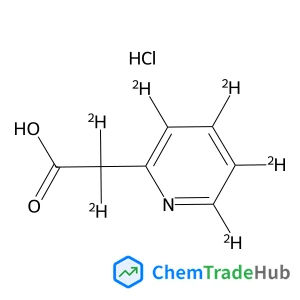
2,2-dideuterio-2-(3,4,5,6-tetradeuterio-2-pyridyl)acetic acid;hydrochloride
CAS番号:
1329799-67-8
分子式:
C7H2ClD6NO2
おすすめサプライヤー



免責事項
このページに表示される学術雑誌情報は、参考および研究目的のみを目的としています。当社は雑誌出版社とは提携しておらず、投稿の取り扱いも行っておりません。出版に関するお問い合わせは、各雑誌出版社に直接ご連絡ください。
表示されている情報に誤りがある場合は、support@chemtradehub.com までご連絡ください。迅速に確認し、対応いたします。