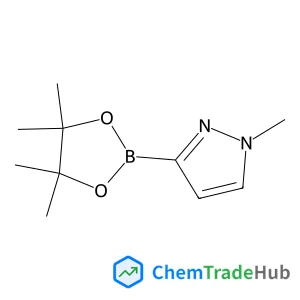
1-Methyl-3-(4,4,5,5-tetramethyl-1,3,2-dioxaborolan-2-yl)-1H-pyrazole
CAS番号:
1020174-04-2
分子式:
C10H17BN2O2
Radhakrishna Gattu, Suchandra Bhattacharjee, Karuna Mahato, Abu T. Khan
A simple and an efficient method for the regioselective synthesis of N-alkyl/aryl/H 3-arylindole derivatives from N-substituted anilines and trans-β-nitrostyrenes has been described using 10 mol% of bismuth(III) triflate as a catalyst in acetonitrile at 80 °C. The present protocol profits from the formation of new C–C and C–N bonds, broad substrate scope and moderate to good yields.
Dominic W. P. Collis, Yichen Yuan, Guy Ochbaum, Yejiao Shi, Veselina Uzunova, Richard Napier, Ronit Bitton
DOI: 10.1039/D0CB00223B
Kuan Hu, Lin Xie, Masayuki Hanyu, Yiding Zhang, Lingyun Li, Xiaohui Ma, Kotaro Nagatsu, Hisashi Suzuki, Weizhi Wang, Ming-Rong Zhang
DOI: 10.1039/D0CB00070A
Andrew J. Ambrose, Nhan T. Pham, Jared Sivinski, Niloufar Mollasalehi, Paula Jimenez, Maria A. Abad, A. Arockia Jeyaprakash, Steven Shave, Letícia V. Costa-Lotufo, James J. La Clair, Manfred Auer, Eli Chapman
DOI: 10.1039/D0CB00122H
Mickal Nawatha, Betsegaw Lemma, Ganga B. Vamisetti, Ido Livneh, Uri Barash, Israel Vlodavsky, Aaron Ciechanover, David Fushman, Hiroaki Suga, Ashraf Brik
DOI: 10.1039/D0CB00179A
Mikhail A. Kabeshov, Biagia Musio, Steven V. Ley
DOI: 10.1039/C7RE00164A
Jinny Claire Lee, Kim D. Janda
DOI: 10.1039/D0CB00165A
Heleen de Jong, Kimberly M. Bonger, Dennis W. P. M. Löwik
DOI: 10.1039/D0CB00114G
Rupali K. Desai, Hélène Monteillet, Xiaohua Li, Boelo Schuur, J. Mieke Kleijn, Frans A. M. Leermakers, Michel H. M. Eppink
DOI: 10.1039/C7RE00116A
M. Pohl, S. V. Ley, B. Musio
DOI: 10.1039/C7RE00173H
Marta Pazo, Giulia Salluce, Irene Lostalé-Seijo, Marisa Juanes, Rebeca Garcia-Fandiño, Javier Montenegro
DOI: 10.1039/D0CB00103A
2-メトキシ-4-(メチルスルフィニル)アミンは、主に医薬品および農薬の製造に使用されます。また、合成化学の一部として研究用材料としても利用されます。
代替品としては、4,6-二クロロピラミジンアミンや他のピラミジン系化合物が考えられます。ただし、目的と用途によって最適な代替品は異なります。
6-氯-4-甲基-1H-吲哚の廃棄物は、適切な容器に収集し、密閉して保管します。温度は常温、湿度は低く、直射日光を避けて保管することを推奨します。廃棄処理は専門...
2-フローユロ-4-(トリフルオロメチル)ベンゾイドのCAS番号は207974-08-1です。この化合物はGHS分類で毒性物質と有害な反応物質として分類されます...
4-ニトロフェニルN-[(ベンゼルオキシルカーボンイル]グリシングリシングリシン酸は、室温で暗所に保管し、乾燥した環境で保存することを推奨します。容器は密閉性の...
イソデスロラタドリンの代替品としては、デスロラタドリンや他の抗ヒスタミン薬が挙げられます。具体的には、デスロラタドリン、ラセカミド、フェルタドリンなどが、症状や...
5-甲氧基-1,2,3,4-四氢异喹啉盐酸盐の一般的な合成方法は、メタノール中で5-メトキシ-1,2,3,4-四ヒュドロイソキシンを塩酸で塩化します。この反応で...
CAS番号6471-78-9の4-アミノ-5-メトキシ-2-トルエンサルホニック酸は、GHS分類では corrosive(腐食性)と識別されます。EUのREAC...
甲基孕酮の取り扱いは、PPE(個人保護具)の使用が必要な重要な安全事項を伴います。防塵マスク、ゴーグル、手袋を着用することが推奨されます。ドラフトチャンバーを使...

Organic & Biomolecular Chemistry (OBC) publishes original and high impact research and reviews in organic chemistry. We welcome research that shows new or significantly improved protocols or methodologies in total synthesis, synthetic methodology or physical and theoretical organic chemistry as well as research that shows a significant advance in the organic chemistry or molecular design aspects of chemical biology, catalysis, supramolecular and macromolecular chemistry, theoretical chemistry, mechanism-oriented physical organic chemistry, medicinal chemistry or natural products. Articles published in the journal should report new work which makes a highly-significant impact in the field. Routine and incremental work is generally not suitable for publication in the journal. More details about key areas of our scope are below. In all cases authors should include in their article clear rationale for why their research has been carried out.