












Lewis acid-catalyzed enantiospecific [3 + 2] annulations of γ-butyrolactone fused cyclopropanes with aromatic aldehydes: synthesis of chiral furanolignans
文献情報
出版日
2018-03-22
DOI
10.1039/C8OB00455B
インパクトファクター
3.876
著者
Peng-Fei Yang, Gaosheng Yang, Wen-Long Chen, Zhuo Chai
原文を見る
要旨
An enantiospecific [3 + 2] annulation of γ-butyrolactone fused cyclopropanes with aromatic aldehydes was realized under Lewis acid catalysis. This method provides facile access to a series of chiral furanolignan derivatives bearing multiple contiguous stereogenic centers in good-to-excellent yields, exclusive diastereoselectivities and excellent enantiopurities under mild reaction conditions. Elaboration work on the product of this reaction delivers stereoisomeric analogues of (+)-virgatusin and suggests a structural revision might be necessary for a previously reported isolated natural product.
関連文献
Inhibition of chloroplast translation as a new target for herbicides
Karen J. Breese, Keith A. Stubbs
2021-11-10
Paper
DOI: 10.1039/D1CB00192B
A STING-based fluorescent polarization assay for monitoring activities of cyclic dinucleotide metabolizing enzymes
Caroline W. Karanja, Kofi S. Yeboah, Wilson W. S. Ong
2020-12-17
Paper
DOI: 10.1039/D0CB00187B
Short oligoalanine helical peptides for supramolecular nanopore assembly and protein cytosolic delivery
Marta Pazo, Giulia Salluce, Irene Lostalé-Seijo, Marisa Juanes, Rebeca Garcia-Fandiño, Javier Montenegro
2020-12-08
Paper
DOI: 10.1039/D0CB00103A
Tranylcypromine specificity for monoamine oxidase is limited by promiscuous protein labelling and lysosomal trapping
Jonas Drechsel, Christina Kyrousi, Silvia Cappello, Stephan A. Sieber
2020-08-12
Communication
DOI: 10.1039/D0CB00048E
The chemical biology of coronavirus host–cell interactions
Suprama Datta, Erik C. Hett, Kalpit A. Vora, Rob C. Oslund, Olugbeminiyi O. Fadeyi, Andrew Emili
2020-12-23
Review Article
DOI: 10.1039/D0CB00197J
Epoxidation of 1-octene under harsh tail-end conditions in a flow reactor I: a comparative study of crystalline vs. amorphous catalysts
Martina Aigner, Nicolás Andrés Grosso-Giordano, Alexander Okrut, Stacey Zones, Alexander Katz
2017-07-26
Paper
DOI: 10.1039/C7RE00076F
Strategies to promote permeation and vectorization, and reduce cytotoxicity of metal complex luminophores for bioimaging and intracellular sensing
Lorcan Holden, Christopher S. Burke, David Cullinane, Tia E. Keyes
2021-05-05
Review Article
DOI: 10.1039/D1CB00049G
Reactive oxygen species, proinflammatory and immunosuppressive mediators induced in COVID-19: overlapping biology with cancer
2021-06-30
Review Article
DOI: 10.1039/D1CB00042J
Natural product scaffolds as inspiration for the design and synthesis of 20S human proteasome inhibitors
Grace E. Hubbell, Jetze J. Tepe
2020-09-16
Review Article
DOI: 10.1039/D0CB00111B
こちらもおすすめ
化合物よくある質問
2-メトキシ-4-(メチルスルフィニル)アミンの主な用途は何ですか?
2-メトキシ-4-(メチルスルフィニル)アミンは、主に医薬品および農薬の製造に使用されます。また、合成化学の一部として研究用材料としても利用されます。
41608-73-52-Methoxy-4-(methyls...
118684-13-24-(Bromomethyl)-3-me...
化合物よくある質問
4,6-二氯-N-甲基ピラミジンアミンの代替品はありますか?
代替品としては、4,6-二クロロピラミジンアミンや他のピラミジン系化合物が考えられます。ただし、目的と用途によって最適な代替品は異なります。
10397-15-64,6-Dichloro-N-methy...
化合物よくある質問
6-氯-4-甲基-1H-吲哚を含む廃棄物はどのように処理すべきですか?
6-氯-4-甲基-1H-吲哚の廃棄物は、適切な容器に収集し、密閉して保管します。温度は常温、湿度は低く、直射日光を避けて保管することを推奨します。廃棄処理は専門...
885520-84-36-chloro-4-methyl-1H...
化合物よくある質問
2-フローユロ-4-(トリフルオロメチル)ベンゾイドについて「に適用される法規ガイドラインは何ですか」
2-フローユロ-4-(トリフルオロメチル)ベンゾイドのCAS番号は207974-08-1です。この化合物はGHS分類で毒性物質と有害な反応物質として分類されます...
207974-08-1[2-Fluoro-4-(trifluo...
化合物よくある質問
4-ニトロフェニルN-[(ベンゼルオキシルカーボンイル]グリシングリシングリシン酸はどのように保存すればよいですか?
4-ニトロフェニルN-[(ベンゼルオキシルカーボンイル]グリシングリシングリシン酸は、室温で暗所に保管し、乾燥した環境で保存することを推奨します。容器は密閉性の...
19811-64-44-Nitrophenyl N-[(be...
化合物よくある質問
イソデスロラタドリンの代替品はありますか?
イソデスロラタドリンの代替品としては、デスロラタドリンや他の抗ヒスタミン薬が挙げられます。具体的には、デスロラタドリン、ラセカミド、フェルタドリンなどが、症状や...
183198-49-4Iso Desloratadine
化合物よくある質問
5-甲氧基-1,2,3,4-四氢异喹啉盐酸盐はどのように合成されますか?
5-甲氧基-1,2,3,4-四氢异喹啉盐酸盐の一般的な合成方法は、メタノール中で5-メトキシ-1,2,3,4-四ヒュドロイソキシンを塩酸で塩化します。この反応で...
103030-69-95-Methoxy-1,2,3,4-te...
化合物よくある質問
4-アミノ-5-メトキシ-2-トルエンサルホニック酸についての法規ガイドラインは何ですか?
CAS番号6471-78-9の4-アミノ-5-メトキシ-2-トルエンサルホニック酸は、GHS分類では corrosive(腐食性)と識別されます。EUのREAC...
6471-78-94-Amino-5-Methoxy-2-...
化合物よくある質問
甲基孕酮を取り扱う際の実験室安全事項は何ですか?
甲基孕酮の取り扱いは、PPE(個人保護具)の使用が必要な重要な安全事項を伴います。防塵マスク、ゴーグル、手袋を着用することが推奨されます。ドラフトチャンバーを使...
204063-33-22-[(Diphenylmethyl)a...
掲載誌
Organic & Biomolecular Chemistry

CiteScore:
3.4
自己引用率:
10.3%
年間論文数:
1041
Organic & Biomolecular Chemistry (OBC) publishes original and high impact research and reviews in organic chemistry. We welcome research that shows new or significantly improved protocols or methodologies in total synthesis, synthetic methodology or physical and theoretical organic chemistry as well as research that shows a significant advance in the organic chemistry or molecular design aspects of chemical biology, catalysis, supramolecular and macromolecular chemistry, theoretical chemistry, mechanism-oriented physical organic chemistry, medicinal chemistry or natural products. Articles published in the journal should report new work which makes a highly-significant impact in the field. Routine and incremental work is generally not suitable for publication in the journal. More details about key areas of our scope are below. In all cases authors should include in their article clear rationale for why their research has been carried out.
おすすめ化合物
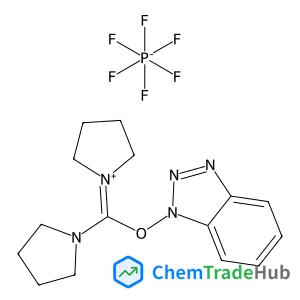
(1H-Benzotriazol-1-yloxy)(di-1-pyrrolidinyl)methylium hexafluorophosphate
CAS番号:
105379-24-6
分子式:
C15H21F6N5OP
おすすめサプライヤー




免責事項
このページに表示される学術雑誌情報は、参考および研究目的のみを目的としています。当社は雑誌出版社とは提携しておらず、投稿の取り扱いも行っておりません。出版に関するお問い合わせは、各雑誌出版社に直接ご連絡ください。
表示されている情報に誤りがある場合は、support@chemtradehub.com までご連絡ください。迅速に確認し、対応いたします。