












Synthesis and aggregation behaviour of single-chain, 1,32-alkyl branched bis(phosphocholines): effect of lateral chain length
文献情報
出版日
2018-03-19
DOI
10.1039/C8OB00424B
インパクトファクター
3.876
著者
K. Gruhle, S. Müller, A. Meister, S. Drescher
原文を見る
要旨
Three novel single-chain bis(phosphocholines) bearing two lateral alkyl chains of variable length next to the headgroup have been synthesized as model lipids for naturally occurring archaeal membrane lipids. The synthesis was realized using the Cu-catalyzed Grignard bis-coupling reaction of a primary bromide as a side part and a 1,ω-dibromide as a centre part. We could show that the aggregation behaviour of the resulting bolalipids strongly depends on the length of the lateral alkyl chain: the C3-branched bolalipid self-assembles into lamellar sheets, whereas the C6- and C9-analogues form nanofibres. The lamella-forming bolalipids could be used in the future to prepare stable and tailored liposomes for oral drug delivery.
関連文献
Fluorescent small-molecule agonists as follicle-stimulating hormone receptor imaging tools
Sascha Hoogendoorn, Gijs H. M. van Puijvelde, Gijs A. van der Marel, Chris J. van Koppen, C. Marco Timmers, Herman S. Overkleeft
2020-08-03
Paper
DOI: 10.1039/D0CB00068J
Investigation of the biological functions of heparan sulfate using a chemoenzymatic synthetic approach
Zhangjie Wang, Katelyn Arnold, Vijay Manohar Dhurandhare, Yongmei Xu, Jian Liu
2021-02-22
Review Article
DOI: 10.1039/D0CB00199F
Continuous direct anodic flow oxidation of aromatic hydrocarbons to benzyl amides
Mikhail A. Kabeshov, Biagia Musio, Steven V. Ley
2017-11-02
Communication
DOI: 10.1039/C7RE00164A
Fluorescence lifetime predicts performance of voltage sensitive fluorophores in cardiomyocytes and neurons
Steven C. Boggess, Julia R. Lazzari-Dean, Benjamin K. Raliski, Dong Min Mun, Amy Y. Li, Joshua L. Turnbull
2020-12-11
Paper
DOI: 10.1039/D0CB00152J
Synthesis and preliminary evaluation of octreotate conjugates of bioactive synthetic amatoxins for targeting somatostatin receptor (sstr2) expressing cells
Alla Pryyma, Kaveh Matinkhoo, Yong Jia Bu, Helen Merkens, Zhengxing Zhang, Francois Bénard, David M. Perrin
2021-10-07
Paper
DOI: 10.1039/D1CB00036E
Optogenetic modulation of real-time nanoscale dynamics of HCN channels using photoactivated adenylyl cyclases
Meenakshi Tanwar, Suneel Kateriya, Deepak Nair, Mini Jose
2021-03-08
Paper
DOI: 10.1039/D0CB00124D
Combining bacteriophage engineering and linear dichroism spectroscopy to produce a DNA hybridisation assay
Haydn A. Little, Jake G. Carter, Craig Douglas, Matthew R. Hicks, David M. Kenyon, Christophe Lacomme, Richard T. Logan, Timothy R. Dafforn, James H. R. Tucker
2020-10-23
Paper
DOI: 10.1039/D0CB00135J
DNA folds threaten genetic stability and can be leveraged for chemotherapy
Joanna Zell, Francesco Rota Sperti, David Monchaud
2020-09-30
Review Article
DOI: 10.1039/D0CB00151A
こちらもおすすめ
化合物よくある質問
2-メトキシ-4-(メチルスルフィニル)アミンの主な用途は何ですか?
2-メトキシ-4-(メチルスルフィニル)アミンは、主に医薬品および農薬の製造に使用されます。また、合成化学の一部として研究用材料としても利用されます。
41608-73-52-Methoxy-4-(methyls...
118684-13-24-(Bromomethyl)-3-me...
化合物よくある質問
4,6-二氯-N-甲基ピラミジンアミンの代替品はありますか?
代替品としては、4,6-二クロロピラミジンアミンや他のピラミジン系化合物が考えられます。ただし、目的と用途によって最適な代替品は異なります。
10397-15-64,6-Dichloro-N-methy...
化合物よくある質問
6-氯-4-甲基-1H-吲哚を含む廃棄物はどのように処理すべきですか?
6-氯-4-甲基-1H-吲哚の廃棄物は、適切な容器に収集し、密閉して保管します。温度は常温、湿度は低く、直射日光を避けて保管することを推奨します。廃棄処理は専門...
885520-84-36-chloro-4-methyl-1H...
化合物よくある質問
2-フローユロ-4-(トリフルオロメチル)ベンゾイドについて「に適用される法規ガイドラインは何ですか」
2-フローユロ-4-(トリフルオロメチル)ベンゾイドのCAS番号は207974-08-1です。この化合物はGHS分類で毒性物質と有害な反応物質として分類されます...
207974-08-1[2-Fluoro-4-(trifluo...
化合物よくある質問
4-ニトロフェニルN-[(ベンゼルオキシルカーボンイル]グリシングリシングリシン酸はどのように保存すればよいですか?
4-ニトロフェニルN-[(ベンゼルオキシルカーボンイル]グリシングリシングリシン酸は、室温で暗所に保管し、乾燥した環境で保存することを推奨します。容器は密閉性の...
19811-64-44-Nitrophenyl N-[(be...
化合物よくある質問
イソデスロラタドリンの代替品はありますか?
イソデスロラタドリンの代替品としては、デスロラタドリンや他の抗ヒスタミン薬が挙げられます。具体的には、デスロラタドリン、ラセカミド、フェルタドリンなどが、症状や...
183198-49-4Iso Desloratadine
化合物よくある質問
5-甲氧基-1,2,3,4-四氢异喹啉盐酸盐はどのように合成されますか?
5-甲氧基-1,2,3,4-四氢异喹啉盐酸盐の一般的な合成方法は、メタノール中で5-メトキシ-1,2,3,4-四ヒュドロイソキシンを塩酸で塩化します。この反応で...
103030-69-95-Methoxy-1,2,3,4-te...
化合物よくある質問
4-アミノ-5-メトキシ-2-トルエンサルホニック酸についての法規ガイドラインは何ですか?
CAS番号6471-78-9の4-アミノ-5-メトキシ-2-トルエンサルホニック酸は、GHS分類では corrosive(腐食性)と識別されます。EUのREAC...
6471-78-94-Amino-5-Methoxy-2-...
化合物よくある質問
甲基孕酮を取り扱う際の実験室安全事項は何ですか?
甲基孕酮の取り扱いは、PPE(個人保護具)の使用が必要な重要な安全事項を伴います。防塵マスク、ゴーグル、手袋を着用することが推奨されます。ドラフトチャンバーを使...
204063-33-22-[(Diphenylmethyl)a...
掲載誌
Organic & Biomolecular Chemistry

CiteScore:
3.4
自己引用率:
10.3%
年間論文数:
1041
Organic & Biomolecular Chemistry (OBC) publishes original and high impact research and reviews in organic chemistry. We welcome research that shows new or significantly improved protocols or methodologies in total synthesis, synthetic methodology or physical and theoretical organic chemistry as well as research that shows a significant advance in the organic chemistry or molecular design aspects of chemical biology, catalysis, supramolecular and macromolecular chemistry, theoretical chemistry, mechanism-oriented physical organic chemistry, medicinal chemistry or natural products. Articles published in the journal should report new work which makes a highly-significant impact in the field. Routine and incremental work is generally not suitable for publication in the journal. More details about key areas of our scope are below. In all cases authors should include in their article clear rationale for why their research has been carried out.
おすすめ化合物
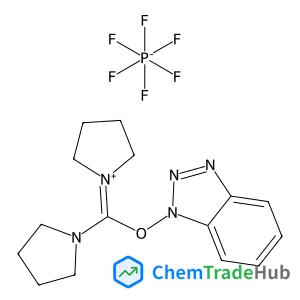
(1H-Benzotriazol-1-yloxy)(di-1-pyrrolidinyl)methylium hexafluorophosphate
CAS番号:
105379-24-6
分子式:
C15H21F6N5OP
![1-Naphthalenesulfonic acid, 2-[(2-hydroxy-1-naphthalenyl)azo]-, bariumsalt (2:1) structure](https://static.chemtradehub.com/structs/110/1103-38-4-0b33.webp "1-Naphthalenesulfonic acid, 2-[(2-hydroxy-1-naphthalenyl)azo]-, bariumsalt (2:1) structure")
1-Naphthalenesulfonic acid, 2-[(2-hydroxy-1-naphthalenyl)azo]-, bariumsalt (2:1)
CAS番号:
1103-38-4
分子式:
C20H14BaN2O4S
![[4-Amino-2-(methylsulfanyl)-5-pyrimidinyl]methanol structure](https://static.chemtradehub.com/structs/588/588-36-3-fc73.webp "[4-Amino-2-(methylsulfanyl)-5-pyrimidinyl]methanol structure")
おすすめサプライヤー



免責事項
このページに表示される学術雑誌情報は、参考および研究目的のみを目的としています。当社は雑誌出版社とは提携しておらず、投稿の取り扱いも行っておりません。出版に関するお問い合わせは、各雑誌出版社に直接ご連絡ください。
表示されている情報に誤りがある場合は、support@chemtradehub.com までご連絡ください。迅速に確認し、対応いたします。