












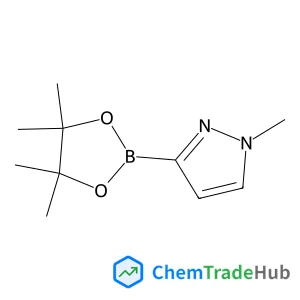
1-Methyl-3-(4,4,5,5-tetramethyl-1,3,2-dioxaborolan-2-yl)-1H-pyrazole
CAS番号:
1020174-04-2
分子式:
C10H17BN2O2
Jianghai Ho, Jason Karl Liu, Radhanath Purakait, Uriel N. Morzan, Lucky Ahmed, Victor S. Batista, Hiroaki Matsunami
The rodent OR-I7 is an olfactory receptor exemplar activated by aliphatic aldehydes such as octanal. Normal alkanals shorter than heptanal bind OR-I7 without activating it and hence function as antagonists in vitro. We report a series of aldehydes designed to probe the structural requirements for aliphatic ligand chains too short to meet the minimum approximate 6.9 Å length requirement for receptor activation. Experiments using recombinant mouse OR-I7 expressed in heterologous cells show that in the context of short aldehyde antagonists, OR-I7 prefers binding aliphatic chains without branches, though a single methyl on carbon-3 is permitted. The receptor can accommodate a surprisingly large number of carbons (e.g. ten in adamantyl) as long as the carbons are part of a conformationally constrained ring system. A rhodopsin-based homology model of mouse OR-I7 docked with the new antagonists suggests that small alkyl branches on the alkyl chain sterically interfere with the hydrophobic residues lining the binding site, but branch carbons can be accommodated when tied back into a compact ring system like the adamantyl and bicyclo[2.2.2]octyl systems.
Huan Peng, Brandon Latifi, Sabine Müller, Andrej Lupták, Irene A. Chen
DOI: 10.1039/D0CB00207K
Arnab Bandyopadhyay, Achinta Sannigrahi, Krishnananda Chattopadhyay
DOI: 10.1039/D0CB00203H
Debabrata Maity, Sunil Kumar, Ruyof AlHussein, Madeline Howarth, Laura Karpauskaite, Mazin Magzoub, Andrew D. Hamilton
DOI: 10.1039/D0CB00086H
Adeline Espinasse, Hannah K. Lembke, Angela A. Cao
DOI: 10.1039/D0CB00078G
Sascha Hoogendoorn, Gijs H. M. van Puijvelde, Gijs A. van der Marel, Chris J. van Koppen, C. Marco Timmers, Herman S. Overkleeft
DOI: 10.1039/D0CB00068J
Tyrza van Leeuwen, Can Araman, Linda Pieper Pournara, Arieke S. B. Kampstra, Thomas Bakkum, Mikkel H. S. Marqvorsen, Clarissa R. Nascimento, G. J. Mirjam Groenewold, Willemijn van der Wulp, Marcel G. M. Camps, George M. C. Janssen, Peter A. van Veelen, Gerard J. P. van Westen, Antonius P. A. Janssen, Bogdan I. Florea, Herman S. Overkleeft, Ferry A. Ossendorp, René E. M. Toes, Sander I. van Kasteren
DOI: 10.1039/D1CB00009H
Taylor A. Lundy, Shogo Mori, Sylvie Garneau-Tsodikova
DOI: 10.1039/D0CB00092B
DOI: 10.1039/D1CB00075F
Florian Mayerthaler, Anna-Lena Feldberg, Jonas Alfermann, Xun Sun, Wieland Steinchen, Haw Yang, Henning D. Mootz
DOI: 10.1039/D0CB00220H
2-メトキシ-4-(メチルスルフィニル)アミンは、主に医薬品および農薬の製造に使用されます。また、合成化学の一部として研究用材料としても利用されます。
代替品としては、4,6-二クロロピラミジンアミンや他のピラミジン系化合物が考えられます。ただし、目的と用途によって最適な代替品は異なります。
6-氯-4-甲基-1H-吲哚の廃棄物は、適切な容器に収集し、密閉して保管します。温度は常温、湿度は低く、直射日光を避けて保管することを推奨します。廃棄処理は専門...
2-フローユロ-4-(トリフルオロメチル)ベンゾイドのCAS番号は207974-08-1です。この化合物はGHS分類で毒性物質と有害な反応物質として分類されます...
4-ニトロフェニルN-[(ベンゼルオキシルカーボンイル]グリシングリシングリシン酸は、室温で暗所に保管し、乾燥した環境で保存することを推奨します。容器は密閉性の...
イソデスロラタドリンの代替品としては、デスロラタドリンや他の抗ヒスタミン薬が挙げられます。具体的には、デスロラタドリン、ラセカミド、フェルタドリンなどが、症状や...
5-甲氧基-1,2,3,4-四氢异喹啉盐酸盐の一般的な合成方法は、メタノール中で5-メトキシ-1,2,3,4-四ヒュドロイソキシンを塩酸で塩化します。この反応で...
CAS番号6471-78-9の4-アミノ-5-メトキシ-2-トルエンサルホニック酸は、GHS分類では corrosive(腐食性)と識別されます。EUのREAC...
甲基孕酮の取り扱いは、PPE(個人保護具)の使用が必要な重要な安全事項を伴います。防塵マスク、ゴーグル、手袋を着用することが推奨されます。ドラフトチャンバーを使...

Organic & Biomolecular Chemistry (OBC) publishes original and high impact research and reviews in organic chemistry. We welcome research that shows new or significantly improved protocols or methodologies in total synthesis, synthetic methodology or physical and theoretical organic chemistry as well as research that shows a significant advance in the organic chemistry or molecular design aspects of chemical biology, catalysis, supramolecular and macromolecular chemistry, theoretical chemistry, mechanism-oriented physical organic chemistry, medicinal chemistry or natural products. Articles published in the journal should report new work which makes a highly-significant impact in the field. Routine and incremental work is generally not suitable for publication in the journal. More details about key areas of our scope are below. In all cases authors should include in their article clear rationale for why their research has been carried out.

![4-{2-[4-(2-Methyl-2-propanyl)phenyl]ethoxy}quinazoline structure](https://static.chemtradehub.com/structs/120/120928-09-8-d3db.webp "4-{2-[4-(2-Methyl-2-propanyl)phenyl]ethoxy}quinazoline structure")
![1,2-Diphenyl-4-[2-(phenylsulfinyl)ethyl]-3,5-pyrazolidinedione structure](https://static.chemtradehub.com/structs/57-/57-96-5-efcc.webp "1,2-Diphenyl-4-[2-(phenylsulfinyl)ethyl]-3,5-pyrazolidinedione structure")





