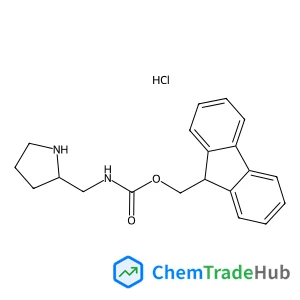
(S)-(9H-Fluoren-9-yl)methyl (pyrrolidin-2-ylmethyl)carbamate hydrochloride
CAS番号:
1217813-15-4
分子式:
C20H23ClN2O2
Xiangkun Wu, Tongpo Yu, Yan Chen, Xiaoguo Zhou, Shilin Liu, Xinhua Dai, Fuyi Liu, Liusi Sheng
The dissociative photoionization of CF3Cl was investigated using threshold photoelectron photoion coincidence (TPEPICO) imaging in the energy range of 12.30–18.50 eV. The coincident time-of-flight mass spectra and three-dimensional time-sliced images of the CF2Cl+ fragment were recorded at a few specific photon energies. Two fragmentation pathways were observed that led to the breakage of the C–Cl and C–F bonds, while the branching ratio elicited an energy-dependent relationship. The CF3+ fragment was dominant in the dissociation of the X2E, A2A′ and B2A′′ states, while CF2Cl+ became the predominant fragment and its branching ratio remained constant in the energy range associated with the C2E and D2E states. Based on the inflection point in the energy-dependent curve of the fragment branching ratios, the adiabatic ionization energy (IEa) of C2E is suggested to be 15.46 eV. Although the excess energy increased considerably from C2E to D2E, the kinetic energy release distributions (KERDs) of CF2Cl+ were similar. Moreover, the anisotropy parameters β for the F-loss channel were positive and larger than those for the Cl-loss channel. The calculated F-loss potential energy curves of CF3Cl+ suggested that for the C2E and D2E states, the C–F bond rupture occurred via the internal conversion to the A2A′ state followed by the dissociation attributed to the crossing of the barrier along the C–F coordinate. Based on the experimental and theoretical conclusions, the internal conversion is the rate-determining step in the dissociative photoionization of CF3Cl via the C2E and D2E ionic states, irrespective of whether the C–F and C–Cl bonds rupture.
Yanfei Shen, Yuanjian Zhang, Qixian Zhang, Tianyan You, Ari Ivaska
DOI: 10.1039/B507688A
Edel M. Minogue, Tammy P. Taylor, Anthony K. Burrell, George J. Havrilla, Benjamin P. Warner, Michael T. Janicke
DOI: 10.1039/B506044C
Liang Li, Huifeng Qian, Jicun Ren
DOI: 10.1039/B505791D
Nagendra K. Sharma, Krishna N. Ganesh
DOI: 10.1039/B506870C
Yvonne Chiang, A. Jerry Kresge, Ikenna Onyido, John P. Richard, Peter Wan, Musheng Xu
DOI: 10.1039/B506706E
Christian J. Baylies, John C. Jeffery, Tom A. Miller, Ryan Moon, Craig R. Rice, T. Riis-Johannessen
DOI: 10.1039/B506199G
Yoshiko K. Takahara, Koji Tachi, Takao Sakata, Toshiaki Hasegawa, Hirotaro Mori, Michio Matsumura, Bunsho Ohtani
DOI: 10.1039/B507123B
Takashi Jin, Fumihiko Fujii, Hiroshi Sakata, Mamoru Tamura, Masataka Kinjo
DOI: 10.1039/B506608E
2-メトキシ-4-(メチルスルフィニル)アミンは、主に医薬品および農薬の製造に使用されます。また、合成化学の一部として研究用材料としても利用されます。
代替品としては、4,6-二クロロピラミジンアミンや他のピラミジン系化合物が考えられます。ただし、目的と用途によって最適な代替品は異なります。
6-氯-4-甲基-1H-吲哚の廃棄物は、適切な容器に収集し、密閉して保管します。温度は常温、湿度は低く、直射日光を避けて保管することを推奨します。廃棄処理は専門...
2-フローユロ-4-(トリフルオロメチル)ベンゾイドのCAS番号は207974-08-1です。この化合物はGHS分類で毒性物質と有害な反応物質として分類されます...
4-ニトロフェニルN-[(ベンゼルオキシルカーボンイル]グリシングリシングリシン酸は、室温で暗所に保管し、乾燥した環境で保存することを推奨します。容器は密閉性の...
イソデスロラタドリンの代替品としては、デスロラタドリンや他の抗ヒスタミン薬が挙げられます。具体的には、デスロラタドリン、ラセカミド、フェルタドリンなどが、症状や...
5-甲氧基-1,2,3,4-四氢异喹啉盐酸盐の一般的な合成方法は、メタノール中で5-メトキシ-1,2,3,4-四ヒュドロイソキシンを塩酸で塩化します。この反応で...
CAS番号6471-78-9の4-アミノ-5-メトキシ-2-トルエンサルホニック酸は、GHS分類では corrosive(腐食性)と識別されます。EUのREAC...
甲基孕酮の取り扱いは、PPE(個人保護具)の使用が必要な重要な安全事項を伴います。防塵マスク、ゴーグル、手袋を着用することが推奨されます。ドラフトチャンバーを使...

Physical Chemistry Chemical Physics (PCCP) is an international journal co-owned by 19 physical chemistry and physics societies from around the world. This journal publishes original, cutting-edge research in physical chemistry, chemical physics and biophysical chemistry. To be suitable for publication in PCCP, articles must include significant innovation and/or insight into physical chemistry; this is the most important criterion that reviewers and Editors will judge against when evaluating submissions. The journal has a broad scope and welcomes contributions spanning experiment, theory, computation and data science. Topical coverage includes spectroscopy, dynamics, kinetics, statistical mechanics, thermodynamics, electrochemistry, catalysis, surface science, quantum mechanics, quantum computing and machine learning. Interdisciplinary research areas such as polymers and soft matter, materials, nanoscience, energy, surfaces/interfaces, and biophysical chemistry are welcomed if they demonstrate significant innovation and/or insight into physical chemistry. Joined experimental/theoretical studies are particularly appreciated when complementary and based on up-to-date approaches.
![4-[(2-{2-[2-(2-Aminoethoxy)ethoxy]ethoxy}ethyl)amino]-2-(2,6-dioxo-3-piperidinyl)-1H-isoindole-1,3(2H)-dione structure](https://static.chemtradehub.com/structs/209/2093416-31-8-3162.webp "4-[(2-{2-[2-(2-Aminoethoxy)ethoxy]ethoxy}ethyl)amino]-2-(2,6-dioxo-3-piperidinyl)-1H-isoindole-1,3(2H)-dione structure")
![[5-fluoro-2-(morpholine-4-carbonyl)phenyl]boronic acid structure](https://static.chemtradehub.com/structs/121/1217501-26-2-505c.webp "[5-fluoro-2-(morpholine-4-carbonyl)phenyl]boronic acid structure")