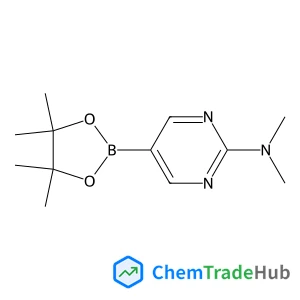
N,N-Dimethyl-5-(4,4,5,5-tetramethyl-1,3,2-dioxaborolan-2-yl)-2-pyrimidinamine
CAS番号:
1032759-30-0
分子式:
C12H20BN3O2
Juan P. Aranguren-Abrate, Claude Dedonder-Lardeux, Christophe Jouvet
The competition between dissociative photodetachment and photodissociation of cold benzoate and naphthoate anions was studied through measurement of the kinetic energy of the neutral fragments and intact parent benzoyloxy and naphtoyloxy radicals as well as by detecting the anionic fragments whenever they are produced. For the benzoate anion, there is no ionic photodissociation and the radical dissociation occurs near the vertical photodetachment energy. This is in agreement with DFT calculations showing that the dissociation energy in CO2 and C6H5˙ is very low. The dissociation barrier can be deduced from experimental results and calculations to be (0.7 ± 0.1) eV, which makes the benzoyloxyradical C6H5COO˙ very unstable, although more stable than the acetyloxy radical. In the case of naphthoate, the observation of negative fragments at low excitation energies demonstrates the opening of the ionic photodissociation channel in the excited state of the naphthoate anion, whose yield decreases at higher energies when the dissociative photodetachment channel opens.
Manolis J. Manos, Joon I. Jang, John B. Ketterson, Mercouri G. Kanatzidis
DOI: 10.1039/B712732D
Michael Schmittel, Prasenjit Mal
DOI: 10.1039/B718185J
Craig P. Butts, Michael Green, Thomas N. Hooper, Richard J. Kilby, John E. McGrady, Dimitrios A. Pantazis, Christopher A. Russell
DOI: 10.1039/B717204D
Christopher J. C. Whitehouse, Stephen G. Bell, Henry G. Tufton, Richard J. P. Kenny, Lydia C. I. Ogilvie, Luet-Lok Wong
DOI: 10.1039/B718124H
Sebastian Burck, Daniela Förster, Dietrich Gudat
DOI: 10.1039/B605278A
Ruth Rawcliffe, Martin Heeney, Steven Tierney, Iain McCulloch, Alasdair Campbell
DOI: 10.1039/B715536K
Junhui Xu
DOI: 10.1039/B606429A
Sébastien Royer, Xavier Sécordel, Markus Brandhorst, Franck Dumeignil, Sylvain Cristol, Christophe Dujardin, Mickaël Capron, Edmond Payen, Jean-Luc Dubois
DOI: 10.1039/B714260A
Jun-Young Lee, Colin D. Wood, Darren Bradshaw, Matthew J. Rosseinsky, Andrew I. Cooper
DOI: 10.1039/B604625H
6- bromo-1-cyclopropyl-1H-benzimidazoleは、抗炎症、抗ウイルス作用を持つことが報告されており、新薬開発の研究対象として注目...
取り扱う際には、防護眼鏡と手袋を使用し、ドラフトチャンバー内で操作することを推奨します。漏洩時には適切な手順で処理し、安全データシートを常に参照してください。
2,2’-ジメチル-3,3’-ビピリジンは、ピリジンと2-メチルアクリルアミドを有機合成反応で合成します。この反応では、ピリジンと2-メチルアクリルアミドを含有...
6-甲基ピリジン-2-ボリック酸は、合成化学、医薬品合成、以及研究用途などに広く使用され、特に組換えDNA技術や分子生物学の研究において重要な役割を果たします。
(R)-3-(1-甲基-2-氧環己基)プロpano酸メチルは一定の安全性がありますが、直接的な皮膚接触や吸入は避けるべきです。使用する際は適切な個々の安全データ...
ketorolacは、密封して遮光容器に保管し、直射日光や高温を避けて保存してください。温度は常温で保存し、湿度をなるべく低く保つことが推奨されます。
L-2,3-二氨基丙酸二盐酸盐は腐食性が強く、皮膚や粘膜に刺激を与える可能性があります。取り扱う際は、防塵マスク、ゴーグル、手袋を使用し、適切な排気設備を使用し...
2-(4-溴ピリジン-2-基)乙腈のCAS番号は312325-73-8です。主に結晶形態で存在し、分子量は159.01 g/molです。この化合物は水に溶けやす...
この化合物は毒性は低いですが、直接的な接触や吸入に注意が必要です。PPE(個人防護具)を着用し、ドラフトチャンバーを使用して操作することを推奨します。また、漏洩...
3-(1-氧代-1,3-二氢-2H-2-异吲哚)丙酸は、薬理学研究や医薬品製造において広く用いられる化合物です。また、工業的な用途でも一部の化学反応の触媒や助剤...

Physical Chemistry Chemical Physics (PCCP) is an international journal co-owned by 19 physical chemistry and physics societies from around the world. This journal publishes original, cutting-edge research in physical chemistry, chemical physics and biophysical chemistry. To be suitable for publication in PCCP, articles must include significant innovation and/or insight into physical chemistry; this is the most important criterion that reviewers and Editors will judge against when evaluating submissions. The journal has a broad scope and welcomes contributions spanning experiment, theory, computation and data science. Topical coverage includes spectroscopy, dynamics, kinetics, statistical mechanics, thermodynamics, electrochemistry, catalysis, surface science, quantum mechanics, quantum computing and machine learning. Interdisciplinary research areas such as polymers and soft matter, materials, nanoscience, energy, surfaces/interfaces, and biophysical chemistry are welcomed if they demonstrate significant innovation and/or insight into physical chemistry. Joined experimental/theoretical studies are particularly appreciated when complementary and based on up-to-date approaches.