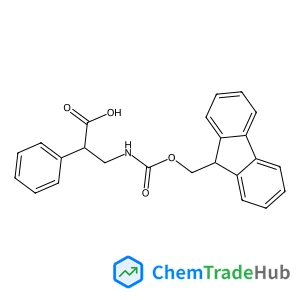
(S)-3-((((9H-Fluoren-9-yl)methoxy)carbonyl)amino)-2-phenylpropanoic acid
CAS番号:
1217663-60-9
分子式:
C24H21NO4
Marcelo Lopes Pereira Junior, Rafael Timóteo de Sousa Júnior, Geraldo Magela e Silva
Polarons play a crucial role in the charge transport mechanism when it comes to organic molecular crystals. The features of their underlying properties – mostly the ones that directly impact the yield of the net charge mobility – are still not completely understood. Here, a two-dimensional Holstein–Peierls model is employed to numerically describe the stationary polaron properties in organic semiconductors at a molecular scale. Our computational protocol yields model parameters that accurately characterize the formation and stability of polarons in ordered and disordered oligoacene-like crystals. The results show that the interplay between the intramolecular (Holstein) and intermolecular (Peierls) electron–lattice interactions critically impacts the polaron stability. Such an interplay can produce four distinct quasi-particle solutions: free-like electrons, metastable polarons, and small and large polarons. The latter governs the charge transport in organic crystalline semiconductors. Regarding disordered lattices, the model takes into account two modes of static disorder. Interestingly, the results show that intramolecular disorder is always unfavorable to the formation of polarons whereas intermolecular disorder may favor the polaron generation in regimes below a threshold for the electronic transfer integral strength.
Felcia Lai, Jonathan J. Du, Linda Váradi, Daniel Baker, Paul W. Groundwater, Jacob Overgaard, James A. Platts, David E. Hibbs
DOI: 10.1039/C6CP02690G
Shubhankar Bhattacharyya, Faiz Ullah Shah
DOI: 10.1039/C6CP05804C
Subrata Mondal, M. V. Sangaranarayanan
DOI: 10.1039/C6CP04975C
Yong Seok Hwang, Valery I. Levitas
DOI: 10.1039/C6CP03897B
Jinze Li, Jieyi Chen, Jiale Yang
DOI: 10.1039/C6CP05671G
Bernhard Frick, Johannes Elbert, Markus Gallei, Bernd Stühn
DOI: 10.1039/C6CP05156A
Yuliang Zhang, Yuzhen Wei, Xiangyun Song, Yanbo Fu, Vincent S. Battaglia
DOI: 10.1039/C6CP06609G
Myriam Barrejón, María J. Gómez-Escalonilla, José Luis G. Fierro, Pilar Prieto, José R. Carrillo, Gonzalo Abellán, M, Mercedes Gabás, Juan T. López-Navarrete, Fernando Langa
DOI: 10.1039/C6CP05285A
Argyrios Karatrantos, Qiong Cai
DOI: 10.1039/C6CP04611H
6- bromo-1-cyclopropyl-1H-benzimidazoleは、抗炎症、抗ウイルス作用を持つことが報告されており、新薬開発の研究対象として注目...
取り扱う際には、防護眼鏡と手袋を使用し、ドラフトチャンバー内で操作することを推奨します。漏洩時には適切な手順で処理し、安全データシートを常に参照してください。
2,2’-ジメチル-3,3’-ビピリジンは、ピリジンと2-メチルアクリルアミドを有機合成反応で合成します。この反応では、ピリジンと2-メチルアクリルアミドを含有...
6-甲基ピリジン-2-ボリック酸は、合成化学、医薬品合成、以及研究用途などに広く使用され、特に組換えDNA技術や分子生物学の研究において重要な役割を果たします。
(R)-3-(1-甲基-2-氧環己基)プロpano酸メチルは一定の安全性がありますが、直接的な皮膚接触や吸入は避けるべきです。使用する際は適切な個々の安全データ...
ketorolacは、密封して遮光容器に保管し、直射日光や高温を避けて保存してください。温度は常温で保存し、湿度をなるべく低く保つことが推奨されます。
L-2,3-二氨基丙酸二盐酸盐は腐食性が強く、皮膚や粘膜に刺激を与える可能性があります。取り扱う際は、防塵マスク、ゴーグル、手袋を使用し、適切な排気設備を使用し...
2-(4-溴ピリジン-2-基)乙腈のCAS番号は312325-73-8です。主に結晶形態で存在し、分子量は159.01 g/molです。この化合物は水に溶けやす...
この化合物は毒性は低いですが、直接的な接触や吸入に注意が必要です。PPE(個人防護具)を着用し、ドラフトチャンバーを使用して操作することを推奨します。また、漏洩...
3-(1-氧代-1,3-二氢-2H-2-异吲哚)丙酸は、薬理学研究や医薬品製造において広く用いられる化合物です。また、工業的な用途でも一部の化学反応の触媒や助剤...

Physical Chemistry Chemical Physics (PCCP) is an international journal co-owned by 19 physical chemistry and physics societies from around the world. This journal publishes original, cutting-edge research in physical chemistry, chemical physics and biophysical chemistry. To be suitable for publication in PCCP, articles must include significant innovation and/or insight into physical chemistry; this is the most important criterion that reviewers and Editors will judge against when evaluating submissions. The journal has a broad scope and welcomes contributions spanning experiment, theory, computation and data science. Topical coverage includes spectroscopy, dynamics, kinetics, statistical mechanics, thermodynamics, electrochemistry, catalysis, surface science, quantum mechanics, quantum computing and machine learning. Interdisciplinary research areas such as polymers and soft matter, materials, nanoscience, energy, surfaces/interfaces, and biophysical chemistry are welcomed if they demonstrate significant innovation and/or insight into physical chemistry. Joined experimental/theoretical studies are particularly appreciated when complementary and based on up-to-date approaches.