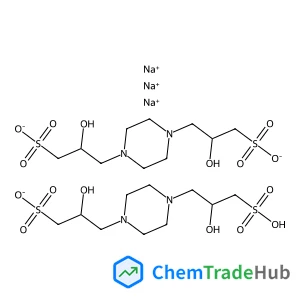
3,3'-(Piperazine-1,4-diyl)bis(2-hydroxypropane-1-sulfonic acid) Sodium Salt
CAS番号:
108321-08-0
分子式:
C20H41N4Na3O16S4
Xiaoguang Li, Xiao Zheng, Jinlong Yang
Understanding the role of spin-environment interactions in the electron transport properties of magnetic quantum systems is central to the rational design of spintronics devices. Herein, two emergent phenomena arising from such interactions, namely, the Kondo effect and magnetic anisotropy, are investigated theoretically in bilayer transition metal phthalocyanine (TMPc) (TM = Co, Fe) on a Pb(111) substrate by combining the density functional theory (DFT) and hierarchical equations of motion (HEOM) approaches. The calculation results indicate that the Kondo temperature TK and magnetic anisotropy energy in TMPc/TMPc/Pb(111) junctions can be actively tuned through the modification of the TM atom at the molecular center. In particular, the CoPc/FePc/Pb(111) composite exhibits a similar spin-1/2 Kondo effect as the CoPc/CoPc/Pb(111) composite reported previously in experiments, but TK is one order of magnitude larger with the modification of the intermediate decoupling layer from CoPc to FePc. Moreover, the magnetic anisotropy energy of the composite systems can also be switched from the easy axis of D = −12.6 meV, E = 1.56 meV in FePc/CoPc/Pb(111) to D = −11.2 meV, E = 0.0 meV in FePc/FePc/Pb(111) by changing the intermediate layer. We attribute these intriguing tunabilities to the different spin-electron coupling and symmetry of the ligand field provided by the intermediate layer. These findings demonstrate the importance of the decoupling layer for the magnetic properties of adsorbates and offer a promising strategy for the design of spintronics.

Journal of Peptide Science

Chemical Communications

Russian Journal of Coordination Chemistry

Journal of Saudi Chemical Society

Russian Chemical Bulletin

Russian Journal of Applied Chemistry

Drug Discovery Today

Journal of Natural Medicines

Russian Journal of Bioorganic Chemistry

Russian Journal of Organic Chemistry
Miloš T. Ivanović, Linda K. Bruetzel, Roman Shevchuk, Jan Lipfert, Jochen S. Hub
DOI: 10.1039/C8CP03080D
Phillip A. Coles, Sergei N. Yurchenko, Richard P. Kovacich, James Hobby, Jonathan Tennyson
DOI: 10.1039/C8CP07110A
Ashok K. Verma, P. Modak
DOI: 10.1039/C8CP04410D
Penggang Wang, Yuting Jia, Tao Li, Dongshuai Hou, Qi Zheng
DOI: 10.1039/C8CP02450B
Dominique Verreault, Sarah Alamdari, Steven J. Roeters, Ravindra Pandey, Jim Pfaendtner
DOI: 10.1039/C8CP03382J
Yuji Nakashima, Kenichi Okutsu, Keita Fujimoto, Yuri Ito, Manabu Kanno, Keijiro Ohshimo, Hirohiko Kono, Fuminori Misaizu
DOI: 10.1039/C8CP07068G
Minh v. Duong, Hieu T. Nguyen, Lam K. Huynh
DOI: 10.1039/C8CP05386C
Guillaume Acke, Sofie Van Damme, Remco W. A. Havenith, Patrick Bultinck
DOI: 10.1039/C8CP07343K
Marija Baranac-Stojanović, Milovan Stojanović
DOI: 10.1039/C8CP07875K
間 brom 苯甲酰腈は、合成化学や薬物化学において重要な Intermediate として使用されています。市場動向としては、その合成性と機能性により、研究開...
CAS番号117324-58-0の塩酸メチル2アミノ-5-トリフルオロメチルベンゼートは、GHS分類により腐食性物質と判定されます。REACH規則では、製造、販...
毒性があるため、適切な安全対策が必須です。皮膚や粘膜への刺激性が強く、吸入や誤飲により健康被害を引き起こす可能性があります。取扱時にはガスマスクや手袋、眼鏡を使...
三氟甲基ピリジン-2-甲アミン塩酸塩は安全性に注意が必要です。毒性は低レベルですが、直接的接触や吸入は避けるべきです。適切な手袋や防塵マスクを着用し、密閉された...
1-エチル-4-(4-硝基フェニル)ピペリジンは有毒であり、取扱には注意が必要です。保管や作業中に手袋を着用し、目や皮膚に接触しないように注意する必要があります...
1,1-ジメトキシプロパン-2-オンは一般的に低毒性ですが、皮膚や目への刺激性があるため、取扱いには注意が必要です。蒸気や液体の吸入には有害な可能性があり、適切...
この化合物はCAS番号259259-80-8に対応しています。GHS分類では、毒性、燃焼性、反応性、炎症性を考慮に入れ、適切な危険性分類が行われます。REACH...
この化合物は、冷却庫で-20℃の温度、乾燥した容器に保管し、直日光から保護する必要があります。湿度の高い環境や高温は避けてください。

Physical Chemistry Chemical Physics (PCCP) is an international journal co-owned by 19 physical chemistry and physics societies from around the world. This journal publishes original, cutting-edge research in physical chemistry, chemical physics and biophysical chemistry. To be suitable for publication in PCCP, articles must include significant innovation and/or insight into physical chemistry; this is the most important criterion that reviewers and Editors will judge against when evaluating submissions. The journal has a broad scope and welcomes contributions spanning experiment, theory, computation and data science. Topical coverage includes spectroscopy, dynamics, kinetics, statistical mechanics, thermodynamics, electrochemistry, catalysis, surface science, quantum mechanics, quantum computing and machine learning. Interdisciplinary research areas such as polymers and soft matter, materials, nanoscience, energy, surfaces/interfaces, and biophysical chemistry are welcomed if they demonstrate significant innovation and/or insight into physical chemistry. Joined experimental/theoretical studies are particularly appreciated when complementary and based on up-to-date approaches.
![O-Benzyl-N-[(9H-fluoren-9-ylmethoxy)carbonyl]-N-methyl-L-threonine structure](https://static.chemtradehub.com/structs/198/198561-81-8-a56e.webp "O-Benzyl-N-[(9H-fluoren-9-ylmethoxy)carbonyl]-N-methyl-L-threonine structure")
![(1S,4aR,5R,7S,7aS)-1-(beta-D-Glucopyranosyloxy)-5-hydroxy-7-methyl-1,4a,5,6,7,7a-hexahydrocyclopenta[c]pyran-7-yl alpha-D-galactopyranoside structure](https://static.chemtradehub.com/structs/817/81720-07-2-4ffd.webp "(1S,4aR,5R,7S,7aS)-1-(beta-D-Glucopyranosyloxy)-5-hydroxy-7-methyl-1,4a,5,6,7,7a-hexahydrocyclopenta[c]pyran-7-yl alpha-D-galactopyranoside structure")