












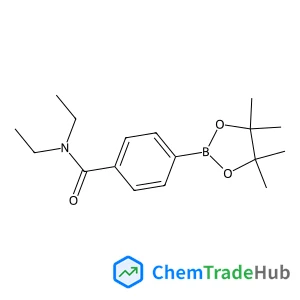
N,N-Diethyl-4-(4,4,5,5-tetramethyl-1,3,2-dioxaborolan-2-yl)benzamide
CAS番号:
325142-99-2
分子式:
C17H26BNO3
Elena F. Belogolova, Evgeniya P. Doronina, Valery F. Sidorkin
The problematic experimental photoelectron spectra of silatranes XSi[OCH2CH2]3N (X = vinyl and Ph) were theoretically studied. The ab initio electron propagator theory, many-body methods, and model vibrational Hamiltonian were employed to establish the nature of bands in the energetically lowest part of the photoelectron spectrum of these intramolecular silicon complexes. The first vertical ionization energy corresponds to a nitrogen atom lone pair, nN, in 1-vinylsilatrane, and the essentially doubly degenerate π-orbitals πPh and πPh′ of the aromatic ring in 1-phenylsilatrane. Peaks at 9.6 and 9.9 eV in the spectra of both compounds, previously associated with the removal of an electron from the lone pair level of the equatorial oxygens, should actually be assigned to the bonding orbital HV1 of their 3c–4e axial CSi←N moiety. Taking silatranes with X = H, Me, OEt, F, vinyl, and Ph as examples, it was found that the length of the dative Si←N contact and the ionization energy of HV2 (formally nN) were in a good linear relationship. Regardless of the nature of the X substituent, this relationship could be used for the identification of orbitals that participate in the formation of the coordination Si←N bond in the wide series of XSi[OCH2CH2]3N and their structural analogs.
Bang-Bao Chen, De-Kun Ma, Qing-Ping Ke, Wei Chen, Shao-Ming Huang
DOI: 10.1039/C5CP07900D
Juliano Katrib, Paula A. Palade, Neil R. Champness, Samuel W. Kingman
DOI: 10.1039/C5CP05426E
Carlos A. Castañeda, Apurva Chaturvedi, Christina M. Camara, Joseph E. Curtis, Susan Krueger, David Fushman
DOI: 10.1039/C5CP04601G
Niki Vergadou, Jörg-Rüdiger Hill
DOI: 10.1039/C5CP05892A
Huaichen Zhang, Silvia V. Nedea, Camilo C. M. Rindt, David M. J. Smeulders
DOI: 10.1039/C5CP07715J
Fei Xie, Martin Turesson, Clifford E. Woodward, Kitty van Gruijthuijsen, Anna Stradner, Jan Forsman
DOI: 10.1039/C5CP07814H
Bo Li, TianFu Liu, Jian Song, Dang Sheng Su
DOI: 10.1039/C5CP07969A
Emma Catherine Adams, Lindsay Richard Merte, Anders Hellman, Magnus Skoglundh, Johan Gustafson, Eva Charlotte Bendixen, Pär Gabrielsson, Florian Bertram, Jonas Evertsson, Chu Zhang, Stefan Carlson, Per-Anders Carlsson
DOI: 10.1039/C5CP07624B
Jeihyun Lee, Soohyung Park, Younjoo Lee, Hyein Kim, Dongguen Shin, Junkyeong Jeong, Kwangho Jeong, Sang Wan Cho, Hyunbok Lee, Yeonjin Yi
DOI: 10.1039/C5CP07099F
Xiaojun Li, Pieterjan Claes, Marko Haertelt, Peter Lievens, Ewald Janssens
DOI: 10.1039/C5CP07298K
2-ヒドロキシ-5-ニトロベンジンブロモイドは特定の化学反応に適しているため、代替品は限られています。しかし、同様の構造を持つ2-ヒドロキシ-4-ニトロベンジン...
N-(2-ブロモフェニル)-1-チロール-3-オキソ-3-(ピペリジニル)プロペン-2-イル)ベンゼンアミドは有毒で、皮膚や粘膜に刺激を与える可能性があります。...
この化合物は、新規治療薬の開発に注目されています。市場では、その有効性と安全性が評価され、研究分野では、分子生物学と医薬化学の新たな発見が期待されています。
Succinimidyl-alanyl-phenylalanyl-prolyl-phenylalanine 4-nitroanilide は主に医薬品開発やポ...
メチル6-アミノ-5-クロロピリジン-2-カーボイル酸(CAS番号: 1256794-05-4)の使用には、GHS( Globally Harmonized S...
取り扱いには、耐薬品性の容器を使用し、通気性の良い場所で操作することを推奨します。漏れ時は、SDS(安全データシート)を参照して適切な措置を取ること。手洗いと洗...
(S)-3-ベンZYルピペリジン塩酸塩は、CAS番号1258940-00-9で表される化合物です。これは、(S)-3-苯基哌啶的盐酸盐であり、主に医薬品の原料と...
3,5-二甲基金剛胺は、主に医薬品の原料として使用され、また抗うつ薬や抗アルツハイマー薬の開発に利用されます。さらに、化粧品や食品添加物の製造でも重要な役割を果...
ビス(4-メチル-2-ペンチル)フェニルカルボン酸エステル (CAS番号: 1398066-13-1) の代替品には、ビス(2-エチルヘキシル)フェノールカルボ...

Physical Chemistry Chemical Physics (PCCP) is an international journal co-owned by 19 physical chemistry and physics societies from around the world. This journal publishes original, cutting-edge research in physical chemistry, chemical physics and biophysical chemistry. To be suitable for publication in PCCP, articles must include significant innovation and/or insight into physical chemistry; this is the most important criterion that reviewers and Editors will judge against when evaluating submissions. The journal has a broad scope and welcomes contributions spanning experiment, theory, computation and data science. Topical coverage includes spectroscopy, dynamics, kinetics, statistical mechanics, thermodynamics, electrochemistry, catalysis, surface science, quantum mechanics, quantum computing and machine learning. Interdisciplinary research areas such as polymers and soft matter, materials, nanoscience, energy, surfaces/interfaces, and biophysical chemistry are welcomed if they demonstrate significant innovation and/or insight into physical chemistry. Joined experimental/theoretical studies are particularly appreciated when complementary and based on up-to-date approaches.
![4-Chloro-3-(trifluoromethyl)-1H-pyrrolo[2,3-b]pyridine structure](https://static.chemtradehub.com/structs/869/869335-75-1-a9d0.webp "4-Chloro-3-(trifluoromethyl)-1H-pyrrolo[2,3-b]pyridine structure")
![Pyrazolo[1,5-a]pyridine-3-carbothioamide structure](https://static.chemtradehub.com/structs/885/885275-44-5-aae0.webp "Pyrazolo[1,5-a]pyridine-3-carbothioamide structure")




