












Tunable interlayer coupling and Schottky barrier in graphene and Janus MoSSe heterostructures by applying an external field
文献情報
出版日
2018-08-30
DOI
10.1039/C8CP04337J
インパクトファクター
3.676
著者
Jiajun Wang, Baozeng Zhou, Fang Wang, Yinping Miao, Junqing Wei, Baojun Zhang, Kailiang Zhang
原文を見る
要旨
A Janus MoSSe monolayer, synthesized recently though the chemical vapor deposition method [A. Y. Lu, H. Zhu, J. Xiao, C. P. Chuu, Y. Han, M. H. Chiu, C. C. Cheng, C. W. Yang, K. H. Wei Y. Yang, Y. Wang, D. Sokaras, D. Nordlund, P. Yang, D. A. Muller, M. Y. Chou, X. Zhang and L. J. Li, Nat. Nanotechnol., 2017, 12, 744–749], has drawn considerable attention as a new two-dimensional (2D) material owing to its fascinating electronic and optical properties. In this study, based on first-principles calculations, we systematically explore for the first time the performance of Janus MoSSe monolayers as a channel material contacting with graphene to form van der Waals (vdW) heterostructures. Our calculations show that the intrinsic electronic properties of both the graphene and MoSSe monolayer are preserved well in our proposed two graphene/MoSSe heterostructures (i.e. G/SMoSe and G/SeMoS heterostructures), and n-type Schottky contacts with a small Schottky barrier height (SBH) are formed at their respective interfaces. An analytical model is presented for the barrier heights. Moreover, the n-type Schottky barrier at the G/SMoSe heterostructure interface can be reduced by increasing the interlayer distance and can even be changed to an Ohmic contact by applying a negative electric field. More interestingly, varying the interlayer distance or applying an external electric field can effectively modulate the Schottky barrier and the Schottky contact (n-type and p-type) of the G/SeMoS heterostructure interface. These theoretical findings not only provide insights into the fundamental properties of the graphene/MoSSe interfaces but also open the possibility of designing high-performance field-effect transistors (FETs) based on the graphene/MoSSe heterostructures.
おすすめジャーナル
関連文献
Photomagnetic nanorods of the Mo(CN)8Cu2 coordination network
Laure Catala, Corine Mathonière, Alexandre Gloter, Odile Stephan, Thierry Gacoin, Jean-Pierre Boilot, Talal Mallah
2004-12-16
Communication
DOI: 10.1039/B415157G
Group transfer polymerisation in hydrophobic ionic liquids
Ranganathan Vijayaraghavan, Douglas R. MacFarlane
2005-01-17
Communication
DOI: 10.1039/B415548C
Rapid synthesis of highly luminescent CdTe nanocrystals in the aqueous phase by microwave irradiation with controllable temperature
Liang Li, Huifeng Qian, Jicun Ren
2004-12-02
Communication
DOI: 10.1039/B412686F
A two-dimensional azido-based topologic ferrimagnet
Albert Escuer, Franz A. Mautner, Mohamed A. S. Goher, Morsy A. M. Abu-Youssef, Ramon Vicente
2004-12-08
Communication
DOI: 10.1039/B413665A
Opening the ‘black box’: oscillations in organocuprate conjugate addition reactions‡
Michael D. Murphy, Craig A. Ogle, Steven H. Bertz
2005-01-13
Communication
DOI: 10.1039/B412514B
Polymer-supported nitroxyl radical catalyst for selective aerobic oxidation of primary alcohols to aldehydes
Michelle Gilhespy, Martin Lok, Xavier Baucherel
2005-01-12
Communication
DOI: 10.1039/B415902K
Synthesis of deuterium labelled l- and d-glutamate semialdehydes and their evaluation as substrates for carboxymethylproline synthase (CarB)—implications for carbapenem biosynthesis
John L. Sorensen, Mark C. Sleeman, Christopher J. Schofield
2005-01-13
Communication
DOI: 10.1039/B416423G
Encapsulated sulfates: insight to binding propensities
Sung Ok Kang, Md. Alamgir Hossain, Douglas Powell, Kristin Bowman-James
2004-11-29
Communication
DOI: 10.1039/B411904E
Resorcinarene assemblies as synthetic receptors
Liam C. Palmer, Alexander Shivanyuk, Masamichi Yamanaka, Julius Rebek, Jr.
2005-01-10
Communication
DOI: 10.1039/B414252G
One-dimensional void-space arrays constructed from a coordination polymer with bowl-like frameworks of cavitands
Makoto Tadokoro, Shin Mizugaki, Masatoshi Kozaki, Keiji Okada
2005-01-17
Communication
DOI: 10.1039/B415374J
こちらもおすすめ
化合物よくある質問
2-ブロモ-9,9-ジフェニル-9H-フルオレンの主な用途は何ですか?
2-溴-9,9-二苯基芴は、医薬品、工業材料、有機合成の研究分野で応用されます。特に、レーザー材料や機能性ポリマーの合成に使用されることがあります。また、蛍光色...
474918-32-62-Bromo-9,9-diphenyl...
化合物よくある質問
四氯化铱の市場動向や研究トレンドはどうですか?
四氯化铱の市場は研究開発分野で注目されており、特にナノ技術や金属有機框架(MOFs)の分野での需要が増加傾向にあります。価格は安定しており、中国や韓国での生産が...
207399-11-9Tetrachloroiridium h...
882-06-44-Nitrocinnamic acid
化合物よくある質問
1-(4-溴-3-氟苯基)-2-氯乙酮を含む廃棄物はどのように処理すべきですか?
1-(4-溴-3-氟苯基)-2-氯乙酮 (CAS番号: 1260857-14-4) の廃棄物は専門的な廃棄処理が必要です。まず、廃棄物は密閉された容器に収集し、...
1260857-14-41-(4-Bromo-3-fluorop...
化合物よくある質問
苦参酚Kとは何ですか?
苦参酚Kは、CAS番号101236-49-1を持つ化合物で、主に天然由来の生薬から抽出されます。この化合物は、抗炎症作用や抗癌作用を持つことが報告されています。
101236-49-1Kushenol K
化合物よくある質問
POTASSIUM (1-(TERTBUTOXYCARBONYL)AZETIDIN-3-YL)TRIFLUOROBORATE を含む廃棄物はどのように処理すべきですか?
POTASSIUM (1-(TERTBUTOXYCARBONYL)AZETIDIN-3-YL)TRIFLUOROBORATE を含む廃棄物は、まず安全なエント...
1430219-73-0Potassium (1-(tert-b...
化合物よくある質問
4-庚基-4’-联苯羧酸の市場動向や研究トレンドはどうですか?
4-庚基-4’-聯苯羧酸は、特殊化学品や合成化学の分野で用いられる化学物質ですが、市場動向としては、研究開発の進展とともに需要が増加しています。また、環境配慮型...
58573-94-74'-Heptyl-4-biphenyl...
化合物よくある質問
6-ブロモ-3-メトキシ-1-フェニル-1H-インドゾールを含む廃棄物はどのように処理すべきですか?
6-ブロモ-3-メトキシ-1-フェニル-1H-インドゾールを含む廃棄物は、適切な化学廃棄処理が必要です。通常、廃棄物は密閉容器に収集され、専門の廃棄処理業者に引...
1332527-03-36-Bromo-3-methoxy-1-...
化合物よくある質問
4,4-二甲基-2-吡咯烷酮はどの業界で使用されていますか?
4,4-二甲基-2-吡咯烷酮は医薬、ポリマー、センサー、半導体などの業界で広く使用されています。特に溶媒としての性能が高く評価されています。
66899-02-34,4-dimethylpyrrolid...
51312-42-6Sodium Phosphotungst...
掲載誌
Physical Chemistry Chemical Physics

CiteScore:
5.5
自己引用率:
10.3%
年間論文数:
3036
Physical Chemistry Chemical Physics (PCCP) is an international journal co-owned by 19 physical chemistry and physics societies from around the world. This journal publishes original, cutting-edge research in physical chemistry, chemical physics and biophysical chemistry. To be suitable for publication in PCCP, articles must include significant innovation and/or insight into physical chemistry; this is the most important criterion that reviewers and Editors will judge against when evaluating submissions. The journal has a broad scope and welcomes contributions spanning experiment, theory, computation and data science. Topical coverage includes spectroscopy, dynamics, kinetics, statistical mechanics, thermodynamics, electrochemistry, catalysis, surface science, quantum mechanics, quantum computing and machine learning. Interdisciplinary research areas such as polymers and soft matter, materials, nanoscience, energy, surfaces/interfaces, and biophysical chemistry are welcomed if they demonstrate significant innovation and/or insight into physical chemistry. Joined experimental/theoretical studies are particularly appreciated when complementary and based on up-to-date approaches.
おすすめ化合物
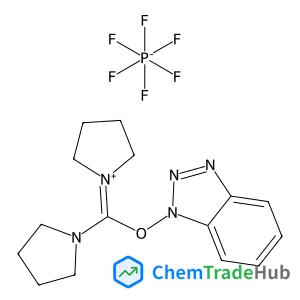
(1H-Benzotriazol-1-yloxy)(di-1-pyrrolidinyl)methylium hexafluorophosphate
CAS番号:
105379-24-6
分子式:
C15H21F6N5OP
おすすめサプライヤー



免責事項
このページに表示される学術雑誌情報は、参考および研究目的のみを目的としています。当社は雑誌出版社とは提携しておらず、投稿の取り扱いも行っておりません。出版に関するお問い合わせは、各雑誌出版社に直接ご連絡ください。
表示されている情報に誤りがある場合は、support@chemtradehub.com までご連絡ください。迅速に確認し、対応いたします。