












MXene nanoribbons as electrocatalysts for the hydrogen evolution reaction with fast kinetics
文献情報
出版日
2018-07-06
DOI
10.1039/C8CP02635A
インパクトファクター
3.676
著者
Xiaowei Yang, Nan Gao, Si Zhou, Jijun Zhao
原文を見る
要旨
MXenes, a new class of two-dimensional materials, arouse great interest due to their diverse chemistries, superior electrical conductivity and stability. Recently, the nanostructures of MXenes such as nanoribbons and nanodots have been synthesized in experiments, which show peculiar properties and expand the application spectrum of MXenes. Here we exploited MXene nanoribbons as potential electrocatalysts for the hydrogen evolution reaction (HER) by considering 12 kinds of MXene systems. Our first-principles calculations showed that the edges of the MXene nanoribbons can adsorb hydrogen species and serve as the reaction sites for hydrogen evolution. The binding strength of the ribbon edge is correlated with the d band center of metal atoms in MXenes. In particular, the nanoribbons of Ti3C2 and solid solution (Ti,Nb)C exhibit high activity for the HER with the adsorption free energy approaching zero and Tafel barrier below 0.42 and 0.17 eV, respectively. The low barrier is owing to the prominent charge transfer from the edge metal atoms to the H* reactants in the transition state. These theoretical results illuminate the principle for designing MXene nanostructures for electrocatalysts with fast kinetics, and shed light on the utilization of MXenes with more than one metal element for a broad range of electrochemical reactions.
関連文献
1,4-Cyclohexadienes as mechanistic probes for the Jacobsen epoxidation: evidence for radical pathways
Ulrike Engelhardt, Torsten Linker
2005-01-17
Communication
DOI: 10.1039/B415723K
A proteomic strategy for the identification of caspase-associating proteins
Eunice L. P. Tan, Resmi C. Panicker
2004-12-08
Communication
DOI: 10.1039/B415506H
Group transfer polymerisation in hydrophobic ionic liquids
Ranganathan Vijayaraghavan, Douglas R. MacFarlane
2005-01-17
Communication
DOI: 10.1039/B415548C
A new class of organic donor–acceptor molecules with large third-order optical nonlinearities
Tsuyoshi Michinobu, Joshua C. May, Jin H. Lim, Corinne Boudon, Jean-Paul Gisselbrecht, Paul Seiler, Maurice Gross, Ivan Biaggio, François Diederich
2005-01-17
Communication
DOI: 10.1039/B417393G
Polymer-supported nitroxyl radical catalyst for selective aerobic oxidation of primary alcohols to aldehydes
Michelle Gilhespy, Martin Lok, Xavier Baucherel
2005-01-12
Communication
DOI: 10.1039/B415902K
Silica-supported lanthanide silylamides for methyl methacrylate polymerisation: controlled grafting induces controlled reactivity
Régis M. Gauvin, André Mortreux
2005-01-13
Communication
DOI: 10.1039/B416533K
Inversion of enantioselectivity of asymmetric biocatalytic decarboxylation by site-directed mutagenesis based on the reaction mechanism
Yoichiro Ijima, Kaori Matoishi, Yosuke Terao, Nobuhide Doi, Hiroshi Yanagawa, Hiromichi Ohta
2005-01-10
Communication
DOI: 10.1039/B416398B
‘Twisted’ isophthalamide analogues
Simon J. Brooks, Louise S. Evans, Philip A. Gale, Michael B. Hursthouse, Mark E. Light
2004-12-23
Communication
DOI: 10.1039/B413654C
Resorcinarene assemblies as synthetic receptors
Liam C. Palmer, Alexander Shivanyuk, Masamichi Yamanaka, Julius Rebek, Jr.
2005-01-10
Communication
DOI: 10.1039/B414252G
A two-dimensional azido-based topologic ferrimagnet
Albert Escuer, Franz A. Mautner, Mohamed A. S. Goher, Morsy A. M. Abu-Youssef, Ramon Vicente
2004-12-08
Communication
DOI: 10.1039/B413665A
こちらもおすすめ
化合物よくある質問
2-ブロモ-9,9-ジフェニル-9H-フルオレンの主な用途は何ですか?
2-溴-9,9-二苯基芴は、医薬品、工業材料、有機合成の研究分野で応用されます。特に、レーザー材料や機能性ポリマーの合成に使用されることがあります。また、蛍光色...
474918-32-62-Bromo-9,9-diphenyl...
化合物よくある質問
四氯化铱の市場動向や研究トレンドはどうですか?
四氯化铱の市場は研究開発分野で注目されており、特にナノ技術や金属有機框架(MOFs)の分野での需要が増加傾向にあります。価格は安定しており、中国や韓国での生産が...
207399-11-9Tetrachloroiridium h...
882-06-44-Nitrocinnamic acid
化合物よくある質問
1-(4-溴-3-氟苯基)-2-氯乙酮を含む廃棄物はどのように処理すべきですか?
1-(4-溴-3-氟苯基)-2-氯乙酮 (CAS番号: 1260857-14-4) の廃棄物は専門的な廃棄処理が必要です。まず、廃棄物は密閉された容器に収集し、...
1260857-14-41-(4-Bromo-3-fluorop...
化合物よくある質問
苦参酚Kとは何ですか?
苦参酚Kは、CAS番号101236-49-1を持つ化合物で、主に天然由来の生薬から抽出されます。この化合物は、抗炎症作用や抗癌作用を持つことが報告されています。
101236-49-1Kushenol K
化合物よくある質問
POTASSIUM (1-(TERTBUTOXYCARBONYL)AZETIDIN-3-YL)TRIFLUOROBORATE を含む廃棄物はどのように処理すべきですか?
POTASSIUM (1-(TERTBUTOXYCARBONYL)AZETIDIN-3-YL)TRIFLUOROBORATE を含む廃棄物は、まず安全なエント...
1430219-73-0Potassium (1-(tert-b...
化合物よくある質問
4-庚基-4’-联苯羧酸の市場動向や研究トレンドはどうですか?
4-庚基-4’-聯苯羧酸は、特殊化学品や合成化学の分野で用いられる化学物質ですが、市場動向としては、研究開発の進展とともに需要が増加しています。また、環境配慮型...
58573-94-74'-Heptyl-4-biphenyl...
化合物よくある質問
6-ブロモ-3-メトキシ-1-フェニル-1H-インドゾールを含む廃棄物はどのように処理すべきですか?
6-ブロモ-3-メトキシ-1-フェニル-1H-インドゾールを含む廃棄物は、適切な化学廃棄処理が必要です。通常、廃棄物は密閉容器に収集され、専門の廃棄処理業者に引...
1332527-03-36-Bromo-3-methoxy-1-...
化合物よくある質問
4,4-二甲基-2-吡咯烷酮はどの業界で使用されていますか?
4,4-二甲基-2-吡咯烷酮は医薬、ポリマー、センサー、半導体などの業界で広く使用されています。特に溶媒としての性能が高く評価されています。
66899-02-34,4-dimethylpyrrolid...
51312-42-6Sodium Phosphotungst...
掲載誌
Physical Chemistry Chemical Physics

CiteScore:
5.5
自己引用率:
10.3%
年間論文数:
3036
Physical Chemistry Chemical Physics (PCCP) is an international journal co-owned by 19 physical chemistry and physics societies from around the world. This journal publishes original, cutting-edge research in physical chemistry, chemical physics and biophysical chemistry. To be suitable for publication in PCCP, articles must include significant innovation and/or insight into physical chemistry; this is the most important criterion that reviewers and Editors will judge against when evaluating submissions. The journal has a broad scope and welcomes contributions spanning experiment, theory, computation and data science. Topical coverage includes spectroscopy, dynamics, kinetics, statistical mechanics, thermodynamics, electrochemistry, catalysis, surface science, quantum mechanics, quantum computing and machine learning. Interdisciplinary research areas such as polymers and soft matter, materials, nanoscience, energy, surfaces/interfaces, and biophysical chemistry are welcomed if they demonstrate significant innovation and/or insight into physical chemistry. Joined experimental/theoretical studies are particularly appreciated when complementary and based on up-to-date approaches.
おすすめ化合物
![[4-Amino-2-(methylsulfanyl)-5-pyrimidinyl]methanol structure](https://static.chemtradehub.com/structs/588/588-36-3-fc73.webp "[4-Amino-2-(methylsulfanyl)-5-pyrimidinyl]methanol structure")
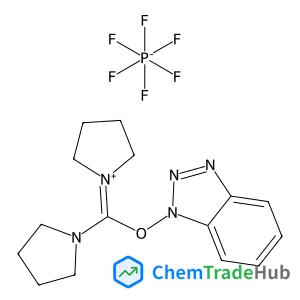
(1H-Benzotriazol-1-yloxy)(di-1-pyrrolidinyl)methylium hexafluorophosphate
CAS番号:
105379-24-6
分子式:
C15H21F6N5OP
おすすめサプライヤー


免責事項
このページに表示される学術雑誌情報は、参考および研究目的のみを目的としています。当社は雑誌出版社とは提携しておらず、投稿の取り扱いも行っておりません。出版に関するお問い合わせは、各雑誌出版社に直接ご連絡ください。
表示されている情報に誤りがある場合は、support@chemtradehub.com までご連絡ください。迅速に確認し、対応いたします。