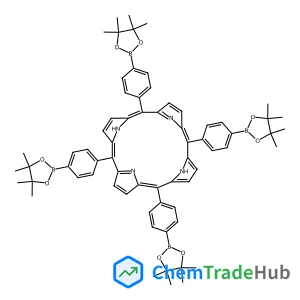
5,10,15,20-tetrakis(4-boronic acid pinacol ester phenyl) porphyrin
CAS番号:
1332748-00-1
分子式:
C68H74B4N4O8
Shenli Zhang, Haoyan Sha, Ricardo H. R. Castro, Roland Faller
The effect of La3+ doping on the structure and ionic conductivity change in nanocrystalline yttria-stabilized zirconia (YSZ) was studied using a combination of Monte Carlo and molecular dynamics simulations. The simulation revealed the segregation of La3+ at eight tilt grain boundary (GB) structures and predicted an average grain boundary (GB) energy decrease of 0.25 J m−2, which is close to the experimental values reported in the literature. Cation stabilization was found to be the main reason for the GB energy decrease, and energy fluctuations near the grain boundary are smoothed out with La3+ segregation. Both dynamic and energetic analysis on the Σ13(510)/[001] GB structure revealed La3+ doping hinders O2− diffusion in the GB region, where the diffusion coefficient monotonically decreases with increasing La3+ doping concentration. The effect was attributed to the increase in the site-dependent migration barriers for O2− hopping caused by segregated La3+, which also leads to anisotropic diffusion at the GB.
Paul Sylvester
DOI: 10.1039/B512647A
Daniel Goitom, Erik Björn
DOI: 10.1039/B514503A
Daniel J. Harrison, Ulrich Fekl
DOI: 10.1039/B915614C
Chenyu Du, Alexandra Cristina Blaga, Maria Camarut, Colin Webb, Christian V. Stevens, Wim Soetaert
DOI: 10.1039/B913021G
Andy Scheffer, Rolf Brandt, Carsten Engelhard, Stephan Evers, Norbert Jakubowski, Wolfgang Buscher
DOI: 10.1039/B510779B
Jan Kratzer, Jiří Dědina
DOI: 10.1039/B513924D
Oleg V. Kulikov, Megan M. Daschbach, Carl R. Yamnitz, Nigam Rath
DOI: 10.1039/B917431A
Xiaosong Xiong, Ruoyu Zhi, Qi Zhou, Wenqi Yan, Yusong Zhu, Yuhui Chen, Lijun Fu, Nengfei Yu, Yuping Wu
DOI: 10.1039/D1MA00121C
Sungjemmenla, Chhail Bihari Soni, S. K. Vineeth, Vipin Kumar
DOI: 10.1039/D1MA00247C
4-アミノフェノール酸ナトリウム水和物は、CAS番号206557-08-6の化合物で、4-アミノフェノールとナトリウムが結合した塩と水和物です。この化合物は、白...
この化合物は特定の合成プロセスに使用される可能性がありますが、代替品として、他の类似的な化合物、例えばMethyl 3-methyl-N-{[(2-methyl...
4-Boc-2-哌嗪甲酸は、薬品開発や合成化学分野で広く使用されており、その需要は継続的に推移しています。特に、新薬開発における合成化学分野での需要が高まってい...
4,4'-二羟甲基联苯のCAS番号は1667-12-5です。この化合物は白色の結晶粉末で、分子量は154.20です。水にわずかに溶けますが、アルコールや有機溶媒...
5-甲硫基戊腈は医薬品産業で使用される可能性があります。また、ポリマー合成の触媒として、センサー製造の一部として、半導体製造のプロセス改善に使用される可能性があ...
この化合物は、1-abieta-8,11,13-trien-19-イルと6'-メトキシシンコナナン-9-基を含有する窒素含有化合物から合成されます。一般的な合成...
6-ブロモベンジジミダゾール-2-カルビルデオキシドは、避光・乾燥した容器(密閉容器)で-20℃~4℃の低温で保存してください。高温や直射日光、湿気は避けてくだ...
621-65-8のCAS番号を持つBoc-N-甲基氨甲环酸は、化学式C7H13NO5を有する化合物です。この化合物は白色の結晶性粉末で、吸湿性があります。
乙基三氟硼酸钾は、トリフLUオール酸カリウムとエチルブロミドを反応させて合成されます。この反応は高い選択性と収率を持ち、触媒を用いることで効率的に進行します。
2-フロウロ-5-クロロ-4-アミノフェノールは、直射日光を避けて冷却された暗所で保存し、密閉容器に保管してください。温度は常温か低温が適しています。

Physical Chemistry Chemical Physics (PCCP) is an international journal co-owned by 19 physical chemistry and physics societies from around the world. This journal publishes original, cutting-edge research in physical chemistry, chemical physics and biophysical chemistry. To be suitable for publication in PCCP, articles must include significant innovation and/or insight into physical chemistry; this is the most important criterion that reviewers and Editors will judge against when evaluating submissions. The journal has a broad scope and welcomes contributions spanning experiment, theory, computation and data science. Topical coverage includes spectroscopy, dynamics, kinetics, statistical mechanics, thermodynamics, electrochemistry, catalysis, surface science, quantum mechanics, quantum computing and machine learning. Interdisciplinary research areas such as polymers and soft matter, materials, nanoscience, energy, surfaces/interfaces, and biophysical chemistry are welcomed if they demonstrate significant innovation and/or insight into physical chemistry. Joined experimental/theoretical studies are particularly appreciated when complementary and based on up-to-date approaches.
![Imidazo[1,2-c]pyrimidine structure](https://static.chemtradehub.com/structs/274/274-78-2-8b4c.webp "Imidazo[1,2-c]pyrimidine structure")