












Magnetism of NaFePO4 and related polyanionic compounds
文献情報
出版日
2018-04-27
DOI
10.1039/C8CP01961D
インパクトファクター
3.676
著者
Oier Arcelus, Sergey Nikolaev, Javier Carrasco
原文を見る
要旨
Magnetic properties of maricite (m) and triphlyte (t) polymorphs of NaFePO4 are investigated by combining ab initio density functional theory with a model Hamiltonian approach, where a realistic Hubbard-type model for magnetic Fe 3d states in NaFePO4 is constructed entirely from first-principles calculations. For these purposes, we perform a comparative study based on the pseudopotential and linear muffin-tin orbital methods while tackling the problem of parasitic non-sphericity of the exchange–correlation potential. Upon calculating the model parameters, magnetic properties are studied by applying the mean-field Hartree–Fock approximation and the theory of superexchange interactions to extract the corresponding interatomic exchange parameters. Despite some differences, the two methods provide a consistent description of the magnetic properties of NaFePO4. On the one hand, our calculations reproduce the correct magnetic ordering for t-NaFePO4 allowing for magnetoelectric effect, and the theoretical values of Néel and Curie–Weiss temperatures are in fair agreement with reported experimental data. Furthermore, we investigate the effect of chemical pressure on magnetic properties by substituting Na with Li and, in turn, we explain how a noncollinear magnetic alignment induced by an external magnetic field leads to magnetoelectric effect in NaFePO4 and other transition-metal phosphates. However, the origin of a magnetic superstructure with q = (1/2, 0, 1/2) observed experimentally in m-NaFePO4 remains puzzling. Instead, we predict that competing exchange interactions can lead to the formation of magnetic superstructures along the shortest orthorhombic c axis of m-NaFePO4, similar to multiferroic manganites.
関連文献
Facile intra- and intermolecular charge transfer control for efficient mechanofluorochromic material
Min-Ji Kim, Mina Ahn, Kyung-Ryang Wee
2021-06-10
Paper
DOI: 10.1039/D1MA00407G
A one-step and biocompatible cellulose functionalization for covalent antibody immobilization on immunoassay membranes
Hervé Volland, Julie Dano, Thomas Berthelot
2013-05-01
Paper
DOI: 10.1039/C3TB20380H
Advances in the designs and mechanisms of MoO3 nanostructures for gas sensors: a holistic review
Ritu Malik, Nirav Joshi, Vijay K. Tomer
2021-06-01
Review Article
DOI: 10.1039/D1MA00374G
Sol–gel based structural designs of macropores and material shapes of metal–organic framework gels
Yosuke Hara, Kohei Manabe, Kazuyoshi Kanamori
2021-05-17
Communication
DOI: 10.1039/D0MA01009J
Novel biocompatible cholinium-based ionic liquids—toxicity and biodegradability
Marija Petkovic, Jamie L. Ferguson, H. Q. Nimal Gunaratne, Rui Ferreira, Maria C. Leitão, Luís Paulo N. Rebelo
2010-02-09
Paper
DOI: 10.1039/B922247B
The effect of the ionic liquid anion in the pretreatment of pine wood chips
Jason P. Hallett, Tom Welton
2010-02-03
Paper
DOI: 10.1039/B918787A
こちらもおすすめ
化合物よくある質問
4-アミノフェノール酸ナトリウム水和物とは何ですか?
4-アミノフェノール酸ナトリウム水和物は、CAS番号206557-08-6の化合物で、4-アミノフェノールとナトリウムが結合した塩と水和物です。この化合物は、白...
206557-08-64-Aminobenzoic acid ...
化合物よくある質問
Methyl 3-methyl-N-{[(2-methyl-2-propanyl)oxy]carbonyl}-L-histidinateの代替品はありますか?
この化合物は特定の合成プロセスに使用される可能性がありますが、代替品として、他の类似的な化合物、例えばMethyl 3-methyl-N-{[(2-methyl...
72212-51-2Methyl 3-methyl-N-{[...
化合物よくある質問
4-Boc-2-哌嗪甲酸の市場動向や研究トレンドはどうですか?
4-Boc-2-哌嗪甲酸は、薬品開発や合成化学分野で広く使用されており、その需要は継続的に推移しています。特に、新薬開発における合成化学分野での需要が高まってい...
192330-11-3(2R)-4-[(tert-butoxy...
化合物よくある質問
4,4'-二羟甲基联苯の物理化学的性質は何ですか?
4,4'-二羟甲基联苯のCAS番号は1667-12-5です。この化合物は白色の結晶粉末で、分子量は154.20です。水にわずかに溶けますが、アルコールや有機溶媒...
1667-12-54,4'-Biphenyldiyldim...
化合物よくある質問
5-甲硫基戊腈はどの業界で使用されていますか?
5-甲硫基戊腈は医薬品産業で使用される可能性があります。また、ポリマー合成の触媒として、センサー製造の一部として、半導体製造のプロセス改善に使用される可能性があ...
59121-25-45-(Methylsulfanyl)pe...
化合物よくある質問
CAS番号1311961-50-8の化合物はどのように合成されますか?
この化合物は、1-abieta-8,11,13-trien-19-イルと6'-メトキシシンコナナン-9-基を含有する窒素含有化合物から合成されます。一般的な合成...
1311961-50-81-Abieta-8,11,13-tri...
化合物よくある質問
6-ブロモベンジジミダゾール-2-カルビルデオキシドはどのように保存すればよいですか?
6-ブロモベンジジミダゾール-2-カルビルデオキシドは、避光・乾燥した容器(密閉容器)で-20℃~4℃の低温で保存してください。高温や直射日光、湿気は避けてくだ...
885280-26-25-Bromo-1H-benzimida...
化合物よくある質問
Boc-N-甲基氨甲环酸とは何ですか?
621-65-8のCAS番号を持つBoc-N-甲基氨甲环酸は、化学式C7H13NO5を有する化合物です。この化合物は白色の結晶性粉末で、吸湿性があります。
621-65-83-Hydroxy-1,2-propan...
化合物よくある質問
乙基三氟硼酸钾はどのように合成されますか?
乙基三氟硼酸钾は、トリフLUオール酸カリウムとエチルブロミドを反応させて合成されます。この反応は高い選択性と収率を持ち、触媒を用いることで効率的に進行します。
882871-21-8Potassium ethyltrifl...
化合物よくある質問
2-フロウロ-5-クロロ-4-アミノフェノールはどのように保存すればよいですか?
2-フロウロ-5-クロロ-4-アミノフェノールは、直射日光を避けて冷却された暗所で保存し、密閉容器に保管してください。温度は常温か低温が適しています。
847872-10-04-Amino-5-chloro-2-f...
掲載誌
Physical Chemistry Chemical Physics

CiteScore:
5.5
自己引用率:
10.3%
年間論文数:
3036
Physical Chemistry Chemical Physics (PCCP) is an international journal co-owned by 19 physical chemistry and physics societies from around the world. This journal publishes original, cutting-edge research in physical chemistry, chemical physics and biophysical chemistry. To be suitable for publication in PCCP, articles must include significant innovation and/or insight into physical chemistry; this is the most important criterion that reviewers and Editors will judge against when evaluating submissions. The journal has a broad scope and welcomes contributions spanning experiment, theory, computation and data science. Topical coverage includes spectroscopy, dynamics, kinetics, statistical mechanics, thermodynamics, electrochemistry, catalysis, surface science, quantum mechanics, quantum computing and machine learning. Interdisciplinary research areas such as polymers and soft matter, materials, nanoscience, energy, surfaces/interfaces, and biophysical chemistry are welcomed if they demonstrate significant innovation and/or insight into physical chemistry. Joined experimental/theoretical studies are particularly appreciated when complementary and based on up-to-date approaches.
おすすめ化合物
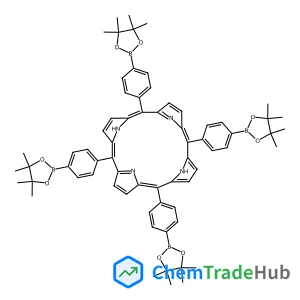
5,10,15,20-tetrakis(4-boronic acid pinacol ester phenyl) porphyrin
CAS番号:
1332748-00-1
分子式:
C68H74B4N4O8
おすすめサプライヤー


免責事項
このページに表示される学術雑誌情報は、参考および研究目的のみを目的としています。当社は雑誌出版社とは提携しておらず、投稿の取り扱いも行っておりません。出版に関するお問い合わせは、各雑誌出版社に直接ご連絡ください。
表示されている情報に誤りがある場合は、support@chemtradehub.com までご連絡ください。迅速に確認し、対応いたします。