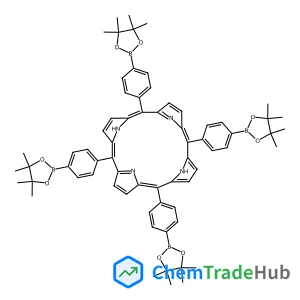
5,10,15,20-tetrakis(4-boronic acid pinacol ester phenyl) porphyrin
CAS番号:
1332748-00-1
分子式:
C68H74B4N4O8
Milan Rambukwella, Anish Ravishanker, Alessandro Fortunelli, Mauro Stener, Amala Dass
Here, we report the synthesis of selenophenol (HSePh) protected Au36(SePh)24 nanomolecules via a ligand-exchange reaction of 4-tert-butylbenzenethiol (HSPh-tBu) protected Au36(SPh-tBu)24 with selenophenol, and its spectroscopic and theoretical analysis. Matrix assisted laser desorption ionization (MALDI) mass spectrometry, electrospray ionization (ESI) mass spectrometry and optical characterization confirm that the composition of the as synthesized product is predominantly Au36(SePh)24 nanomolecules. Size exclusion chromatography (SEC) was employed to isolate the Au36(SePh)24 and temperature dependent optical absorption studies and theoretical analysis were performed. Theoretically, an Independent Component Maps of Oscillator Strength (ICM-OS) analysis of simulated spectra shows that the enhancement in absorption intensity in Au36(SePh)24 with respect to Au36(SPh)24 can be ascribed to the absence of interference and/or increased long-range coupling between interband metal core and ligand excitations. This work demonstrates and helps to understand the effect of Au–Se bridging on the properties of gold nanomolecules.
Hervé Volland, Julie Dano, Thomas Berthelot
DOI: 10.1039/C3TB20380H
Paul N. Davey, Martyn J. Earle, Jennifer T. Hamill, Suhas P. Katdare, David W. Rooney, Kenneth R. Seddon
DOI: 10.1039/B915131A
Yogendra Kumar, Prerna Yogeshwar, Sushant Bajpai, Pooja Jaiswal, Shalu Yadav, Diksha Praveen Pathak, Muskan Sonker, Saurabh Kr Tiwary
DOI: 10.1039/D1MA00538C
Owen T. Butler, Jennifer M. Cook, Chris F. Harrington, Steve J. Hill, John Rieuwerts, Douglas L. Miles
DOI: 10.1039/B516025C
Christophe Renault, Véronique Balland, Eugenia Martinez-Ferrero, Lionel Nicole, Clément Sanchez, Benoît Limoges
DOI: 10.1039/B919976D
Andreas Nenning, Manuel Holzmann, Jürgen Fleig, Alexander K. Opitz
DOI: 10.1039/D1MA00202C
Jason P. Hallett, Tom Welton
DOI: 10.1039/B918787A
DOI: 10.1039/B713875J
Nelly Shapiro, Maria Kramer, Israel Goldberg, Arkadi Vigalok
DOI: 10.1039/B922475K
4-アミノフェノール酸ナトリウム水和物は、CAS番号206557-08-6の化合物で、4-アミノフェノールとナトリウムが結合した塩と水和物です。この化合物は、白...
この化合物は特定の合成プロセスに使用される可能性がありますが、代替品として、他の类似的な化合物、例えばMethyl 3-methyl-N-{[(2-methyl...
4-Boc-2-哌嗪甲酸は、薬品開発や合成化学分野で広く使用されており、その需要は継続的に推移しています。特に、新薬開発における合成化学分野での需要が高まってい...
4,4'-二羟甲基联苯のCAS番号は1667-12-5です。この化合物は白色の結晶粉末で、分子量は154.20です。水にわずかに溶けますが、アルコールや有機溶媒...
5-甲硫基戊腈は医薬品産業で使用される可能性があります。また、ポリマー合成の触媒として、センサー製造の一部として、半導体製造のプロセス改善に使用される可能性があ...
この化合物は、1-abieta-8,11,13-trien-19-イルと6'-メトキシシンコナナン-9-基を含有する窒素含有化合物から合成されます。一般的な合成...
6-ブロモベンジジミダゾール-2-カルビルデオキシドは、避光・乾燥した容器(密閉容器)で-20℃~4℃の低温で保存してください。高温や直射日光、湿気は避けてくだ...
621-65-8のCAS番号を持つBoc-N-甲基氨甲环酸は、化学式C7H13NO5を有する化合物です。この化合物は白色の結晶性粉末で、吸湿性があります。
乙基三氟硼酸钾は、トリフLUオール酸カリウムとエチルブロミドを反応させて合成されます。この反応は高い選択性と収率を持ち、触媒を用いることで効率的に進行します。
2-フロウロ-5-クロロ-4-アミノフェノールは、直射日光を避けて冷却された暗所で保存し、密閉容器に保管してください。温度は常温か低温が適しています。

Physical Chemistry Chemical Physics (PCCP) is an international journal co-owned by 19 physical chemistry and physics societies from around the world. This journal publishes original, cutting-edge research in physical chemistry, chemical physics and biophysical chemistry. To be suitable for publication in PCCP, articles must include significant innovation and/or insight into physical chemistry; this is the most important criterion that reviewers and Editors will judge against when evaluating submissions. The journal has a broad scope and welcomes contributions spanning experiment, theory, computation and data science. Topical coverage includes spectroscopy, dynamics, kinetics, statistical mechanics, thermodynamics, electrochemistry, catalysis, surface science, quantum mechanics, quantum computing and machine learning. Interdisciplinary research areas such as polymers and soft matter, materials, nanoscience, energy, surfaces/interfaces, and biophysical chemistry are welcomed if they demonstrate significant innovation and/or insight into physical chemistry. Joined experimental/theoretical studies are particularly appreciated when complementary and based on up-to-date approaches.