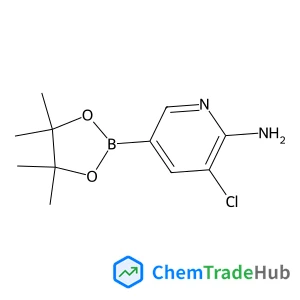
3-Chloro-5-(4,4,5,5-tetramethyl-1,3,2-dioxaborolan-2-yl)-2-pyridinamine
CAS番号:
1032758-99-8
分子式:
C11H16BClN2O2
Jakob Andersson, Melanie A. Fuller, Kathleen Wood, Stephen A. Holt, Ingo Köper
A model membrane system has been developed, which mimics the outer membrane of Gram negative bacteria. The structure is based on a tethered monolayer which has been fused with vesicles containing lipopolysaccharide molecules. The effect of the composition of the monolayer and the lipids in the outer layer on the structural and electrical properties of the membrane has been investigated. By using electrochemical impedance spectroscopy as well as neutron scattering techniques, it could be shown that a relatively high tethering density and a small amount of diluting lipids in the outer membrane leaflet leads to the formation of a stable solid supported membrane. The influence of divalent ions on the membrane stability has been probed as well as the interaction of the bilayer with the antibiotic colistin. A number of different architectures were developed, suited to both the study of bacterial membrane proteins and the screening of antimicrobial activity of potential drug candidates.
Kıvanç Esat, Grégory David, Theodoros Poulkas, Mikhail Shein, Ruth Signorell
DOI: 10.1039/C8CP00599K
Chantal Sleiman, Gisèle El Dib, Marzio Rosi, Dimitrios Skouteris, Nadia Balucani, André Canosa
DOI: 10.1039/C7CP05746F
Tsukuru Ohwaki, Taisuke Ozaki, Yukihiro Okuno, Hideto Imai, Minoru Otani
DOI: 10.1039/C7CP08569A
Robert G. Acres, Xun Cheng, Sofiia Bercha, Tomáš Skála, Vladimír Matolín, Ye Xu, Kevin C. Prince, Nataliya Tsud
DOI: 10.1039/C7CP08102B
Ziling Ding, Yan Xiong
DOI: 10.1039/C7CP07491C
Denis Jacquemin, Daniel Escudero
DOI: 10.1039/C8CP01101J
H. Tarábková, Z. Zelinger, P. Janda
DOI: 10.1039/C7CP08018B
2-ヒドロキシ-5-ニトロベンジンブロモイドは特定の化学反応に適しているため、代替品は限られています。しかし、同様の構造を持つ2-ヒドロキシ-4-ニトロベンジン...
N-(2-ブロモフェニル)-1-チロール-3-オキソ-3-(ピペリジニル)プロペン-2-イル)ベンゼンアミドは有毒で、皮膚や粘膜に刺激を与える可能性があります。...
この化合物は、新規治療薬の開発に注目されています。市場では、その有効性と安全性が評価され、研究分野では、分子生物学と医薬化学の新たな発見が期待されています。
Succinimidyl-alanyl-phenylalanyl-prolyl-phenylalanine 4-nitroanilide は主に医薬品開発やポ...
メチル6-アミノ-5-クロロピリジン-2-カーボイル酸(CAS番号: 1256794-05-4)の使用には、GHS( Globally Harmonized S...
取り扱いには、耐薬品性の容器を使用し、通気性の良い場所で操作することを推奨します。漏れ時は、SDS(安全データシート)を参照して適切な措置を取ること。手洗いと洗...
(S)-3-ベンZYルピペリジン塩酸塩は、CAS番号1258940-00-9で表される化合物です。これは、(S)-3-苯基哌啶的盐酸盐であり、主に医薬品の原料と...
3,5-二甲基金剛胺は、主に医薬品の原料として使用され、また抗うつ薬や抗アルツハイマー薬の開発に利用されます。さらに、化粧品や食品添加物の製造でも重要な役割を果...
ビス(4-メチル-2-ペンチル)フェニルカルボン酸エステル (CAS番号: 1398066-13-1) の代替品には、ビス(2-エチルヘキシル)フェノールカルボ...

Physical Chemistry Chemical Physics (PCCP) is an international journal co-owned by 19 physical chemistry and physics societies from around the world. This journal publishes original, cutting-edge research in physical chemistry, chemical physics and biophysical chemistry. To be suitable for publication in PCCP, articles must include significant innovation and/or insight into physical chemistry; this is the most important criterion that reviewers and Editors will judge against when evaluating submissions. The journal has a broad scope and welcomes contributions spanning experiment, theory, computation and data science. Topical coverage includes spectroscopy, dynamics, kinetics, statistical mechanics, thermodynamics, electrochemistry, catalysis, surface science, quantum mechanics, quantum computing and machine learning. Interdisciplinary research areas such as polymers and soft matter, materials, nanoscience, energy, surfaces/interfaces, and biophysical chemistry are welcomed if they demonstrate significant innovation and/or insight into physical chemistry. Joined experimental/theoretical studies are particularly appreciated when complementary and based on up-to-date approaches.
![6-Benzyl-4,5,6,7-tetrahydro-1H-pyrazolo[3,4-c]pyridin-3(2H)-one structure](https://static.chemtradehub.com/structs/909/909187-64-0-f54f.webp "6-Benzyl-4,5,6,7-tetrahydro-1H-pyrazolo[3,4-c]pyridin-3(2H)-one structure")