












Interaction study of cancer cells and fibroblasts on a spatially confined oxygen gradient microfluidic chip to investigate the tumor microenvironment
文献情報
出版日
2018-10-01
DOI
10.1039/C8AN01216D
インパクトファクター
4.616
著者
Wei Sun, Yuqing Chen, Yuerong Wang, Pei Luo, Min Zhang, Hongyang Zhang, Ping Hu
原文を見る
要旨
This paper reports a single-layered microfluidic device for studying the interaction of cancer cells and fibroblasts in an oxygen gradient. This gradient can be established from 1.9% to 18.8% using a spatially confined oxygen scavenging chemical reaction. Due to the spatial design of the chip, only cancer cells can sustain low oxygen conditions when co-cultured with fibroblasts in the adjacent channels, simulating the cell–cell interactions of the hypoxic cancer cells and the surrounding fibroblasts in tumor microenvironment in vivo. Moreover, a cell migration assay is performed on the chip for studying the tumor invasion ability. The results show that the migration speed of B16 cells is increased by hypoxia and the co-culture with L929 cells. In addition, we use ELISA to quantify the migration-related cytokines transforming growth factor-β1 (TGF-β1) in the microfluidic system. Our results confirm interaction between cancer cells and fibroblasts. This microfluidic device provides new insight for the investigation of tumor microenvironment and cell interactions.
関連文献
Origin of electrolyte-dopant dependent sulfur poisoning of SOFC anodes
ZhenHua Zeng, Mårten E. Björketun, Sune Ebbesen, Mogens B. Mogensen, Jan Rossmeisl
2013-03-14
Communication
DOI: 10.1039/C3CP51099A
Modeling CO2reduction on Pt(111)
Chuan Shi, Christopher P. O'Grady, Andrew A. Peterson, Heine A. Hansen
2013-03-19
Paper
DOI: 10.1039/C3CP50645B
Nature of proton transport in a water-filled carbon nanotube and in liquid water
Ji Chen, Qianfan Zhang, Angelos Michaelides, Enge Wang
2013-03-07
Paper
DOI: 10.1039/C3CP50218J
Interaction of CO2 with oxygen adatoms on rutile TiO2(110)
Xiao Lin, Zhi-Tao Wang, Igor Lyubinetsky, Bruce D. Kay, Zdenek Dohnálek
2013-01-10
Paper
DOI: 10.1039/C3CP44040K
Ligand strain and conformations in a family of Fe(ii) spin crossover hexadentate complexes involving the 2-pyridylmethyl-amino moiety: DFT modelling
Galina S. Matouzenko, Serguei A. Borshch, Volker Schünemann, Juliusz A. Wolny
2013-03-22
Paper
DOI: 10.1039/C3CP44570D
A 3D-RISM-SCF method with dual solvent boxes for a highly polarized system: application to 1,6-anhydrosugar formation reaction of phenyl α- and β-d-glucosides under basic conditions
Shinji Aono, Takashi Hosoya, Shigeyoshi Sakaki
2013-03-01
Paper
DOI: 10.1039/C3CP43892A
Adsorption of diferrocenylacetylene on Au(111) studied by scanning tunneling microscopy
Rebecca C. Quardokus, Natalie A. Wasio, Ryan P. Forrest, Craig S. Lent, Steven A. Corcelli, John A. Christie, Kenneth W. Henderson, S. Alex Kandel
2013-03-19
Paper
DOI: 10.1039/C3CP50225B
Visible light initiated and collapsed resistive switching in TbMnO3/Nb:SrTiO3 heterojunctions
Yimin Cui, Wei Liu, Rongming Wang
2013-03-14
Paper
DOI: 10.1039/C3CP00132F
Effects of intramolecular hydrogen bonding on the excited state dynamics of phenol chromophores
Yi Lin Yang, Yu-Chieh Ho, Yuri A. Dyakov, Wen-Hsin Hsu, Yi-Lun Sun, Wan-Chen Tsai, Wei-Ping Hu
2013-03-15
Paper
DOI: 10.1039/C3CP44674C
Analysis of visible-light-active Sn(ii)–TiO2 photocatalysts
Venkata Bharat Ram Boppana, Feng Jiao, Dave Newby, Jr., Jude Laverock, Kevin E. Smith, Jean Claude Jumas, Greg Hutchings, Raul F. Lobo
2013-03-13
Communication
DOI: 10.1039/C3CP44635B
こちらもおすすめ
化合物よくある質問
3-イチチルビフェニルはどのように合成されますか?
3-イチチルビフェニルは、ビフェニルとイチプロピオニトリルを回収率約90%で反応させて合成されます。触媒は通常、亜リチウムホウ素を用います。
5668-93-93-Ethylbiphenyl
化合物よくある質問
8-溴-5-三氟甲基喹啉はどのように合成されますか?
8-溴-5-三氟甲基喹啉は、5-トリフルオロメチル-2-メチル-1,3-ベンゼンジオールをブロモエタノールと反応させて生成します。この反応は塩基性条件下で行われ...
917251-92-48-Bromo-5-(trifluoro...
化合物よくある質問
ジメチル4-(4,4,5,5-テトラメチル-1,3,2-ドioxaborolan-2-基)-2,6-ピリジンジカルボイル酸フェニルアミニドの代替品はありますか?
ジメチル4-(4,4,5,5-テトラメチル-1,3,2-ドioxaborolan-2-基)-2,6-ピリジンジカルボイル酸フェニルアミニドの代替品としては、4-...
741709-66-0Dimethyl 4-(4,4,5,5-...
化合物よくある質問
N-(3,5-ヘキサクロロ-4-ピリドインイル)-8-メチオキシ-5-キノリンカーボン酸の市場動向や研究トレンドはどのようなものでしょうか?
N-(3,5-ヘキサクロロ-4-ピリドインイル)-8-メチオキシ-5-キノリンカーボン酸の市場動向は、主に産業用途での需要により影響を受けます。研究トレンドとし...
199871-63-1N-(3,5-Dichloro-4-py...
化合物よくある質問
イソステアロイルグリセリルは安全ですか?
イソステアロイルグリセリルは一般的に安全性が高いとされていますが、過度な使用や個人差により皮�owsん炎などの反応が起こる可能性があります。使用前に医師に相談す...
222723-55-92-[(5Z,8Z,11Z,14Z)-5...
化合物よくある質問
1-(二苯甲基)-3,3-二氟-氮杂环丁烷の市場動向や研究トレンドはどうですか?
1-(二苯甲基)-3,3-二氟-氮杂环丁烷の市場動向は、医薬品や合成化学の研究分野で注目を集めています。新興研究は、該当化合物の合成改良と生体内での作用メカニズ...
288315-02-61-Benzhydryl-3,3-dif...
化合物よくある質問
3-チオフェンスチオールの物理化学的性質は何ですか?
3-チオフェンスチオールのCAS番号は7774-73-4です。結晶性の白色粉末で、分子量は122.17です。この化合物は水に微溶解し、エタノールやジクロロメタン...
7774-73-43-Thiophenethiol
化合物よくある質問
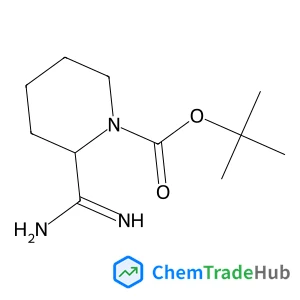
2-Methyl-2-propanyl (2S)-2-(aminomethyl)-1-piperidinecarboxylateは安全ですか?
2-Methyl-2-propanyl (2S)-2-(aminomethyl)-1-piperidinecarboxylateは一定の安全性基準を満たしていま...
475105-35-22-Methyl-2-propanyl ...
化合物よくある質問
CAS番号1316822-90-8の化合物は安全ですか?
CAS番号1316822-90-8の化合物は安全性に関しては評価が不足していますが、一般的には生物学的に活性な物質であり、取り扱いには適切な安全防護措置が必要で...
1316822-90-8Gal beta(1-3)[Neu5Ac...
化合物よくある質問
Tert-butyl 2-(2-羟基乙基)哌嗪-1-羧酸はどのように保存すればよいですか?
Tert-butyl 2-(2-羟基乙基)哌嗪-1-羧酸は、冷暗所で保存し、直射日光から遠ざけてください。容器は密閉し、高湿度や高温を避けて保管してください。
517866-79-4Tert-butyl 2-(2-hydr...
掲載誌
Analyst

CiteScore:
7.8
自己引用率:
5.6%
年間論文数:
653
Analyst publishes analytical and bioanalytical research that reports premier fundamental discoveries and inventions, and the applications of those discoveries, unconfined by traditional discipline barriers.
おすすめ化合物
おすすめサプライヤー


免責事項
このページに表示される学術雑誌情報は、参考および研究目的のみを目的としています。当社は雑誌出版社とは提携しておらず、投稿の取り扱いも行っておりません。出版に関するお問い合わせは、各雑誌出版社に直接ご連絡ください。
表示されている情報に誤りがある場合は、support@chemtradehub.com までご連絡ください。迅速に確認し、対応いたします。