












Rapid and sensitive detection of viral nucleic acids using silicon microchips
文献情報
出版日
2018-05-01
DOI
10.1039/C8AN00552D
インパクトファクター
4.616
著者
Laura Powell, Rodrigo Sergio Wiederkehr, Paige Damascus, Maarten Fauvart, Federico Buja, Tim Stakenborg, Stuart C. Ray, Paolo Fiorini, William O. Osburn
原文を見る
要旨
Clinical laboratory-based nucleic acid amplification tests (NAT) play an important role in diagnosing viral infections. However, laboratory infrastructure requirements and their failure to diagnose at the point-of-need (PON) limit their clinical utility in both resource-rich and -limited clinical settings. The development of fast and sensitive PON viral NAT may overcome these limitations. The scalability of silicon microchip manufacturing combined with advances in silicon microfluidics present an opportunity for development of rapid and sensitive PON NAT on silicon microchips. In the present study, we present rapid and sensitive NAT for a number of RNA and DNA viruses on the same silicon microchip platform. We first developed sensitive (4 copies per reaction) one-step RT-qPCR and qPCR assays detecting HCV, HIV, Zika, HPV 16, and HPV 18 on a benchtop real-time PCR instrument. A silicon microchip was designed with an etched 1.3 μL meandering microreactor, integrated aluminum heaters, thermal insulation trenches and microfluidic channels; this chip was used in all on-chip experiments. Melting curve analysis confirmed precise and localized heating of the microreactor. Following minimal optimization of reaction conditions, the bench-scale assays were successfully transferred to 1.3 μL silicon microreactors with reaction times of 25 min with no reduction in sensitivity, reproducibility, or reaction efficiencies. Taken together, these results demonstrate that rapid and sensitive detection of multiple viruses on the same silicon microchip platform is feasible. Further development of this technology, coupled with silicon microchip-based nucleic acid extraction solutions, could potentially shift viral nucleic acid detection and diagnosis from centralized clinical laboratories to the PON.
おすすめジャーナル
関連文献
Molecular insights into the binding variance of the SARS-CoV-2 spike with human, cat and dog ACE2 proteins
Yongjian Zang, Xuhua Li, Yizhen Zhao, He Wang, Dongxiao Hao, Lei Zhang, Zhiwei Yang, Xiaohui Yuan, Shengli Zhang
2021-06-03
Paper
DOI: 10.1039/D1CP01611C
The origin of the faster mechanism of partial enthalpy recovery deep in the glassy state of polymers
2021-05-24
Paper
DOI: 10.1039/D1CP01445E
Raman and ROA analyses of twisted anthracenes: connecting vibrational and electronic/photonic structures
Luis Palomo, Fernando Gordillo Gámez, Ori Gidron, Juan Casado, Francisco J. Ramírez
2021-05-31
Paper
DOI: 10.1039/D1CP01505B
Absorption of self-propelled particles into a dense porous medium
Bing-shuang Qian, Wen-de Tian
2021-08-20
Paper
DOI: 10.1039/D1CP01234G
Thermo-osmotic pressure and resistance to mass transport in a vapor-gap membrane
Michael T. Rauter, Sondre K. Schnell, Bjørn Hafskjold, Signe Kjelstrup
2021-06-04
Paper
DOI: 10.1039/D0CP06556K
Spectroscopic investigations of electron and hole dynamics in MAPbBr3 perovskite film and carrier extraction to PEDOT hole transport layer
Mojgan Kouhnavard, Yifan Diao, Pratim Biswas
2021-05-28
Paper
DOI: 10.1039/D1CP00658D
Controlled 2H/1T phase transition in MoS2 monolayers by a strong interface with M2C MXenes: a computational study
Zhongxu Wang, Yu Liu, FengYu Li, Jingxiang Zhao
2021-08-25
Paper
DOI: 10.1039/D1CP02648H
Computational prediction of the supramolecular self-assembling properties of organic molecules: the role of conformational flexibility of amide moieties
Laura Le Bras, Yves L. Dory, Benoît Champagne
2021-08-31
Paper
DOI: 10.1039/D1CP02675E
The manner and extent to which the hydration shell impacts interactions between hydrated species
Jinyang Jiang, Le Guo, Luping Tang, Yu Zhang
2021-08-17
Paper
DOI: 10.1039/D1CP03368A
Molecular properties affecting the hydration of acid–base clusters
Deanna Myers, Sabrina Chee, James N. Smith
2021-05-25
Paper
DOI: 10.1039/D1CP01704G
こちらもおすすめ
化合物よくある質問
3-イチチルビフェニルはどのように合成されますか?
3-イチチルビフェニルは、ビフェニルとイチプロピオニトリルを回収率約90%で反応させて合成されます。触媒は通常、亜リチウムホウ素を用います。
5668-93-93-Ethylbiphenyl
化合物よくある質問
8-溴-5-三氟甲基喹啉はどのように合成されますか?
8-溴-5-三氟甲基喹啉は、5-トリフルオロメチル-2-メチル-1,3-ベンゼンジオールをブロモエタノールと反応させて生成します。この反応は塩基性条件下で行われ...
917251-92-48-Bromo-5-(trifluoro...
化合物よくある質問
ジメチル4-(4,4,5,5-テトラメチル-1,3,2-ドioxaborolan-2-基)-2,6-ピリジンジカルボイル酸フェニルアミニドの代替品はありますか?
ジメチル4-(4,4,5,5-テトラメチル-1,3,2-ドioxaborolan-2-基)-2,6-ピリジンジカルボイル酸フェニルアミニドの代替品としては、4-...
741709-66-0Dimethyl 4-(4,4,5,5-...
化合物よくある質問
N-(3,5-ヘキサクロロ-4-ピリドインイル)-8-メチオキシ-5-キノリンカーボン酸の市場動向や研究トレンドはどのようなものでしょうか?
N-(3,5-ヘキサクロロ-4-ピリドインイル)-8-メチオキシ-5-キノリンカーボン酸の市場動向は、主に産業用途での需要により影響を受けます。研究トレンドとし...
199871-63-1N-(3,5-Dichloro-4-py...
化合物よくある質問
イソステアロイルグリセリルは安全ですか?
イソステアロイルグリセリルは一般的に安全性が高いとされていますが、過度な使用や個人差により皮�owsん炎などの反応が起こる可能性があります。使用前に医師に相談す...
222723-55-92-[(5Z,8Z,11Z,14Z)-5...
化合物よくある質問
1-(二苯甲基)-3,3-二氟-氮杂环丁烷の市場動向や研究トレンドはどうですか?
1-(二苯甲基)-3,3-二氟-氮杂环丁烷の市場動向は、医薬品や合成化学の研究分野で注目を集めています。新興研究は、該当化合物の合成改良と生体内での作用メカニズ...
288315-02-61-Benzhydryl-3,3-dif...
化合物よくある質問
3-チオフェンスチオールの物理化学的性質は何ですか?
3-チオフェンスチオールのCAS番号は7774-73-4です。結晶性の白色粉末で、分子量は122.17です。この化合物は水に微溶解し、エタノールやジクロロメタン...
7774-73-43-Thiophenethiol
化合物よくある質問
2-Methyl-2-propanyl (2S)-2-(aminomethyl)-1-piperidinecarboxylateは安全ですか?
2-Methyl-2-propanyl (2S)-2-(aminomethyl)-1-piperidinecarboxylateは一定の安全性基準を満たしていま...
475105-35-22-Methyl-2-propanyl ...
化合物よくある質問
CAS番号1316822-90-8の化合物は安全ですか?
CAS番号1316822-90-8の化合物は安全性に関しては評価が不足していますが、一般的には生物学的に活性な物質であり、取り扱いには適切な安全防護措置が必要で...
1316822-90-8Gal beta(1-3)[Neu5Ac...
化合物よくある質問
Tert-butyl 2-(2-羟基乙基)哌嗪-1-羧酸はどのように保存すればよいですか?
Tert-butyl 2-(2-羟基乙基)哌嗪-1-羧酸は、冷暗所で保存し、直射日光から遠ざけてください。容器は密閉し、高湿度や高温を避けて保管してください。
517866-79-4Tert-butyl 2-(2-hydr...
掲載誌
Analyst

CiteScore:
7.8
自己引用率:
5.6%
年間論文数:
653
Analyst publishes analytical and bioanalytical research that reports premier fundamental discoveries and inventions, and the applications of those discoveries, unconfined by traditional discipline barriers.
おすすめ化合物
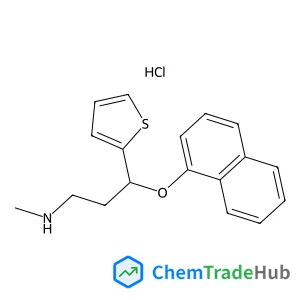
N-Methyl-3-(1-naphthyloxy)-3-(2-thienyl)-1-propanamine hydrochloride (1:1)
CAS番号:
1188266-11-6
分子式:
C18H20ClNOS
おすすめサプライヤー



免責事項
このページに表示される学術雑誌情報は、参考および研究目的のみを目的としています。当社は雑誌出版社とは提携しておらず、投稿の取り扱いも行っておりません。出版に関するお問い合わせは、各雑誌出版社に直接ご連絡ください。
表示されている情報に誤りがある場合は、support@chemtradehub.com までご連絡ください。迅速に確認し、対応いたします。