












Molecularly imprinted polymer nanoparticle-based assay (MINA): application for fumonisin B1 determination
文献情報
出版日
2018-05-21
DOI
10.1039/C8AN00322J
インパクトファクター
4.616
著者
Katarzyna Smolinska-Kempisty, Alvaro Garcia Cruz, Francesco Canfarotta, Elena Piletska, Khalku Karim, Sergey A. Piletsky
原文を見る
要旨
The enzyme-linked immunosorbent assay (ELISA) has been used as a standard tool for monitoring food and animal feed contamination from the carcinogenic fumonisin B1 (FB1). Unfortunately, ELISA is not always efficient due to the instability of the antibody and enzyme components in the immunoassay, the presence of natural enzyme inhibitors in the samples and the high levels of non-specific protein binding. Additionally, the production of antibodies for ELISA can be time-consuming and costly, due to the involvement of animals in the manufacturing process. To overcome these limiting factors, a molecularly imprinted nanoparticle based assay (MINA) has been developed, where the molecularly imprinted nanoparticles (nanoMIPs) replace the primary antibody used in a competitive ELISA. Herein, computational modelling was used to design the nanoMIPs by selecting monomers that specifically interact with FB1. The affinity of the monomers to FB1 was verified by measuring their binding in affinity chromatography experiments. The nanoMIPs were produced by solid phase synthesis and the results showed that nanoMIPs had a hydrodynamic diameter of around 249 ± 29 nm. The assay tested in model samples is highly selective and does not show cross-reactivity with other mycotoxins such as fumonisin B2 (FB2), aflatoxin B1 (AFB1), citrinin (CTT), zearalenone (ZEA), and deoxynivalenol (DON). The MINA allows the detection of FB1 in the concentration range of 10 pM–10 nM with a detection limit of 1.9 pM and a recovery of 108.13–113.76%.
関連文献
Tetraphenylethylene conjugated p-hydroxyphenacyl: fluorescent organic nanoparticles for the release of hydrogen sulfide under visible light with real-time cellular imaging
C. Parthiban, Pavithra M., L. Vinod Kumar Reddy, Dwaipayan Sen, Melvin Samuel S., N. D. Pradeep Singh
2018-10-03
Paper
DOI: 10.1039/C8OB01629A
Catalytic enantioselective one-pot approach to cis- and trans-2,3-diaryl substituted 1,5-benzothiazepines
Sara Meninno, Ilaria Quaratesi, Chiara Volpe, Andrea Mazzanti, Alessandra Lattanzi
2018-09-12
Paper
DOI: 10.1039/C8OB01988F
Synthesis of 2-aminobenzophenones through acylation of anilines with α-oxocarboxylic acids assisted by tert-butyl nitrite
Xinying Zhang, Xuesen Fan
2018-10-03
Paper
DOI: 10.1039/C8OB01846D
Palladium-catalyzed selective synthesis of 3,4-dihydroquinazolines from electron-rich arylamines, electron-poor arylamines and glyoxalates
Jie Wang, Xing-Yu Zhang, Guo-Kai Jia, Zhong Cao, Zilong Tang, Xianyong Yu, Xinhua Xu
2018-06-25
Paper
DOI: 10.1039/C8OB01005F
Regioselectivity of aryl radical attack onto isocyanates and isothiocyanates
Geethika K. Weragoda, Rowan L. Pilkington, Richard A. J. O'Hair
2018-11-14
Paper
DOI: 10.1039/C8OB02209G
Visible light catalyzed reaction of α-bromochalcones with chalcones: direct access to the urundeuvine scaffold
Ruchir Kant
2018-09-24
Paper
DOI: 10.1039/C8OB01881B
Novel binaphthyl and biphenyl α- and β-amino acids and esters: organocatalysis of asymmetric Diels–Alder reactions. A combined synthetic and computational study
Philip C. Bulman Page, Francesca S. Kinsey, Yohan Chan, Ian R. Strutt, Alexandra M. Z. Slawin, Garth A. Jones
2018-09-17
Paper
DOI: 10.1039/C8OB01795F
Toward the total synthesis of patellazole B: synthesis of an advanced C1–C25 fragment corresponding to the macrocyclic skeleton
Andrew W. Phillips, Matthew J. Anketell, Tudor Balan, Nelson Y. S. Lam, Simon Williams, Ian Paterson
2018-09-07
Paper
DOI: 10.1039/C8OB01621F
The catalytic Mitsunobu reaction: a critical analysis of the current state-of-the-art
Rhydian H. Beddoe, Helen F. Sneddon, Ross M. Denton
2018-10-01
Review Article
DOI: 10.1039/C8OB01929K
Recent developments in functionalization of acyclic α-keto amides
Alagesan Muthukumar, Subramani Sangeetha, Govindasamy Sekar
2018-08-06
Review Article
DOI: 10.1039/C8OB01423J
こちらもおすすめ
化合物よくある質問
3-イチチルビフェニルはどのように合成されますか?
3-イチチルビフェニルは、ビフェニルとイチプロピオニトリルを回収率約90%で反応させて合成されます。触媒は通常、亜リチウムホウ素を用います。
5668-93-93-Ethylbiphenyl
化合物よくある質問
8-溴-5-三氟甲基喹啉はどのように合成されますか?
8-溴-5-三氟甲基喹啉は、5-トリフルオロメチル-2-メチル-1,3-ベンゼンジオールをブロモエタノールと反応させて生成します。この反応は塩基性条件下で行われ...
917251-92-48-Bromo-5-(trifluoro...
化合物よくある質問
ジメチル4-(4,4,5,5-テトラメチル-1,3,2-ドioxaborolan-2-基)-2,6-ピリジンジカルボイル酸フェニルアミニドの代替品はありますか?
ジメチル4-(4,4,5,5-テトラメチル-1,3,2-ドioxaborolan-2-基)-2,6-ピリジンジカルボイル酸フェニルアミニドの代替品としては、4-...
741709-66-0Dimethyl 4-(4,4,5,5-...
化合物よくある質問
N-(3,5-ヘキサクロロ-4-ピリドインイル)-8-メチオキシ-5-キノリンカーボン酸の市場動向や研究トレンドはどのようなものでしょうか?
N-(3,5-ヘキサクロロ-4-ピリドインイル)-8-メチオキシ-5-キノリンカーボン酸の市場動向は、主に産業用途での需要により影響を受けます。研究トレンドとし...
199871-63-1N-(3,5-Dichloro-4-py...
化合物よくある質問
イソステアロイルグリセリルは安全ですか?
イソステアロイルグリセリルは一般的に安全性が高いとされていますが、過度な使用や個人差により皮�owsん炎などの反応が起こる可能性があります。使用前に医師に相談す...
222723-55-92-[(5Z,8Z,11Z,14Z)-5...
化合物よくある質問
1-(二苯甲基)-3,3-二氟-氮杂环丁烷の市場動向や研究トレンドはどうですか?
1-(二苯甲基)-3,3-二氟-氮杂环丁烷の市場動向は、医薬品や合成化学の研究分野で注目を集めています。新興研究は、該当化合物の合成改良と生体内での作用メカニズ...
288315-02-61-Benzhydryl-3,3-dif...
化合物よくある質問
3-チオフェンスチオールの物理化学的性質は何ですか?
3-チオフェンスチオールのCAS番号は7774-73-4です。結晶性の白色粉末で、分子量は122.17です。この化合物は水に微溶解し、エタノールやジクロロメタン...
7774-73-43-Thiophenethiol
化合物よくある質問
2-Methyl-2-propanyl (2S)-2-(aminomethyl)-1-piperidinecarboxylateは安全ですか?
2-Methyl-2-propanyl (2S)-2-(aminomethyl)-1-piperidinecarboxylateは一定の安全性基準を満たしていま...
475105-35-22-Methyl-2-propanyl ...
化合物よくある質問
CAS番号1316822-90-8の化合物は安全ですか?
CAS番号1316822-90-8の化合物は安全性に関しては評価が不足していますが、一般的には生物学的に活性な物質であり、取り扱いには適切な安全防護措置が必要で...
1316822-90-8Gal beta(1-3)[Neu5Ac...
化合物よくある質問
Tert-butyl 2-(2-羟基乙基)哌嗪-1-羧酸はどのように保存すればよいですか?
Tert-butyl 2-(2-羟基乙基)哌嗪-1-羧酸は、冷暗所で保存し、直射日光から遠ざけてください。容器は密閉し、高湿度や高温を避けて保管してください。
517866-79-4Tert-butyl 2-(2-hydr...
掲載誌
Analyst

CiteScore:
7.8
自己引用率:
5.6%
年間論文数:
653
Analyst publishes analytical and bioanalytical research that reports premier fundamental discoveries and inventions, and the applications of those discoveries, unconfined by traditional discipline barriers.
おすすめ化合物
![1-(1-Benzyl-1,2,3,6-tetrahydropyridin-4-yl)-1H-benzo[d]imidazol-2(3H)-one structure](https://static.chemtradehub.com/structs/603/60373-71-9-7dfb.webp "1-(1-Benzyl-1,2,3,6-tetrahydropyridin-4-yl)-1H-benzo[d]imidazol-2(3H)-one structure")
1-(1-Benzyl-1,2,3,6-tetrahydropyridin-4-yl)-1H-benzo[d]imidazol-2(3H)-one
CAS番号:
60373-71-9
分子式:
C19H19N3O


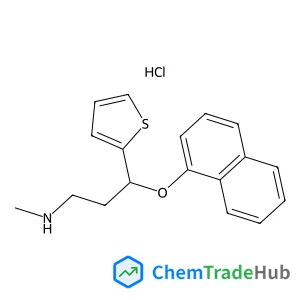
N-Methyl-3-(1-naphthyloxy)-3-(2-thienyl)-1-propanamine hydrochloride (1:1)
CAS番号:
1188266-11-6
分子式:
C18H20ClNOS
おすすめサプライヤー



免責事項
このページに表示される学術雑誌情報は、参考および研究目的のみを目的としています。当社は雑誌出版社とは提携しておらず、投稿の取り扱いも行っておりません。出版に関するお問い合わせは、各雑誌出版社に直接ご連絡ください。
表示されている情報に誤りがある場合は、support@chemtradehub.com までご連絡ください。迅速に確認し、対応いたします。