











![5'-Fluoro-[2,3'-biindolinylidene]-2',3-dione structure](https://static.chemtradehub.com/structs/251/251903-00-1-9cb1.webp "5'-Fluoro-[2,3'-biindolinylidene]-2',3-dione structure")
Gene expression data and FTIR spectra provide a similar phenotypic description of breast cancer cell lines in 2D and 3D cultures
文献情報
出版日
2018-04-09
DOI
10.1039/C8AN00145F
インパクトファクター
4.616
著者
Margarita Smolina, Erik Goormaghtigh
原文を見る
要旨
Thirteen breast cancer cell lines were grown in traditional two-dimensional (2D) monolayer and three-dimensional (3D) laminin-rich extracellular matrix (lrECM) culture models. Microarray-based transcriptional profiling data were published for these cell lines under both culture conditions. Colonies embedded in Matrigel matrix were fixed in formalin, embedded in paraffin and cut into 4 μm thick sections. The sections were mounted onto infrared-transparent barium fluoride windows and deparaffinized for Fourier transform infrared (FTIR) imaging. Samples consisting of Matrigel-coated 2D-grown cells followed the same processing procedure, simplifying comparison with 3D-cultured cells as well as with routinely prepared formalin-fixed, paraffin-embedded tissue specimens. Gene expression was found to be dominated by the cell line genome. Cluster analysis first groups the same cell line samples, independent of whether cells have been grown in 2D or 3D cultures. FTIR spectroscopy first groups by culture conditions when considering the full spectrum length. The paper reports two important results. First, both gene expression level and FTIR spectroscopy are multivariate techniques that contain sufficient information to identify uniquely both any cell line (among thirteen breast cancer cell lines) and phenotype induced by growing the cells in 2D or 3D lrECM cultures. Second, we established the presence of a strong correlation between gene expression patterns and FTIR spectral data for the thirteen breast cancer cell lines grown in both 2D and 3D lrECM cultures. These results suggest that, although based on completely different principles, the two approaches describe similarly the patterns of variations in cells.
関連文献
C-Alkylation of N-alkylamides with styrenes in air and scale-up using a microwave flow reactor
Souma Tamaoki, Hiromichi Egami, Noriyuki Ohneda, Tadashi Okamoto, Hiromichi Odajima, Yoshitaka Hamashima
2018-09-29
Communication
DOI: 10.1039/C8OB02282H
Regioselectivity of aryl radical attack onto isocyanates and isothiocyanates
Geethika K. Weragoda, Rowan L. Pilkington, Richard A. J. O'Hair
2018-11-14
Paper
DOI: 10.1039/C8OB02209G
Converting a weaker ATP-binding site inhibitor into a potent hetero-bivalent ligand by tethering to a unique peptide sequence derived from the same kinase
Samanth Reddy Kedika
2018-08-17
Paper
DOI: 10.1039/C8OB01406J
Transition metal-free coupling of terminal alkynes and hypervalent iodine-based alkyne-transfer reagents to access unsymmetrical 1,3-diynes
J. Schörgenhumer, M. Waser
2018-10-02
Communication
DOI: 10.1039/C8OB02375A
Novel binaphthyl and biphenyl α- and β-amino acids and esters: organocatalysis of asymmetric Diels–Alder reactions. A combined synthetic and computational study
Philip C. Bulman Page, Francesca S. Kinsey, Yohan Chan, Ian R. Strutt, Alexandra M. Z. Slawin, Garth A. Jones
2018-09-17
Paper
DOI: 10.1039/C8OB01795F
Synthesis of iminoisoindolinones via a cascade of the three-component Ugi reaction, palladium catalyzed isocyanide insertion, hydroxylation and an unexpected rearrangement reaction
Zhi-Lin Ren, Ping He, Wen-Ting Lu, Mei Sun, Ming-Wu Ding
2018-08-17
Paper
DOI: 10.1039/C8OB01728J
The catalytic Mitsunobu reaction: a critical analysis of the current state-of-the-art
Rhydian H. Beddoe, Helen F. Sneddon, Ross M. Denton
2018-10-01
Review Article
DOI: 10.1039/C8OB01929K
Palladium catalyzed carbonylative annulation of the C(sp2)–H bond of N,1-diaryl-1H-tetrazol-5-amines and N,4-diaryl-4H-triazol-3-amines to quinazolinones
Attoor Chandrasekhar, Venkatachalam Ramkumar, Sethuraman Sankararaman
2018-10-25
Paper
DOI: 10.1039/C8OB02516A
こちらもおすすめ
化合物よくある質問
3-イチチルビフェニルはどのように合成されますか?
3-イチチルビフェニルは、ビフェニルとイチプロピオニトリルを回収率約90%で反応させて合成されます。触媒は通常、亜リチウムホウ素を用います。
5668-93-93-Ethylbiphenyl
化合物よくある質問
8-溴-5-三氟甲基喹啉はどのように合成されますか?
8-溴-5-三氟甲基喹啉は、5-トリフルオロメチル-2-メチル-1,3-ベンゼンジオールをブロモエタノールと反応させて生成します。この反応は塩基性条件下で行われ...
917251-92-48-Bromo-5-(trifluoro...
化合物よくある質問
ジメチル4-(4,4,5,5-テトラメチル-1,3,2-ドioxaborolan-2-基)-2,6-ピリジンジカルボイル酸フェニルアミニドの代替品はありますか?
ジメチル4-(4,4,5,5-テトラメチル-1,3,2-ドioxaborolan-2-基)-2,6-ピリジンジカルボイル酸フェニルアミニドの代替品としては、4-...
741709-66-0Dimethyl 4-(4,4,5,5-...
化合物よくある質問
N-(3,5-ヘキサクロロ-4-ピリドインイル)-8-メチオキシ-5-キノリンカーボン酸の市場動向や研究トレンドはどのようなものでしょうか?
N-(3,5-ヘキサクロロ-4-ピリドインイル)-8-メチオキシ-5-キノリンカーボン酸の市場動向は、主に産業用途での需要により影響を受けます。研究トレンドとし...
199871-63-1N-(3,5-Dichloro-4-py...
化合物よくある質問
イソステアロイルグリセリルは安全ですか?
イソステアロイルグリセリルは一般的に安全性が高いとされていますが、過度な使用や個人差により皮�owsん炎などの反応が起こる可能性があります。使用前に医師に相談す...
222723-55-92-[(5Z,8Z,11Z,14Z)-5...
化合物よくある質問
1-(二苯甲基)-3,3-二氟-氮杂环丁烷の市場動向や研究トレンドはどうですか?
1-(二苯甲基)-3,3-二氟-氮杂环丁烷の市場動向は、医薬品や合成化学の研究分野で注目を集めています。新興研究は、該当化合物の合成改良と生体内での作用メカニズ...
288315-02-61-Benzhydryl-3,3-dif...
化合物よくある質問
3-チオフェンスチオールの物理化学的性質は何ですか?
3-チオフェンスチオールのCAS番号は7774-73-4です。結晶性の白色粉末で、分子量は122.17です。この化合物は水に微溶解し、エタノールやジクロロメタン...
7774-73-43-Thiophenethiol
化合物よくある質問
2-Methyl-2-propanyl (2S)-2-(aminomethyl)-1-piperidinecarboxylateは安全ですか?
2-Methyl-2-propanyl (2S)-2-(aminomethyl)-1-piperidinecarboxylateは一定の安全性基準を満たしていま...
475105-35-22-Methyl-2-propanyl ...
化合物よくある質問
CAS番号1316822-90-8の化合物は安全ですか?
CAS番号1316822-90-8の化合物は安全性に関しては評価が不足していますが、一般的には生物学的に活性な物質であり、取り扱いには適切な安全防護措置が必要で...
1316822-90-8Gal beta(1-3)[Neu5Ac...
化合物よくある質問
Tert-butyl 2-(2-羟基乙基)哌嗪-1-羧酸はどのように保存すればよいですか?
Tert-butyl 2-(2-羟基乙基)哌嗪-1-羧酸は、冷暗所で保存し、直射日光から遠ざけてください。容器は密閉し、高湿度や高温を避けて保管してください。
517866-79-4Tert-butyl 2-(2-hydr...
掲載誌
Analyst

CiteScore:
7.8
自己引用率:
5.6%
年間論文数:
653
Analyst publishes analytical and bioanalytical research that reports premier fundamental discoveries and inventions, and the applications of those discoveries, unconfined by traditional discipline barriers.
おすすめ化合物
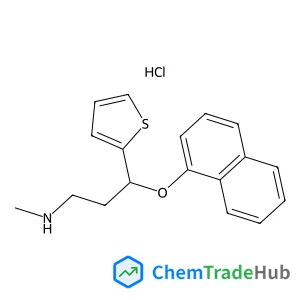
N-Methyl-3-(1-naphthyloxy)-3-(2-thienyl)-1-propanamine hydrochloride (1:1)
CAS番号:
1188266-11-6
分子式:
C18H20ClNOS
おすすめサプライヤー





免責事項
このページに表示される学術雑誌情報は、参考および研究目的のみを目的としています。当社は雑誌出版社とは提携しておらず、投稿の取り扱いも行っておりません。出版に関するお問い合わせは、各雑誌出版社に直接ご連絡ください。
表示されている情報に誤りがある場合は、support@chemtradehub.com までご連絡ください。迅速に確認し、対応いたします。