












Phosphine-sulfonate-based nickel catalysts: ethylene polymerization and copolymerization with polar-functionalized norbornenes
文献情報
出版日
2017-11-14
DOI
10.1039/C7PY01661A
インパクトファクター
5.582
著者
Guangzhi Song, Wenmin Pang, Weimin Li, Min Chen, Changle Chen
原文を見る
要旨
In this contribution, the effect of substitution on biaryl-based phosphine-sulfonate nickel catalysts is investigated. A series of [κ2-(P,O)-2-(P-PhAr)-1-benzenesulfonato]NiPh(PPh3) nickel complexes (Ni–OMe, Ar = 2-[2′,6′-(OMe)2-C6H3]-C6H4; Ni–H, Ar = 2-(C6H5)-C6H4; Ni–OiPr, Ar = 2-[2′,6′-(OiPr)2-C6H3]-C6H4; Ni–F, Ar = 2-[2′,6′-F2-C6H3]-C6H4) are prepared and applied to the polymerization of ethylene as well as its copolymerizations with polar functionalized norbornene comonomers. These nickel complexes are highly active toward ethylene polymerization without the requirement of any cocatalyst. Specifically, the Ni–F complex exhibits high stability and high activity (up to 3.0 × 10⁶ g mol−1 h−1), and catalyzes the formation of polyethylene of high molecular weight (Mn up to 216 200) and high melting point (Tm up to 139.6 °C). The polyethylene molecular-weight distribution from this system is very sensitive to the steric demand of the ligand, as well as the nature of the coordinating base, polymerization temperature, and ethylene pressure. This, in turn, provides a simple and efficient strategy for the control of the polyethylene molecular-weight distribution, which is an important parameter that determines multiple material properties such as viscosity, stiffness, and crystallinity. Ni–F also exhibits good ethylene-copolymerization behavior toward polar-functionalized norbornene comonomers, leading to moderate comonomer incorporation in copolymers of moderate molecular weight and high melting point.
関連文献
Correlation of chemical reactivity of Nudaurelia capensis ω virus with a pH-induced conformational change
Qian Wang, Brian Bothner, Padmaja Natarajan, M. G. Finn
2003-10-15
Communication
DOI: 10.1039/B310533D
Photoinduced Ba2+ release and thermal rebinding by an azacrown ether linked by an alkynyl pyridine to a (bpy)Re(CO)3 group
Jared D. Lewis, John N. Moore
2003-10-22
Communication
DOI: 10.1039/B309436G
Direct analysis of catalysts immobilised in ionic liquids using electrospray ionisation ion trap mass spectrometry
Paul J. Dyson, J. Scott McIndoe, Dongbin Zhao
2003-01-28
Communication
DOI: 10.1039/B211669C
Directed regio- and stereoselective hydroformylation of mono- and 1,3-disubstituted allylic alcohols: a catalytic approach to the anti-aldol-retron
Bernhard Breit, Peter Demel, Antje Gebert
2003-11-11
Communication
DOI: 10.1039/B311378G
The effect of ion energy upon plasma polymerization deposition rate for acrylic acid
David Barton, Robert D. Short, Stuart Fraser, James W. Bradley
2003-01-14
Communication
DOI: 10.1039/B210781C
A diatropic ring current in a fluorofullerene trannulene
Patrick W Fowler, Alessandro Soncini, John P B Sandall
2003-10-22
Communication
DOI: 10.1039/B307514C
Facile fabrication of 2-dimensional arrays of sub-10 nm single crystalline Si nanopillars using nanoparticle masks
Young-Kyu Hong, Jae Ho Bahng, Geunseop Lee, Hanchul Kim, Wondong Kim, Sekyung Lee, Ja-Yong Koo, Jong-Il Park, Woo-ram Lee, Jinwoo Cheon
2003-11-13
Communication
DOI: 10.1039/B310098G
Regio- and enantioselective iridium-catalysed allylic aminations and alkylations of dienyl esters
Gunter Lipowsky, Günter Helmchen
2003-11-07
Communication
DOI: 10.1039/B311502J
こちらもおすすめ
化合物よくある質問
2,3-スチオエポキシマドルを取り扱う際の実験室安全事項は何ですか?
取り扱いにはPPE(プロテクティブ・パーソナル・エイド)が必要で、防ぐ手袋と保護眼鏡を着用してください。ドラフトチャンバーの使用を推奨します。漏洩した場合は、適...
4267-80-52,3-Thioepoxy Madol
53981-25-22-Amino-6-fluorophen...
化合物よくある質問
BOC-S-3-アミニ-4-(4-メチオキシベンチル)-ブタン酸の代替品はありますか?
この化合物の代替品としては、BOC保護基を有さないアミノ酸やその他の保護基化合物が考えられます。また、メチオキシ基を有しない他の芳香族アミノ酸も代替品として挙げ...
126800-59-7(3S)-4-(4-Methoxyphe...
化合物よくある質問
Methyl 2-(chloromethyl)-3-nitrobenzoate(1218910-61-2)の代替品はありますか?
Methyl 2-(chloromethyl)-3-nitrobenzoate(1218910-61-2)の代替品としては、化学組成を変えることで効果を達成する...
1218910-61-2Methyl 2-(chlorometh...
化合物よくある質問
(2R)-2-アミノ-N-ベンジル-3-ヒドロキシプロパナミドを含む廃棄物はどのように処理すべきですか?
(2R)-2-アミノ-N-ベンジル-3-ヒドロキシプロパナミドを含む廃棄物は、適切な廃棄物管理ガイドラインに基づき処理する必要があります。まず、廃棄物を適切に収...
175481-39-7(2R)-2-amino-N-benzy...
化合物よくある質問
6,7-二氢-咪唑並[1,2-a]ピリドイン-8(5h)-酮はどのように合成されますか?
6,7-二氢-咪唑並[1,2-a]ピリドイン-8(5h)-酮は、2-ブロモフェニルアセトインとリン酸ハロゲン化物を反応させることで合成できます。この反応は高温で...
457949-09-66,7-Dihydroimidazo[1...
化合物よくある質問
エチル(3R)-3-ピロリジニル酢酸水和塩とは何ですか?
エチル(3R)-3-ピロリジニル酢酸水和塩は、CAS番号1332459-32-1の化合物で、(R)-乙基2-(ピロリジン-3-基)酢酸塩水和塩と呼ばれます。この...
1332459-32-1Ethyl (3R)-3-pyrroli...
化合物よくある質問
(2S)-{[(2-メチルエチルオキシ]カルボニル}アミノ)[2-(トリアフルオロメチルフェニル]エチカシック酸の物理化学的性質は何ですか?
(2S)-{[(2-メチルエチルオキシ]カルボニル}アミノ)[2-(トリアフルオロメチルフェニル]エチカシック酸のCAS番号は1203454-45-8です。この...
1203454-45-8(2S)-({[(2-Methyl-2-...
化合物よくある質問
2-ブロモ-1-(2-メチル-2-プロパニル)-4-ニトロベンゼンはどのように保存すればよいですか?
2-ブロモ-1-(2-メチル-2-プロパニル)-4-ニトロベンゼンは、直射日光を避けて暗所で、室温(約15℃〜25℃)、乾燥した場所に保存する必要があります。ま...
6310-17-42-Bromo-1-(2-methyl-...
化合物よくある質問
1-[(4-硝基フェニル)スルホニル]-1H-1,2,4-三唑の市場動向や研究トレンドはどうですか?
市場動向としては、1-[(4-硝基フェニル)スルホニル]-1H-1,2,4-三唑は主に農業用除草剤や合成化学製品の原料として利用されています。研究トレンドとして...
57777-84-11-[(4-Nitrophenyl)su...
掲載誌
Polymer Chemistry

CiteScore:
8.6
自己引用率:
7.3%
年間論文数:
457
Polymer Chemistry welcomes submissions in all areas of polymer science that have a strong focus on macromolecular chemistry. Manuscripts may cover a broad range of fields, yet no direct application focus is required.
おすすめ化合物
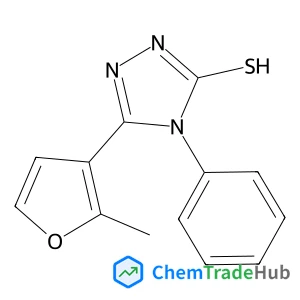
5-(2-Methyl-3-furyl)-4-phenyl-2,4-dihydro-3H-1,2,4-triazole-3-thione
CAS番号:
346464-59-3
分子式:
C13H11N3OS
![N-[2-(2-Pyridinyl)ethyl]-1-propanamine structure](https://static.chemtradehub.com/structs/554/55496-57-6-22b4.webp "N-[2-(2-Pyridinyl)ethyl]-1-propanamine structure")
おすすめサプライヤー




免責事項
このページに表示される学術雑誌情報は、参考および研究目的のみを目的としています。当社は雑誌出版社とは提携しておらず、投稿の取り扱いも行っておりません。出版に関するお問い合わせは、各雑誌出版社に直接ご連絡ください。
表示されている情報に誤りがある場合は、support@chemtradehub.com までご連絡ください。迅速に確認し、対応いたします。