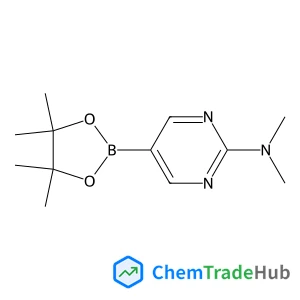
N,N-Dimethyl-5-(4,4,5,5-tetramethyl-1,3,2-dioxaborolan-2-yl)-2-pyrimidinamine
CAS番号:
1032759-30-0
分子式:
C12H20BN3O2
Liejiang Jin, Hongbo Zeng, Aman Ullah
A canola oil derived monomer, 1-decene, was converted to 1,2-epoxydecane with >90% yield. The ring opening copolymerization of 1,2-epoxydecane with carbon dioxide (CO2) and different cyclic anhydrides including maleic, succinic, itaconic, phthalic and tetrahydrophthalic was carried out using a double metal cyanide (DMC) catalyst under microwave and conventional heating conditions. The microwave-assisted polymerizations were significantly faster than those observed under conventional heating conditions. The polycarbonates, copolymers with CO2, were synthesized within minutes (∼30 min) under microwave conditions with high conversions (up to 99%), carbonate linkage (∼88%) and molecular weight (Mw ∼ 15 kDa). The polyesters, copolymers with anhydrides, were synthesized in ∼60 min with high ester content (up to 90%) and Mw (up to 17 kDa). The synthesized copolymers were characterized by Fourier transform infrared spectroscopy (FTIR), proton nuclear magnetic resonance (1H NMR), gel permeation chromatography (GPC), differential scanning calorimetry (DSC) and thermal gravimetric analysis (TGA) techniques. The configuration of double bonds in unsaturated polyesters such as poly(1-decene-co-maleate) was completely isomerized through post polymerization modification to enhance its activity as an unsaturated polyester resin (UPR) for different potential applications.

Crystallography Reports

Nature Medicine

Chemistry Education Research and Practice

New Journal of Chemistry

Russian Journal of General Chemistry

Current Opinion in Solid State & Materials Science

Current Opinion in Colloid & Interface Science

Russian Journal of Coordination Chemistry

Journal of Saudi Chemical Society

Journal of Peptide Science
Victor A. Streltsov, Joseph N. Varghese
DOI: 10.1039/B803911A
Ana Sousa-Herves, Eduardo Fernandez-Megia, Ricardo Riguera
DOI: 10.1039/B805208E
Claudia Caltagirone, Philip A. Gale, Jennifer R. Hiscock, Simon J. Brooks, Michael B. Hursthouse, Mark E. Light
DOI: 10.1039/B806238B
Ning Du, Hui Zhang, Bingdi Chen, Xiangyang Ma, Deren Yang
DOI: 10.1039/B800401C
Yajun Tian, Huaixin Yang, Shuanglin Zhan, Yunfa Chen
DOI: 10.1039/B801966E
Kyung-Soo Moon, Eunji Lee, Myongsoo Lee
DOI: 10.1039/B801108G
Qiao Jin, Jian-Ping Xu, Jian Ji, Jia-Cong Shen
DOI: 10.1039/B801959B
Pengfei Li, Yongcan Wang, Jinxing Ye
DOI: 10.1039/B804540B
C. V. Ramana, Challa Nageswara Reddy, Rajesh G. Gonnade
DOI: 10.1039/B801755G
6- bromo-1-cyclopropyl-1H-benzimidazoleは、抗炎症、抗ウイルス作用を持つことが報告されており、新薬開発の研究対象として注目...
取り扱う際には、防護眼鏡と手袋を使用し、ドラフトチャンバー内で操作することを推奨します。漏洩時には適切な手順で処理し、安全データシートを常に参照してください。
2,2’-ジメチル-3,3’-ビピリジンは、ピリジンと2-メチルアクリルアミドを有機合成反応で合成します。この反応では、ピリジンと2-メチルアクリルアミドを含有...
6-甲基ピリジン-2-ボリック酸は、合成化学、医薬品合成、以及研究用途などに広く使用され、特に組換えDNA技術や分子生物学の研究において重要な役割を果たします。
(R)-3-(1-甲基-2-氧環己基)プロpano酸メチルは一定の安全性がありますが、直接的な皮膚接触や吸入は避けるべきです。使用する際は適切な個々の安全データ...
ketorolacは、密封して遮光容器に保管し、直射日光や高温を避けて保存してください。温度は常温で保存し、湿度をなるべく低く保つことが推奨されます。
L-2,3-二氨基丙酸二盐酸盐は腐食性が強く、皮膚や粘膜に刺激を与える可能性があります。取り扱う際は、防塵マスク、ゴーグル、手袋を使用し、適切な排気設備を使用し...
2-(4-溴ピリジン-2-基)乙腈のCAS番号は312325-73-8です。主に結晶形態で存在し、分子量は159.01 g/molです。この化合物は水に溶けやす...
この化合物は毒性は低いですが、直接的な接触や吸入に注意が必要です。PPE(個人防護具)を着用し、ドラフトチャンバーを使用して操作することを推奨します。また、漏洩...
3-(1-氧代-1,3-二氢-2H-2-异吲哚)丙酸は、薬理学研究や医薬品製造において広く用いられる化合物です。また、工業的な用途でも一部の化学反応の触媒や助剤...

Polymer Chemistry welcomes submissions in all areas of polymer science that have a strong focus on macromolecular chemistry. Manuscripts may cover a broad range of fields, yet no direct application focus is required.