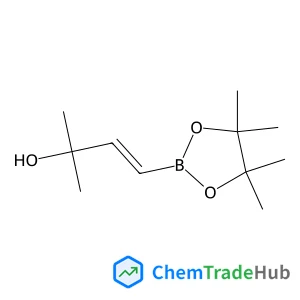
(E)-2-methyl-4-(4,4,5,5-tetramethyl-1,3,2-dioxaborolan-2-yl)but-3-en-2-ol
CAS番号:
581802-26-8
分子式:
C11H21BO3
L. P. D. Ratcliffe, K. J. Bentley, R. Wehr, N. J. Warren, B. R. Saunders, S. P. Armes
The recent development of polymerization-induced self-assembly (PISA) has facilitated the rational synthesis of a range of diblock copolymer worms, which hitherto could only be prepared via traditional post-polymerization processing in dilute solution. Herein we explore a new synthetic route to aqueous dispersions of cationic disulfide-functionalized worm gels. This is achieved via the PISA synthesis of poly[(glycerol monomethacrylate-stat-glycidyl methacrylate)]-block-poly(2-hydroxypropyl methacrylate) (P(GMA-stat-GlyMA)-PHPMA) block copolymer worms via reversible addition–fragmentation chain transfer (RAFT) aqueous dispersion polymerization of HPMA. A water-soluble reagent, cystamine, is then reacted with the pendent epoxy groups located within the P(GMA-stat-GlyMA) stabilizer chains to introduce disulfide functionality, while simultaneously conferring cationic character via formation of secondary amine groups. Moreover, systematic variation of the cystamine/epoxy molar ratio enables either chemically cross-linked worm gels or physical (linear) primary amine-functionalized disulfide-based worm gels to be obtained. These new worm gels were characterized using gel permeation chromatography, 1H NMR spectroscopy, transmission electron microscopy, dynamic light scattering, aqueous electrophoresis and rheology. In principle, such hydrogels may offer enhanced mucoadhesive properties.
Ainara Nova, Gregori Ujaque, Pilar González-Duarte, Agustí Lledós
DOI: 10.1039/B801889H
Søren Bertelsen, Rasmus L. Johansen, Karl Anker Jørgensen
DOI: 10.1039/B806418K
Jen-Chieh Hsieh, Chien-Hong Cheng
DOI: 10.1039/B801870G
Arjan Odedra, Karolin Geyer, Tomas Gustafsson, Ryan Gilmour, Peter H. Seeberger
DOI: 10.1039/B803715A
Cristina Femoni, Maria Carmela Iapalucci, Giuliano Longoni, Stefano Zacchini
DOI: 10.1039/B803992E
Jyotirmayee Dash, Pravin S. Shirude, Shankar Balasubramanian
DOI: 10.1039/B806042H
Neng-Fang She, Xiang-Gao Meng, Meng Gao, An-Xin Wu, Lyle Isaacs
DOI: 10.1039/B800785C
Amit Basak, Debarati Mitra, Moumita Kar, Kumar Biradha
DOI: 10.1039/B801644E
Masato Ohashi, Akihiro Yagyu, Tsuneaki Yamagata, Kazushi Mashima
DOI: 10.1039/B703730A
Shinzo Kobayashi, Ken Itomi, Kazuhide Morino, Hiroki Iida, Eiji Yashima
DOI: 10.1039/B806343E
6- bromo-1-cyclopropyl-1H-benzimidazoleは、抗炎症、抗ウイルス作用を持つことが報告されており、新薬開発の研究対象として注目...
取り扱う際には、防護眼鏡と手袋を使用し、ドラフトチャンバー内で操作することを推奨します。漏洩時には適切な手順で処理し、安全データシートを常に参照してください。
2,2’-ジメチル-3,3’-ビピリジンは、ピリジンと2-メチルアクリルアミドを有機合成反応で合成します。この反応では、ピリジンと2-メチルアクリルアミドを含有...
6-甲基ピリジン-2-ボリック酸は、合成化学、医薬品合成、以及研究用途などに広く使用され、特に組換えDNA技術や分子生物学の研究において重要な役割を果たします。
(R)-3-(1-甲基-2-氧環己基)プロpano酸メチルは一定の安全性がありますが、直接的な皮膚接触や吸入は避けるべきです。使用する際は適切な個々の安全データ...
ketorolacは、密封して遮光容器に保管し、直射日光や高温を避けて保存してください。温度は常温で保存し、湿度をなるべく低く保つことが推奨されます。
L-2,3-二氨基丙酸二盐酸盐は腐食性が強く、皮膚や粘膜に刺激を与える可能性があります。取り扱う際は、防塵マスク、ゴーグル、手袋を使用し、適切な排気設備を使用し...
2-(4-溴ピリジン-2-基)乙腈のCAS番号は312325-73-8です。主に結晶形態で存在し、分子量は159.01 g/molです。この化合物は水に溶けやす...
この化合物は毒性は低いですが、直接的な接触や吸入に注意が必要です。PPE(個人防護具)を着用し、ドラフトチャンバーを使用して操作することを推奨します。また、漏洩...
3-(1-氧代-1,3-二氢-2H-2-异吲哚)丙酸は、薬理学研究や医薬品製造において広く用いられる化合物です。また、工業的な用途でも一部の化学反応の触媒や助剤...

Polymer Chemistry welcomes submissions in all areas of polymer science that have a strong focus on macromolecular chemistry. Manuscripts may cover a broad range of fields, yet no direct application focus is required.
![2-{[(1R,2S)-2-Aminocyclohexyl]amino}-4-{[3-(2H-1,2,3-triazol-2-yl)phenyl]amino}-5-pyrimidinecarboxamide structure](https://static.chemtradehub.com/structs/137/1370261-96-3-40df.webp "2-{[(1R,2S)-2-Aminocyclohexyl]amino}-4-{[3-(2H-1,2,3-triazol-2-yl)phenyl]amino}-5-pyrimidinecarboxamide structure")