


Retinol initiated poly(lactide)s: stability upon polymerization and nanoparticle preparation
文献情報
出版日
2017-06-26
DOI
10.1039/C7PY00881C
インパクトファクター
5.582
著者
Diana Kalden, Matthias Westerhausen
原文を見る
要旨
The synthesis of retinol initiated polylactide (PLA) by ring opening polymerization (ROP) of L-lactide via in situ calcium alkoxide formation with all-trans-retinol and Ca[N(SiMe3)2]2(THF)2 is described. PLAs with degree of polymerization (DP) values ranging from 13 to 60 were obtained and characterized in detail by means of 1H nuclear magnetic resonance (NMR) spectroscopy, size exclusion chromatography (SEC), UV/vis spectroscopy and (tandem) mass spectrometry techniques. Stable nanoparticles (NPs) were prepared via a nanoprecipitation method and characterized by DLS and SEM. The stability of retinol upon conjugation to PLA as well as the nanoparticle formulation was investigated in detail and found to be significantly affected by the storage conditions such as exposure to light, oxygen and temperature.
おすすめジャーナル

Pharmacological Reviews

Planta Medica

Organic Preparations and Procedures International

Molecular Pharmacology

Russian Chemical Reviews

Journal of Medicinal Chemistry

Journal of Organometallic Chemistry

Israel Journal of Chemistry

Proceedings of the National Academy of Sciences of the United States of America

Journal of Heterocyclic Chemistry
関連文献
Fundamental frequency from classical molecular dynamics
Tomonori Yamada, Misako Aida
2014-12-03
Paper
DOI: 10.1039/C4CP04068F
Li/Ag ratio dependent structure and upconversion photoluminescence of LixAg1−xYb0.99(MoO4)2:0.01Er3+ phosphors
Fangrui Cheng, Xiping Jing, Ziyuan Wang
2014-12-18
Paper
DOI: 10.1039/C4CP03950E
The effect of sugar stereochemistry on protein self-assembly: the case of β-casein micellization in different aldohexose solutions
Ofer Setter
2014-12-16
Paper
DOI: 10.1039/C4CP03686G
Nanometer-sized dynamic entities in an aqueous system
E. Mamontov, P. Zolnierczuk, M. Ohl
2015-01-05
Paper
DOI: 10.1039/C4CP05081A
Large-scale virtual high-throughput screening for the identification of new battery electrolyte solvents: computing infrastructure and collective properties
Tamara Husch, Nusret Duygu Yilmazer, Andrea Balducci, Martin Korth
2014-12-10
Paper
DOI: 10.1039/C4CP04338C
Controlled direct growth of Al2O3-doped HfO2 films on graphene by H2O-based atomic layer deposition
Li Zheng, Xinhong Cheng, Yuehui Yu, Yahong Xie, Xiaolong Li, Zhongjian Wang
2014-12-11
Paper
DOI: 10.1039/C4CP04957H
Moderate band-gap-broadening induced high separation of electron–hole pairs in Br substituted BiOI: a combined experimental and theoretical investigation
Hongwei Huang, Xiaowei Li, Xu Han, Na Tian, Yihe Zhang, Tierui Zhang
2014-12-15
Paper
DOI: 10.1039/C4CP04842C
Differences in single and aggregated nanoparticle plasmon spectroscopy
Pushkar Singh, Tanja Deckert-Gaudig, Henrik Schneidewind, Konstantin Kirsch, Evelien M. van Schrojenstein Lantman, Bert M. Weckhuysen
2014-12-10
Communication
DOI: 10.1039/C4CP04850D
Negative isotope effect for charge transport in acenes and derivatives – a theoretical conclusion
Yuqian Jiang, Qian Peng, Hua Geng, He Ma, Zhigang Shuai
2014-12-04
Paper
DOI: 10.1039/C4CP04826A
こちらもおすすめ
化合物よくある質問
2-ブロモ-9,9-ジフェニル-9H-フルオレンの主な用途は何ですか?
2-溴-9,9-二苯基芴は、医薬品、工業材料、有機合成の研究分野で応用されます。特に、レーザー材料や機能性ポリマーの合成に使用されることがあります。また、蛍光色...
474918-32-62-Bromo-9,9-diphenyl...
化合物よくある質問
四氯化铱の市場動向や研究トレンドはどうですか?
四氯化铱の市場は研究開発分野で注目されており、特にナノ技術や金属有機框架(MOFs)の分野での需要が増加傾向にあります。価格は安定しており、中国や韓国での生産が...
207399-11-9Tetrachloroiridium h...
882-06-44-Nitrocinnamic acid
化合物よくある質問
1-(4-溴-3-氟苯基)-2-氯乙酮を含む廃棄物はどのように処理すべきですか?
1-(4-溴-3-氟苯基)-2-氯乙酮 (CAS番号: 1260857-14-4) の廃棄物は専門的な廃棄処理が必要です。まず、廃棄物は密閉された容器に収集し、...
1260857-14-41-(4-Bromo-3-fluorop...
化合物よくある質問
苦参酚Kとは何ですか?
苦参酚Kは、CAS番号101236-49-1を持つ化合物で、主に天然由来の生薬から抽出されます。この化合物は、抗炎症作用や抗癌作用を持つことが報告されています。
101236-49-1Kushenol K
化合物よくある質問
POTASSIUM (1-(TERTBUTOXYCARBONYL)AZETIDIN-3-YL)TRIFLUOROBORATE を含む廃棄物はどのように処理すべきですか?
POTASSIUM (1-(TERTBUTOXYCARBONYL)AZETIDIN-3-YL)TRIFLUOROBORATE を含む廃棄物は、まず安全なエント...
1430219-73-0Potassium (1-(tert-b...
化合物よくある質問
4-庚基-4’-联苯羧酸の市場動向や研究トレンドはどうですか?
4-庚基-4’-聯苯羧酸は、特殊化学品や合成化学の分野で用いられる化学物質ですが、市場動向としては、研究開発の進展とともに需要が増加しています。また、環境配慮型...
58573-94-74'-Heptyl-4-biphenyl...
化合物よくある質問
6-ブロモ-3-メトキシ-1-フェニル-1H-インドゾールを含む廃棄物はどのように処理すべきですか?
6-ブロモ-3-メトキシ-1-フェニル-1H-インドゾールを含む廃棄物は、適切な化学廃棄処理が必要です。通常、廃棄物は密閉容器に収集され、専門の廃棄処理業者に引...
1332527-03-36-Bromo-3-methoxy-1-...
化合物よくある質問
4,4-二甲基-2-吡咯烷酮はどの業界で使用されていますか?
4,4-二甲基-2-吡咯烷酮は医薬、ポリマー、センサー、半導体などの業界で広く使用されています。特に溶媒としての性能が高く評価されています。
66899-02-34,4-dimethylpyrrolid...
51312-42-6Sodium Phosphotungst...
掲載誌
Polymer Chemistry

CiteScore:
8.6
自己引用率:
7.3%
年間論文数:
457
Polymer Chemistry welcomes submissions in all areas of polymer science that have a strong focus on macromolecular chemistry. Manuscripts may cover a broad range of fields, yet no direct application focus is required.
おすすめ化合物
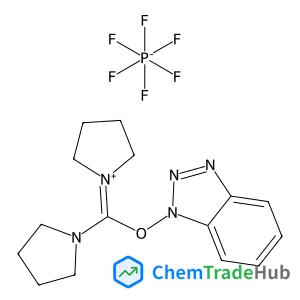
(1H-Benzotriazol-1-yloxy)(di-1-pyrrolidinyl)methylium hexafluorophosphate
CAS番号:
105379-24-6
分子式:
C15H21F6N5OP
おすすめサプライヤー



免責事項
このページに表示される学術雑誌情報は、参考および研究目的のみを目的としています。当社は雑誌出版社とは提携しておらず、投稿の取り扱いも行っておりません。出版に関するお問い合わせは、各雑誌出版社に直接ご連絡ください。
表示されている情報に誤りがある場合は、support@chemtradehub.com までご連絡ください。迅速に確認し、対応いたします。