












Quantitatively monitoring polymer chain growth and topology formation based on monodisperse polymers
文献情報
出版日
2017-03-21
DOI
10.1039/C7PY00322F
インパクトファクター
5.582
著者
Zimu Wang, Zhihao Huang, Nianchen Zhou, Xue-Hui Dong, Xiulin Zhu, Zhengbiao Zhang
原文を見る
要旨
In this work, for the first time, polymer chain growth and topology formation was monitored and quantitatively evaluated using a maleimide-based fluorogenic probe based on a photo-induced electron transfer (PET) mechanism. A fluorene-containing monomer bearing terminal maleimide and thiol functional groups was rationally designed. The fluorescence of fluorene was effectively quenched by the adjacent maleimide group, which was proved by model reactions. Firstly, the correlation between molecular weight and fluorescence intensity was established as a calibration curve using precisely synthesized monodisperse polymers with varying numbers of repeating units via an iterative exponential growth strategy. Secondly, step-growth polymerization of the maleimide–fluorene–thiol monomer progressively consumed the maleimide group during polymer chain propagation and led to a gradual increase of fluorescence. This provides a quantitative and robust approach to monitor polymerization processes in situ. Moreover, cyclic oligomers were produced via intramolecular thiol–maleimide Michael addition in highly diluted solutions of linear precursors, and the cyclization process resulted in gradual enhancements of fluorescence intensity due to the elimination of maleimide groups. The cyclic oligomer content at a determined time can thus be quantitatively calculated based on fluorescence emission, enabling a real-time approach for monitoring/surveilling the cyclization process. We further applied this fluorogenic probe method to quantitatively monitor the formation of polymers with more complicated topologies, such as “cyclic-brush-like” macromolecules. This work demonstrates a facile, robust, and versatile platform for monitoring polymerization processes in situ, which may inspire and facilitate diverse molecular design and preparation in the field of precision polymer synthesis.
関連文献
An equation to calculate internuclear distances of covalent, ionic and metallic lattices
Peter F. Lang, Barry C. Smith
2014-12-16
Paper
DOI: 10.1039/C4CP05135A
A quantitative prediction of the viscosity of ionic liquids using Sσ-profile molecular descriptors
Xiangping Zhang, Suojiang Zhang
2014-12-17
Paper
DOI: 10.1039/C4CP04712E
Self-assembly polymorphism of 2,7-bis-nonyloxy-9-fluorenone: solvent induced the diversity of intermolecular dipole–dipole interactions
Lihua Cui, Xinrui Miao, Li Xu, Yi Hu, Wenli Deng
2014-12-09
Paper
DOI: 10.1039/C4CP04773G
Investigation of solvent dynamic effects on the electron self-exchange in two thianthrene couples with large inner reorganization energies
P. Choto, K. Rasmussen, G. Grampp
2014-12-11
Paper
DOI: 10.1039/C4CP04581E
Thermodynamic insights into the self-assembly of capped nanoparticles using molecular dynamic simulations
André F. de Moura, Kalil Bernardino, Cleocir J. Dalmaschio, Edson R. Leite, Nicholas A. Kotov
2014-12-16
Paper
DOI: 10.1039/C4CP03519D
A practical guide to using boron doped diamond in electrochemical research
2014-12-18
Perspective
DOI: 10.1039/C4CP04022H
Adsorbate-driven morphological changes on Cu(111) nano-pits
F. M. Hoffmann, J. Hrbek, I. Waluyo, J. A. Boscoboinik, D. J. Stacchiola
2014-12-09
Paper
DOI: 10.1039/C4CP05088F
Alternative alcohol-soluble conjugated small molecule electrolytes for high-efficiency inverted polymer solar cells
Yueqin Shi
2014-12-09
Paper
DOI: 10.1039/C4CP04295F
The molecular interfacial structure and plasticizer migration behavior of “green” plasticized poly(vinyl chloride)
Xiaoxian Zhang, Yaoxin Li, Jeanne M. Hankett, Zhan Chen
2015-01-02
Paper
DOI: 10.1039/C4CP05287K
こちらもおすすめ
化合物よくある質問
2-ブロモ-9,9-ジフェニル-9H-フルオレンの主な用途は何ですか?
2-溴-9,9-二苯基芴は、医薬品、工業材料、有機合成の研究分野で応用されます。特に、レーザー材料や機能性ポリマーの合成に使用されることがあります。また、蛍光色...
474918-32-62-Bromo-9,9-diphenyl...
化合物よくある質問
四氯化铱の市場動向や研究トレンドはどうですか?
四氯化铱の市場は研究開発分野で注目されており、特にナノ技術や金属有機框架(MOFs)の分野での需要が増加傾向にあります。価格は安定しており、中国や韓国での生産が...
207399-11-9Tetrachloroiridium h...
882-06-44-Nitrocinnamic acid
化合物よくある質問
1-(4-溴-3-氟苯基)-2-氯乙酮を含む廃棄物はどのように処理すべきですか?
1-(4-溴-3-氟苯基)-2-氯乙酮 (CAS番号: 1260857-14-4) の廃棄物は専門的な廃棄処理が必要です。まず、廃棄物は密閉された容器に収集し、...
1260857-14-41-(4-Bromo-3-fluorop...
化合物よくある質問
苦参酚Kとは何ですか?
苦参酚Kは、CAS番号101236-49-1を持つ化合物で、主に天然由来の生薬から抽出されます。この化合物は、抗炎症作用や抗癌作用を持つことが報告されています。
101236-49-1Kushenol K
化合物よくある質問
POTASSIUM (1-(TERTBUTOXYCARBONYL)AZETIDIN-3-YL)TRIFLUOROBORATE を含む廃棄物はどのように処理すべきですか?
POTASSIUM (1-(TERTBUTOXYCARBONYL)AZETIDIN-3-YL)TRIFLUOROBORATE を含む廃棄物は、まず安全なエント...
1430219-73-0Potassium (1-(tert-b...
化合物よくある質問
4-庚基-4’-联苯羧酸の市場動向や研究トレンドはどうですか?
4-庚基-4’-聯苯羧酸は、特殊化学品や合成化学の分野で用いられる化学物質ですが、市場動向としては、研究開発の進展とともに需要が増加しています。また、環境配慮型...
58573-94-74'-Heptyl-4-biphenyl...
化合物よくある質問
6-ブロモ-3-メトキシ-1-フェニル-1H-インドゾールを含む廃棄物はどのように処理すべきですか?
6-ブロモ-3-メトキシ-1-フェニル-1H-インドゾールを含む廃棄物は、適切な化学廃棄処理が必要です。通常、廃棄物は密閉容器に収集され、専門の廃棄処理業者に引...
1332527-03-36-Bromo-3-methoxy-1-...
化合物よくある質問
4,4-二甲基-2-吡咯烷酮はどの業界で使用されていますか?
4,4-二甲基-2-吡咯烷酮は医薬、ポリマー、センサー、半導体などの業界で広く使用されています。特に溶媒としての性能が高く評価されています。
66899-02-34,4-dimethylpyrrolid...
51312-42-6Sodium Phosphotungst...
掲載誌
Polymer Chemistry

CiteScore:
8.6
自己引用率:
7.3%
年間論文数:
457
Polymer Chemistry welcomes submissions in all areas of polymer science that have a strong focus on macromolecular chemistry. Manuscripts may cover a broad range of fields, yet no direct application focus is required.
おすすめ化合物

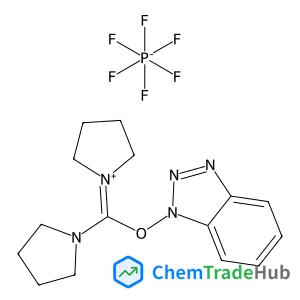
(1H-Benzotriazol-1-yloxy)(di-1-pyrrolidinyl)methylium hexafluorophosphate
CAS番号:
105379-24-6
分子式:
C15H21F6N5OP
おすすめサプライヤー




免責事項
このページに表示される学術雑誌情報は、参考および研究目的のみを目的としています。当社は雑誌出版社とは提携しておらず、投稿の取り扱いも行っておりません。出版に関するお問い合わせは、各雑誌出版社に直接ご連絡ください。
表示されている情報に誤りがある場合は、support@chemtradehub.com までご連絡ください。迅速に確認し、対応いたします。